Why Meaning Has Always Been the Hard Part of AI // Ontology, Semantics, and NLP

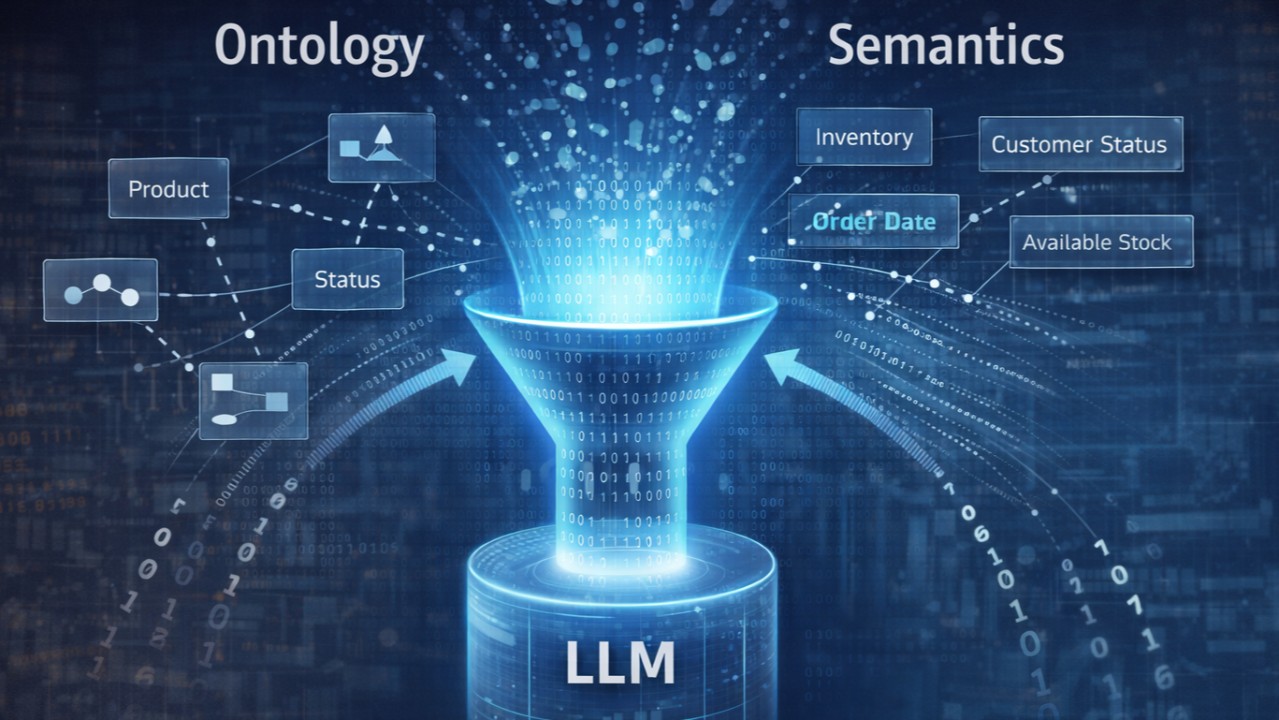
Why Meaning Has Always Been the Hard Part of AI // Ontology, Semantics, and NLP
Why Meaning Has Always Been the Hard Part of AI, and how we got here.
Every wave of AI eventually runs into the same problem.
Not scale. Not compute. Not models.
Meaning.
Long before large language models, retrieval pipelines, or "agentic AI," the hardest challenge in intelligent systems was always the same:
How do we represent what things mean—consistently, explicitly, and usefully?
That question sits at the intersection of ontology, semantics, and natural language processing. And understanding their relationship explains both why AI has progressed so far—and why it still fails in predictable ways.
Ontology: What Exists (According to the System)
An ontology is not a buzzword. It's a commitment.
At its core, an ontology defines:
- What entities exist
- How they are categorized
- How they relate to one another
- What constraints apply
In other words, ontology answers:
What is this thing, and how does it relate to everything else?
In enterprise systems, ontologies show up everywhere:
- Customer vs account vs party
- Product vs SKU vs item vs configuration
- Order vs shipment vs invoice
Even if no one calls them ontologies, they exist—implicitly or explicitly. When they are implicit, systems drift. When they are explicit, systems scale.
Semantics: What Things Mean
If ontology defines what exists, semantics defines what those things mean.
Semantics deals with:
- Interpretation
- Context
- Intent
- Consistency across systems
Two systems can share the same ontology and still disagree semantically.
For example:
- "Order date"
- "Available inventory"
- "Customer status"
These sound straightforward—until different teams interpret them differently. Semantics is where most integration projects fail quietly. Not because data is missing—but because meaning isn't aligned.
Early NLP: Rules, Grammars, and Explicit Meaning
Early NLP systems were built on the assumption that meaning could be engineered.
They relied on:
- Grammars
- Lexicons
- Symbolic representations
- Hand-built ontologies
These systems were brittle, expensive, and slow—but they had one advantage:
Meaning was explicit.
If something failed, you could trace why.
The problem wasn't that the approach was wrong. It was that language is far messier than we hoped.
Statistical NLP and the Shift Away from Meaning
As data and compute increased, NLP shifted from symbolic systems to statistical ones. Words became vectors. Meaning became probability. Structure gave way to scale. This worked—spectacularly. Search improved. Translation improved. Speech recognition improved. But something important was lost along the way:
Explicit semantics.
Models learned patterns, not meaning. Correlation replaced representation. For many tasks, that was enough. For systems that need to reason, act, or integrate deeply—it wasn't.
LLMs: A Return to Semantics—Without Ontology
Large language models changed the game again. They:
- Encode vast amounts of implicit semantic knowledge
- Capture relationships across domains
- Generate language that appears meaningful
But LLMs don't have ontologies.
They don't know what exists. They don't enforce constraints. They don't distinguish between "true," "allowed," and "plausible."
They approximate meaning—but they don't own it.
This is why LLMs:
- Hallucinate
- Drift
- Contradict themselves
- Struggle with system-level consistency
They are powerful semantic engines operating without explicit ontological grounding.
Why Ontology Matters More Now, Not Less
Modern AI didn't eliminate the need for ontology and semantics.
It made them unavoidable.
As AI systems move from:
- Answering questions
- To making recommendations
- To triggering actions
- To coordinating workflows
They must interact with:
- Business rules
- Constraints
- Authority
- Accountability
And those live squarely in ontology and semantics—not in embeddings. The more autonomous systems become, the more dangerous implicit meaning becomes.
The Real Pattern Emerging
The most effective AI systems today combine:
- Statistical intelligence (LLMs, embeddings, models)
- Explicit structure (ontologies, schemas, rules)
- Semantic clarity (definitions that humans agree on)
This isn't a step backward. It's a synthesis. We're rediscovering that intelligence without structure doesn't scale—and structure without intelligence doesn't adapt.
Final Thought
AI didn't fail to understand language because it lacked models.
It struggled because meaning is social, contextual, and constrained.
Ontology defines the world. Semantics defines meaning. NLP bridges human language to both.
The future of AI won't belong to systems that generate the most text— but to systems that know what they're talking about.
And that starts with meaning.
Closing questions:
- If your AI systems can generate language, make recommendations, and trigger actions—where does the authoritative meaning of your business actually live today: in people's heads, in code, or nowhere at all?
- Should "meaning" in the organization be owned by the business (because it defines reality), by IT (because systems enforce it), or is the real problem that most companies have never made that ownership explicit at all?
Think this argument fits your event? Tell me about the room — the calendar is selective.
Start a conversation