Why Manufacturing Will Lead Enterprise AI (Not Silicon Valley)

Why Manufacturing Will Lead Enterprise AI (Not Silicon Valley)
Physical constraints force better AI design
Silicon Valley has taught us many useful lessons about software. It has also taught us some dangerous habits about AI.
Most modern AI narratives were shaped in environments where failure is cheap:
- A bad recommendation is ignored
- A hallucinated answer is embarrassing
- A broken feature is rolled back
Manufacturing doesn't work that way.
In the physical world, ambiguity has weight. Decisions move material, people, capital, and risk. When something goes wrong, it doesn't fail quietly — it breaks equipment, halts production, or creates safety incidents.
That difference is exactly why manufacturing will lead enterprise AI.
Manufacturing Can't Tolerate Ambiguity
In consumer tech, ambiguity is often acceptable:
- "Good enough" answers
- Probabilistic outputs
- Vague confidence thresholds
In manufacturing, ambiguity becomes liability.
A system that is:
- Unsure about inventory
- Confused about routing
- Inconsistent about definitions
doesn't just reduce efficiency — it creates operational risk.
Manufacturing environments demand:
- Clear state
- Explicit ownership
- Deterministic boundaries
- Known failure modes
AI systems that survive here must be designed differently from the start.
Constraints Don't Slow AI — They Shape It
There's a myth that constraints limit innovation.
In reality, constraints are what turn experiments into systems.
Manufacturing forces AI to confront questions that software-first teams often postpone:
- What does "correct" actually mean?
- When should the system stop and escalate?
- Who owns the decision when the model is unsure?
- How do humans override outcomes safely?
These questions don't block AI progress — they mature it.
The result is not more fragile intelligence, but more reliable systems.
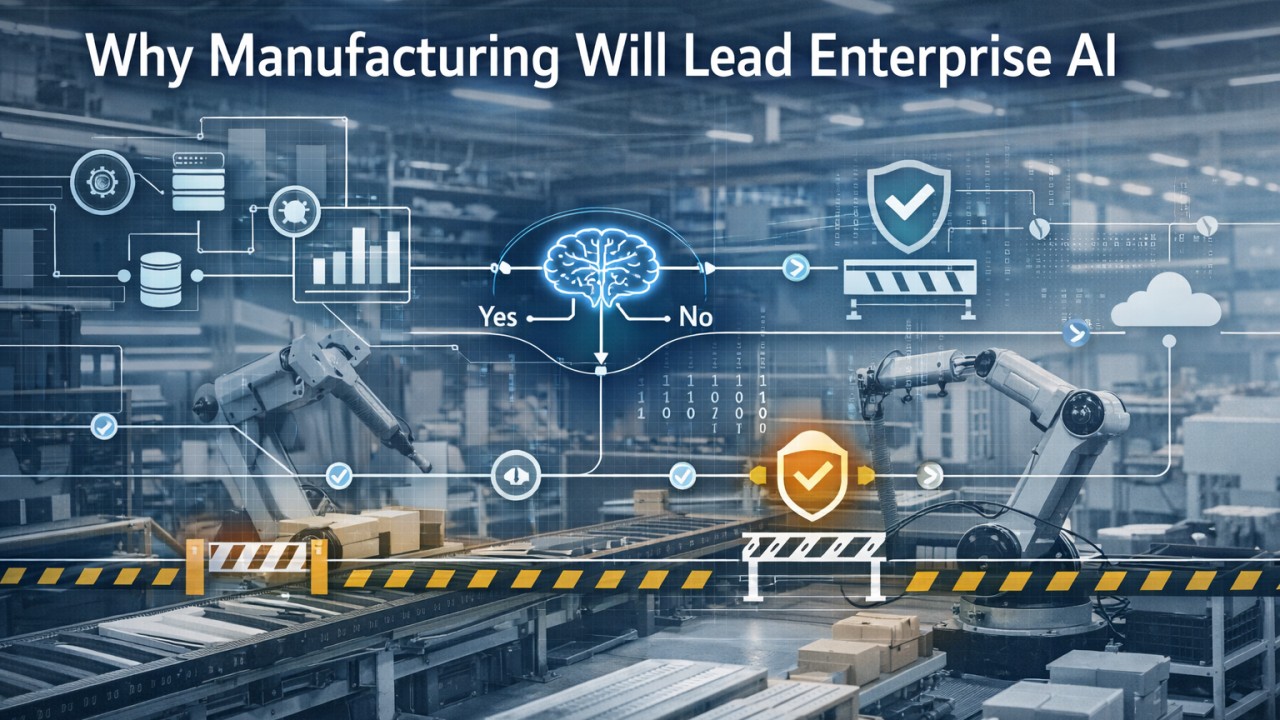
AI in Software vs AI in Manufacturing - Constraints don't limit AI - they make it Operational.
Why "Move Fast and Break Things" Fails in the Real World
That mantra worked when:
- Software was the product
- Users were the testers
- Rollbacks were instant
It fails when:
- Systems control physical processes
- Errors propagate into the supply chain
- Downtime costs millions per hour
In manufacturing, AI must be:
- Observable, not opaque
- Governed, not improvised
- Integrated into workflows, not bolted on
This is why the future of enterprise AI won't be led by demos — it will be led by disciplines that already understand operational rigor.
Manufacturing as the Proving Ground for Enterprise AI
Manufacturing organizations already excel at:
- Process definition
- Quality control
- Root-cause analysis
- Safety systems
- Continuous improvement
These capabilities map directly to what AI needs to succeed at scale.
What looks like "slowness" from the outside is actually institutional memory — and that memory is what keeps AI systems aligned with reality over time.
The Real Shift
The future of AI doesn't belong to the systems that generate the most output.
It belongs to the systems that:
- Know when to act
- Know when to stop
- Know when to ask for help
- And know who is accountable for the outcome
Manufacturing isn't behind the AI curve.
It's ahead of it — because it has always designed for the real world.
Provocative question:
If your AI system makes a bad decision tomorrow, will it fail like a demo — or like a production line?
Think this argument fits your event? Tell me about the room — the calendar is selective.
Start a conversation