Why Confidence Beats Correctness in Organizations

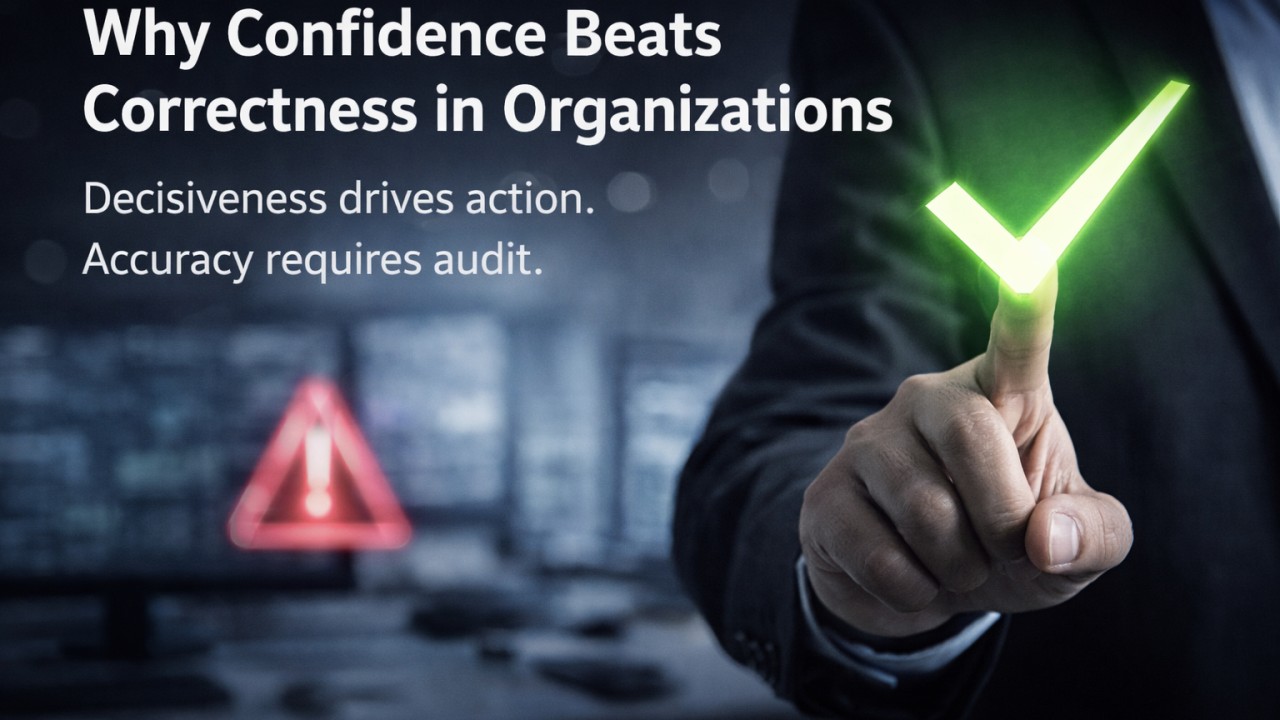
Why Confidence Beats Correctness in Organizations
In most organizations, confidence outperforms correctness long before anyone notices a problem. This is not because people prefer to be wrong, but because confidence aligns more cleanly with how work actually moves. Confident statements create momentum. They reduce debate, shorten meetings, and allow decisions to be logged and tasks to be assigned. Correctness, by contrast, often arrives with caveats, conditions, and open questions. It asks the organization to slow down.
Over time, this dynamic becomes structural. Systems, processes, and incentives evolve to reward forward motion over epistemic accuracy. The person who sounds sure is seen as helpful. The person who asks for verification is seen as careful, but also as a potential blocker. Neither role is explicitly discouraged, but only one reliably keeps work moving.
AI systems inherit this environment immediately. Outputs that sound decisive integrate smoothly into workflows. They fit into documents, dashboards, and approval chains without friction. Outputs that surface ambiguity require interpretation, discussion, and ownership. They ask someone to decide what uncertainty means and who should address it. In busy systems, that additional cognitive and organizational load is often avoided.
This is why confident AI outputs travel farther than correct ones. Fluency is legible. Confidence is easy to consume. Correctness is harder to assess without effort, context, or follow-up. Once a confident answer enters the system, it benefits from repetition. Each reuse increases its perceived validity, even if the original signal was weak.
Human psychology reinforces this pattern. People are more likely to trust information that is delivered clearly and without hesitation, especially under time pressure. This is not a failure of training or diligence. It is a predictable response to environments where speed is valued and consequences are often delayed. AI does not create this bias; it amplifies it.
The organizational cost shows up later. Confident but incorrect outputs are rarely challenged early. By the time discrepancies surface, the information has already been operationalized. Plans have been made, resources allocated, and dependencies formed. Correcting the error now requires undoing work, not just questioning an answer. At that point, confidence has already won.
Most attempts to address this problem focus on improving model accuracy. Accuracy matters, but it does not resolve the underlying incentive structure. Even highly accurate systems will occasionally be wrong. When those rare errors are delivered with confidence, they can still cascade. The issue is not error frequency alone; it is error amplification.
Shifting this balance requires changing what the organization treats as valuable signal. Confidence should not be the default proxy for readiness. Systems must create space where uncertainty can slow decisions without stigma. That means explicitly defining when it is acceptable—and expected—to pause, verify, or escalate.
This is not about encouraging indecision. It is about aligning confidence with accountability. When confident statements carry consequences, and uncertainty is routed to clear owners, the organization can move quickly without being reckless. Confidence becomes a tool, not a shortcut.
The harder question is cultural. Where does the organization reward being right later over sounding right now? Until that question is answered, confidence will continue to beat correctness, no matter how advanced the AI becomes.
Think this argument fits your event? Tell me about the room — the calendar is selective.
Start a conversation