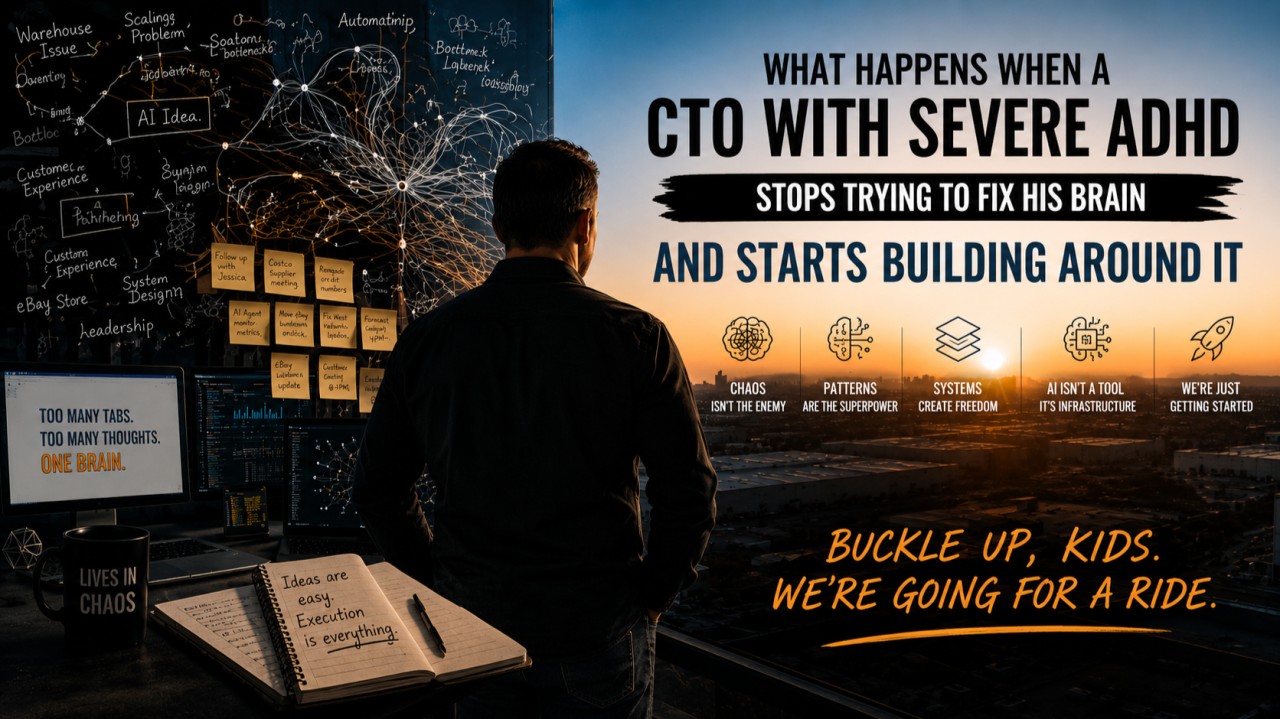
What Happens When a CTO With Severe ADHD Stops Trying to Fix His Brain and Starts Building Around It

---
I have never once in my life decided to do something and then simply done it. Not once.
I know that sounds ridiculous. It sounds ridiculous to me when I say it out loud because I'm 50 years old, I'm a CTO for a HUGE company, I run multiple personal businesses, I manage a 42,000-square-foot warehouse operation, I have an eBay store with hundreds of listings, I lead technology organizations, and somewhere along the way I apparently decided building AI agents was a reasonable hobby. By every external metric, I look like somebody who gets an extraordinary amount done.
And I do. What people don't see is the scaffolding.
They see the building. They don't see the steel beams holding it up. They don't see the work, the pain, the effort that goes into that sentence.
For most of my life I thought the goal was to get rid of the scaffolding. I thought if I found the right planner, the right system, the right notebook, the right task manager, the right medication, the right morning routine, eventually I'd become one of those mythical people who can look at a task, decide it needs to be done, and then immediately do it.
I've never met that person. At least not inside my own head.
What happens instead is that I decide I should start something, and then my brain immediately starts generating bonus content.
Everything I say comes with bonus content. Everything I think comes with bonus content too.
I don't think about the task. I think about the task, the dependencies of the task, the thing the task reminds me of, the meeting related to the task, the email I should answer before the task, the information I might need for the task, whether I actually have that information, where I would get that information if I don't have it, whether somebody else already solved the problem, whether I should organize my notes before starting, and whether organizing my notes is actually a form of procrastination disguised as productivity.
Then I wonder if the inventory discrepancy from last week was ever resolved.
Then I remember I forgot to answer a text.
Then I remember why I forgot to answer the text.
Three hours later the original task is still sitting there untouched.
The frustrating part is that people hear that and assume it's a motivation problem. It isn't. That's the thing I've spent most of my life trying to explain. I want to do the thing. I need to do the thing. Sometimes the consequences of not doing the thing are immediate, obvious, painful, and potentially expensive. My brain just refuses to issue the start command.
For years I thought this meant something was wrong with me. Not clinically wrong. Morally wrong. A discipline problem. A character flaw. Everybody around me seemed capable of deciding to do something and then doing it. Meanwhile I was building increasingly elaborate systems just to accomplish what appeared to come naturally to everybody else.
Looking back, I think I misunderstood the problem. Actually, I know I misunderstood the problem. Because I spent decades focused on what my brain couldn't do while completely ignoring what it could.
And that's where things get interesting.
The conversation around ADHD tends to focus on deficits. That's understandable because deficits are visible. People see procrastination. People see missed emails. People see unfinished projects. People see somebody walk into a room and immediately forget why they walked into the room.
What they don't see is everything happening underneath. They don't see the constant pattern matching. They don't see the dozens of mental threads running simultaneously. They don't see the strange ability to connect things that don't appear connected. They don't see that while you're talking, my brain is quietly indexing, correlating, comparing, and cross-referencing everything you're saying against fifteen years of experiences, conversations, projects, failures, and observations.
Sometimes I joke that I don't think in lists. I think in graphs. (For the Nerds, the best description of my brain is that it's a B-Tree )
One idea connects to another idea which connects to a conversation from six months ago which connects to a dashboard I saw in June which connects to a warehouse issue which reminds me of a software deployment from three years ago which suddenly makes me realize we're solving the wrong problem entirely.
That's not an exaggeration.
That's Tuesday.
Most people think in lines. I think in webs. The problem is that webs are powerful. They're also chaotic. And chaos is where I've spent most of my life. In fact, for years I've joked that my actual title isn't CTO. My title is: "Lives in Chaos."
The funny thing is that I don't actually hate chaos. I think I'm unusually good at it.
That's probably the biggest misunderstanding people have when they hear me talk about ADHD. They assume chaos must be exhausting. Sometimes it is. But it's also where a lot of my value comes from.
I context switch better than most people I know. I know that's not the standard ADHD narrative, but it's true. My entire career is one giant context switch.
Warehouse operations. Software architecture. Software Development. AI systems. Leadership. Inventory forecasting. Customer experience. Organizational design. Finance. Strategy.
Sometimes all before lunch. That doesn't drain me. It energizes me.
The value often comes from the collision of those domains. A warehouse problem reminds me of a software problem. A software problem reminds me of a scaling problem. A scaling problem reminds me of a leadership problem. A leadership problem reminds me of something I learned ten years ago.
The connections happen automatically. I don't sit there intentionally looking for them. My brain just does it. And honestly, I think that's the superpower.
Not intelligence. Not knowledge. Not experience. Pattern recognition.
The ability to see the thing underneath the thing.
I've spent years sitting in meetings listening to people describe a problem and feeling this strange sense of familiarity. Not because I've seen that exact problem before, but because I've seen the shape of it before. The details are different. The pattern isn't.
A warehouse bottleneck behaves suspiciously like a software bottleneck. A data quality issue behaves suspiciously like an organizational issue. A customer experience issue behaves suspiciously like a communication issue.
The nouns change. The systems don't.
For years I assumed everybody experienced the world this way. Apparently they don't.
What I've come to realize is that the same brain creating many of my challenges is also creating many of my strengths. The same brain that struggles to prioritize one thing is often processing twenty things at once. The same brain that gets overwhelmed by too many inputs is also identifying relationships inside those inputs that other people never notice.
The strengths and weaknesses aren't separate systems. They're the same system. That's probably the most important thing I've learned about myself. The thing that creates the chaos is also the thing that creates the insight. The thing that makes me difficult to manage is also the thing that makes me valuable.
The challenge was never removing the chaos.
The challenge was learning how to harness it. Working memory is probably the best example. People hear me talk about remembering details and assume I must have incredible memory. I don't. At least not in the way they're imagining. I've started describing it using computer architecture because it's the closest analogy I know.
My brain isn't a storage problem. It's a cache problem.
The data is usually there. The retrieval path is what disappears.
I can remember a dashboard I saw six months ago. I can remember where a chart was positioned on the screen. I can remember the conversation that happened immediately afterward. I can remember an offhand comment somebody made that turned out to matter later. I can remember the color of the shoelaces of a waiter in 2002, on a Tuesday night at 7:42pm at a restaurant that no longer exists. I also don't know what I had for breakfast today. I can't reliably remember why I opened Chrome thirty seconds ago. I can't reliably remember the fourth thing somebody told me if the third thing triggered a thought. I can't reliably remember what I was doing before a notification interrupted me.
The cache gets flushed constantly.
A text message. A notification. A sound. A random thought. Somebody saying my name.
Everything competes for the same limited working memory pool.
For most of my life I thought this was normal. I thought everybody was maintaining twenty browser tabs, multiple notebooks, screenshots, sticky notes, text files, voice memos, and random reminders just to keep a single project moving forward. Eventually I realized that wasn't normal at all.
I wasn't building productivity systems. I was building external memory.
Actually, that's not quite right.
I was building external executive function. I just didn't know it yet.
20+ years ago I became fascinated with memory palaces. The idea that you could build mental structures and place information inside them made intuitive sense to me because that's already how my brain worked. Concepts lived in places. Projects lived in places. Ideas connected to other ideas. I built these enormous mental maps because I was trying to compensate for the fact that my working memory couldn't be trusted.
Eventually those maps became too large. So I started rebuilding them externally.
Today my Obsidian graph is called Cortex.
That's not a branding exercise. That's literally how I think about it. It's a digital extension of my cognition. It's where ideas live when my brain can't hold them anymore.
It's where projects live. It's where relationships live. It's where context lives.
And then AI showed up.
Most people assume I use AI because I'm technical. Or because I'm a CTO. Or because I write software. Those things are true. But they're not the real reason.
The real reason is that AI became the first technology I've ever encountered that functions like cognitive infrastructure. Not a tool. Infrastructure.
There's a difference.
A tool is something you use. Infrastructure is something you build on.
AI became my external working memory, my external retrieval engine, my external prioritization system, my external context manager, and eventually something I started thinking of as external executive function.
A few months ago I was in a meeting discussing warehouse throughput metrics when somebody mentioned a number that immediately triggered a memory. I knew I'd seen something before. I could almost see the dashboard. I knew there was a connection somewhere. I knew it mattered. And I could feel the thought beginning to disappear.
If you have ADHD, you know exactly what I'm talking about.
It's not forgetting. It's losing access. The thought is still there somewhere. You just can't reach it anymore.
A few years ago that idea would have vanished forever. Instead I grabbed my phone and recorded a six-second note, or typed 10 words. "Check throughput dip from first week of June. Feels related." That was it. The meeting continued. Later AI surfaced the dashboard, connected it to other notes, and reconstructed the context.
The insight wasn't generated by AI. The insight was mine. AI simply caught it before I dropped it.
That's a massive distinction.
"AI doesn't create most of my best ideas. It prevents me from losing them."
The other place where AI changed my life is prioritization.
God, prioritization. That's the real battle. Not effort. Not intelligence. Not motivation. Prioritization. People think the challenge is getting things done. The challenge is deciding what deserves attention in the first place.
When you have ten things to do, they all feel important. When you have twenty things to do, they all feel urgent. When you have fifty things to do, your brain basically throws an exception.
Every morning I perform what can only be described as a cognitive dump. Everything goes in. The quarterly review. The warehouse issue. The employee conversation. The random thought that woke me up at 2:17 in the morning. The project I'm excited about. The project I'm avoiding. The thing that's probably important but I haven't figured out why yet.
Everything.
Then I ask a simple question.
"What actually matters today?"
The answer doesn't need to be perfect. It just needs to be better than my native prioritization engine. And honestly, that's a surprisingly low bar. The biggest surprise in all of this is that AI didn't make me dramatically more productive. That's not really what happened.
What happened is that it made me less exhausted.
For most of my life, an enormous percentage of my mental energy went toward compensation. Remembering. Tracking. Reconstructing context. Trying not to lose ideas. Trying not to lose momentum. Trying not to lose myself.
Now I spend more of that energy doing the things my brain was always good at. Seeing patterns. Connecting ideas. Operating across domains. Building systems. Living comfortably inside complexity. For most of my life I thought success meant becoming more disciplined, more organized, more structured, more normal.
Today I think success looks different. Success is understanding how your brain actually works. Success is recognizing that strengths and weaknesses often come from the same source. Success is building systems that amplify the gifts while protecting yourself from the costs.
For fifty years I thought I was compensating for my brain. Now I think I was training for it.
And for the first time in my life, I don't feel like I'm fighting the way my mind works. I feel like I'm finally building on top of it.
Soooo.. Those of you that see me as an AI Evangelist. You should know that there is SO MUCH MORE TRUTH to everyone (me included) saying "AI is going to change everything"...
I spent decades trying to fix the engine. I finally understand the machine, and now we're about to see what happens, cause we're just getting started. It's going to be messy. It's going to be chaotic. It's probably going to be a little insane. And it's going to be amazing. Buckle up, kids. Let's see what this thing can really do.
Think this argument fits your event? Tell me about the room — the calendar is selective.
Start a conversation