What Comes Next Is Different: Why Agentic AI Must Move Beyond Loops and Into Systems

What Comes Next Is Different: Why Agentic AI Must Move Beyond Loops and Into Systems
Agentic AI is having a moment.
We're seeing eye-opening results from systems that run models in tight loops—retrying, iterating, and pushing forward until something works. In the right context, these approaches are genuinely impressive. They reduce cost, compress timelines, and unlock surprising productivity gains.
But they're also being misunderstood. Even by leaders who should know better.
What many people are celebrating right now is not the beginning of a new paradigm—it's the peak expression of an old one.
Simple loops. Retry until success. Let the model keep going.
That pattern works. Sometimes spectacularly. But it doesn't scale into environments where failure matters.
And that's why what comes next is different.
The Limits of Vibe Coding and Loop-Driven Agents
Loop-based agent workflows are attractive because they remove friction. There's no heavy planning phase, no upfront structure, and very little orchestration. You trust the model, keep it running, and intervene only when something clearly breaks.
This is powerful for:
- Exploratory work
- Greenfield coding
- Low-risk automation
- Tasks where "good enough" is acceptable
But loops have inherent weaknesses:
- No explicit initialization — context, constraints, and intent are implicit, not enforced
- No progress semantics — you know something is running, but not where it is
- No designed checkpoints — oversight is reactive, not intentional
- Weak validation — success is often defined as "it didn't error"
In other words, loops optimize for momentum, not reliability.
That's fine—until the system leaves the demo phase.
When the Cost of Failure Changes, Architecture Must Change
In early agent workflows, failure is cheap. A bad output means wasted tokens or a retry.
In enterprise environments—manufacturing, logistics, infrastructure, customer operations—that's no longer true.
Failure becomes:
- Corrupted data
- Broken workflows
- Safety risks
- Compliance exposure
- Real financial impact
At that point, "just let it run" is no longer a strategy.
This is where agentic AI must evolve from clever execution into designed systems.
From Loops to Agent Harnesses
The next generation of agentic systems won't be defined by bigger models or longer runtimes. They'll be defined by structure.
Specifically:
- Initialization Phases Before an agent acts, it needs a deliberate setup phase:
- Objectives clarified
- Constraints enforced
- Available tools defined
- Success criteria made explicit
- Structured Progress Tracking Systems need to know where they are:
- What phase is active
- What has been completed
- What remains uncertain
- Human-in-the-Loop at Phase Boundaries Humans shouldn't babysit agents continuously. They should intervene strategically.
- Risk concentrates
- Ambiguity spikes
- Directional decisions matter
- Real Validation Validation isn't "the code ran" or "the answer looks plausible."
- Did this meet the intent?
- Did it respect constraints?
- Can we trust this output downstream?
- Inspectable
- Interruptible
- Governed
- Accountable
This is the difference between "start running" and "start correctly."
This enables observability, interruption, and recovery—things loops are inherently bad at.
Phase boundaries are where:
Designed review gates turn humans from fire-fighters into governors.
It's:
Without validation, systems drift. Quietly—and dangerously.
Why Systems Thinking Wins
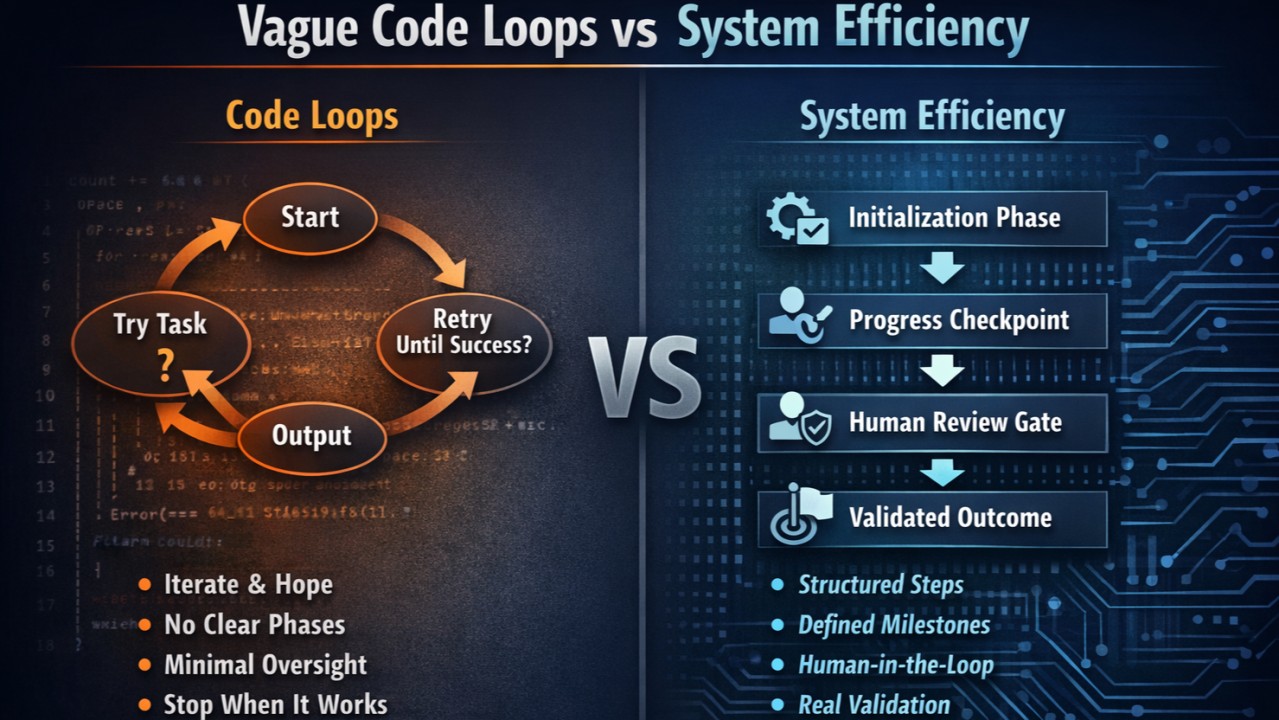
The diagram above shows the core difference:
Loop-based approaches optimize for speed. System-based approaches optimize for trust.
Loops stop when something works. Systems stop when something is correct.
That distinction is subtle—but it's everything.
This is the same transition we've seen before:
From scripts to services
From servers to platforms
From manual ops to SRE
Agentic AI is following the same path. Think about that logically for a moment... it is following THE SAME PATH... and that is why I believe System Thinking WINS. EVERY. TIME.
The Real Inflection Point
The future of agentic AI is not autonomous chaos.
It's intentional orchestration:
The biggest breakthroughs ahead won't come from letting agents run longer.
They'll come from designing agent harnesses that know when to act, when to pause, and when to ask for help.
That's how capability becomes reliability. And reliability is what turns experiments into systems.
What comes next is different—and it's already starting. If you are not already on the path of really understanding AI.. you are already behind... you still have time to catch up. Are you coming along for the ride? Comment your thoughts.
Think this argument fits your event? Tell me about the room — the calendar is selective.
Start a conversation