The New Build vs Buy Decision in the Age of AI

The New Build vs Buy Decision in the Age of AI
Build vs buy has always been a core technology decision. AI is changing the answer—but not in the way many expected. It's not about choosing one over the other. It's about understanding where differentiation actually lives.
The Old Model
Traditionally: core systems were bought, differentiating capabilities were built. This created a relatively stable model. AI disrupts this. Because AI doesn't just sit inside systems. It shapes how decisions are made across them.
The Shift
With AI, differentiation is increasingly found in: how workflows are designed, how decisions are made, how systems interact, how data is interpreted. Not just in the underlying application. This changes the build vs buy calculus.
Buying
Vendors can provide: models, tools, platforms, pre-built features. These are valuable. But they are also accessible to competitors. What they don't provide is: your workflow design, your decision logic, your operational patterns. That is where advantage sits.
Building
At the same time, building from scratch is rarely efficient. It creates: unnecessary complexity, longer time to value, maintenance overhead. The goal is not full control. It is targeted control.
Assemble
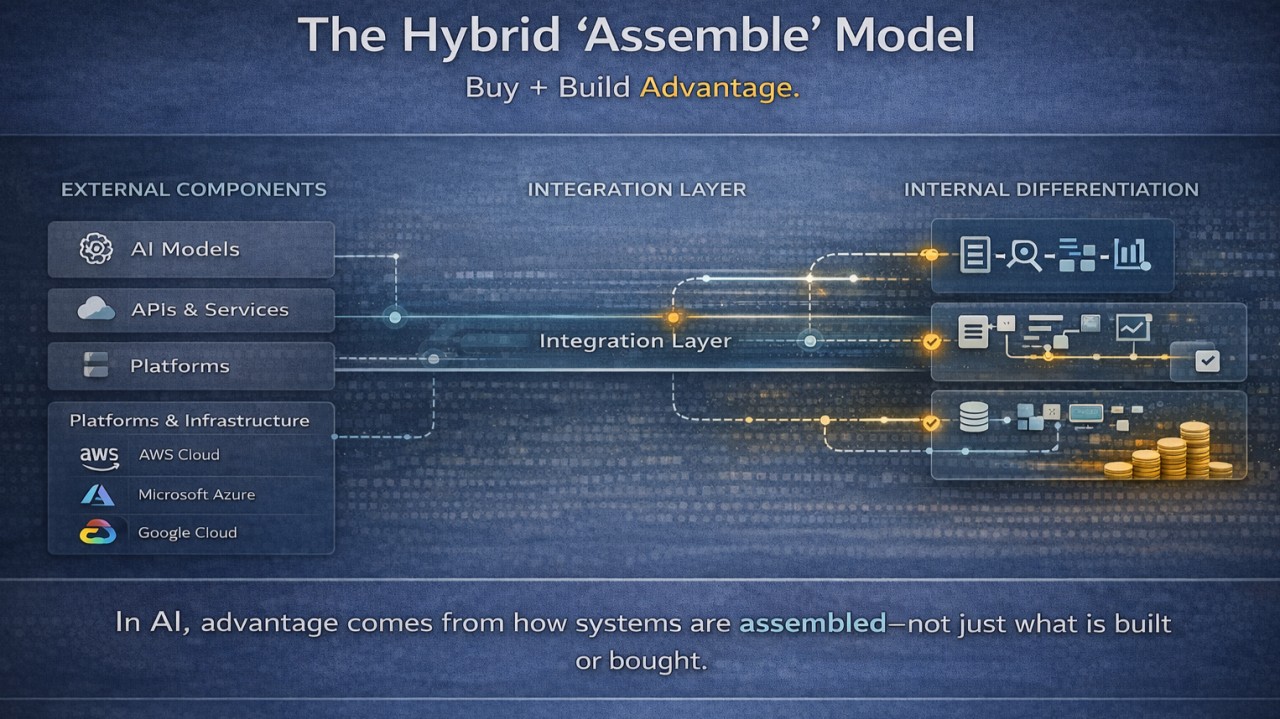
Instead of build vs buy, leading organizations are assembling systems: buying foundational capabilities, building differentiating layers, integrating across workflows, controlling decision points. This hybrid model balances: speed, flexibility, control.
Where to Build
Organizations should consider building when: workflows are unique or core to differentiation, decision logic is complex or strategic, integration across systems is critical, control and adaptability are required.
Where to Buy
Buying makes sense when: capabilities are commoditized, speed is critical, differentiation is low, maintenance would be inefficient.
Integration
The hardest part is not building or buying. It is connecting everything into a cohesive system. This includes: data flow between systems, consistent decision logic, aligned control mechanisms, unified user experience. Without integration, value remains fragmented.
The CTO's Role
CTOs must guide: where to invest in internal capability, where to leverage external platforms, how to connect systems effectively, how to retain control over key decisions. This is not just architecture. It is strategic positioning.
Opportunity
AI lowers the barrier to capability. But it raises the importance of how capability is applied. That is where differentiation moves.
Path Forward
To navigate build vs buy in AI: focus on workflows not just tools, identify where differentiation matters, assemble rather than choose extremes, prioritize integration, retain control over decision logic.
Because in the end, advantage does not come from what you buy. It comes from how you put it together.
And the executive question becomes: Are you deciding what to build and buy—or where your organization actually needs to be different?
Think this argument fits your event? Tell me about the room — the calendar is selective.
Start a conversation