The Myth of Autonomous AI: Why Humans Should Never Leave the Loop

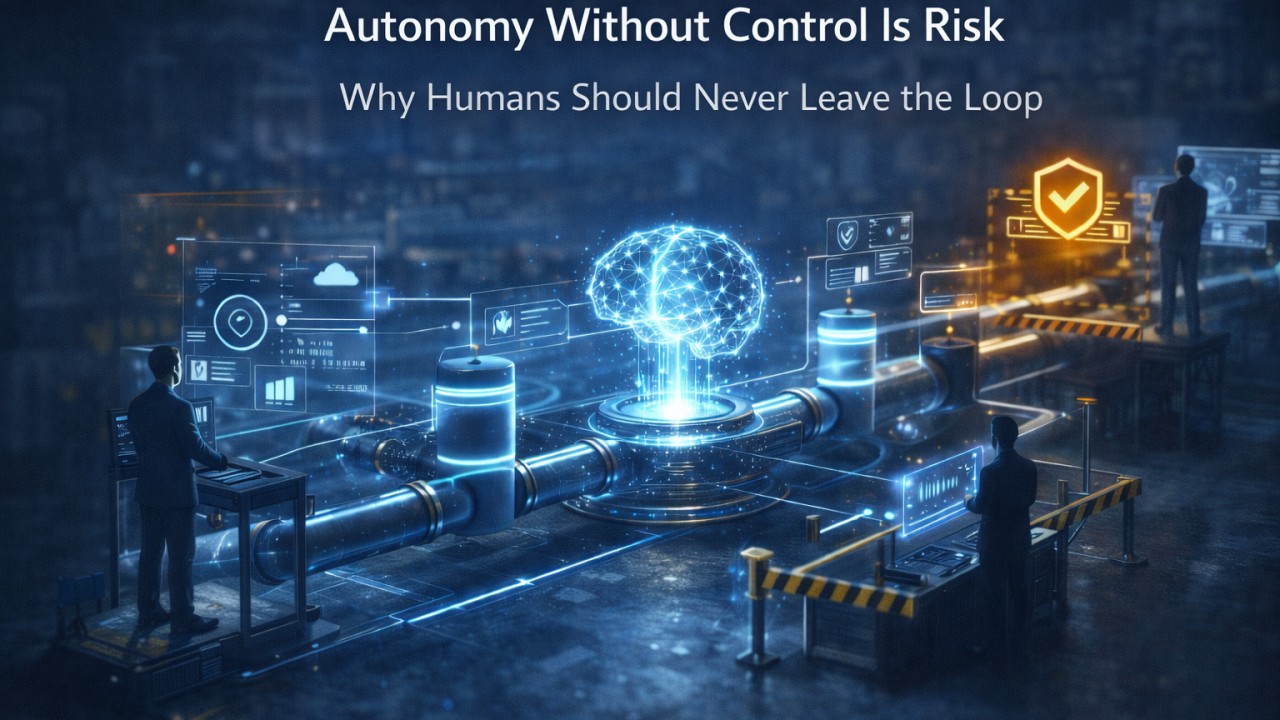
The Myth of Autonomous AI: Why Humans Should Never Leave the Loop
"Human-in-the-loop" is often framed as a safety net.
That framing is wrong.
In mature AI systems, humans aren't a fallback — they're a deliberate design choice.
Autonomy isn't a destination. It's a risk multiplier.
The Fantasy of Autonomous AI
The idea of fully autonomous AI is seductive:
- Faster decisions
- Lower costs
- Fewer bottlenecks
- Minimal human involvement
It sounds like efficiency.
In practice, it's how organizations quietly lose control.
Humans Don't Belong at the End of the Loop
Most "human-in-the-loop" designs put people in the worst possible place:
- After decisions are made
- After actions are taken
- After damage is done
That's not a loop. That's incident response.
Real systems place humans strategically, not defensively.
Where Humans Actually Belong in AI Systems
Mature organizations design human involvement across four distinct control points:
- Initiation — Humans decide when AI is allowed to act (What problems are eligible? Under what conditions?)
- Validation — Humans approve or reject high-impact recommendations (Before they become actions)
- Escalation — AI knows when it's out of bounds (Ambiguity, uncertainty, or semantic conflict trigger escalation)
- Override — Humans can interrupt, reverse, or halt behavior (Immediately, without justification)
Removing humans from any of these increases risk — not efficiency.
Why Removing Humans Increases Cost
Organizations often justify autonomy as a cost-saving measure.
In reality, autonomy:
- Pushes errors further downstream
- Amplifies small mistakes into large failures
- Makes root cause analysis harder
- Shifts cost from operations to recovery
Humans are expensive.
Incidents are far more expensive.
Agentic Systems Make This Problem Worse (and Better)
Agentic systems don't just answer questions — they:
- Plan
- Execute
- Chain actions
- Affect real-world systems
Without humans in the right places, agentic AI becomes:
- Unaccountable
- Opaque
- Operationally dangerous
With properly designed human control points, agentic systems become:
- Scalable
- Governable
- Trustworthy
The difference isn't the model.
It's the architecture.
Autonomy Fails Without Meaning Ownership
Here's the uncomfortable truth:
If no human owns:
- The ontology
- The definitions
- The meaning of concepts
- The boundaries of authority
Then autonomy isn't intelligence.
It's delegation without accountability.
AI doesn't decide what things mean. Organizations do — or they abdicate that responsibility.
"Human-in-the-Loop" Is Not a Brake Pedal
It's the steering wheel.
If your AI system only involves humans when something goes wrong, you didn't design a loop — you designed a hope strategy.
If your AI system acts autonomously today, where exactly can a human intervene — and would they know when to do it?
Humans don't slow down AI. They steer it.
Think this argument fits your event? Tell me about the room — the calendar is selective.
Start a conversation