The Metrics That Actually Tell You If Your AI Is Healthy

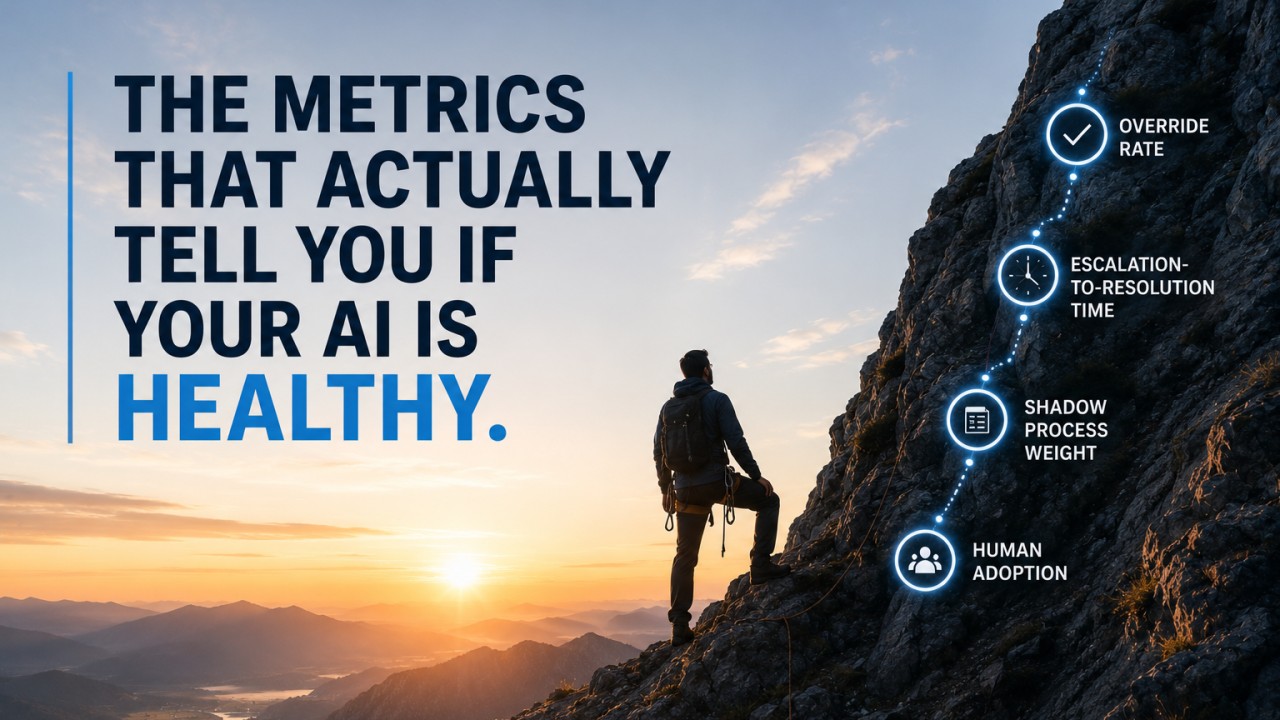
The Metrics That Actually Tell You If Your AI Is Healthy
I've reviewed a lot of AI dashboards. Most of them are measuring the wrong things.
They track uptime (the system is running). They track throughput (the system is processing). They track model accuracy (the system is correct on test data). All of these are useful. None of them tell you whether your AI is healthy in production.
The problem isn't that teams don't measure. It's that they measure what's easy instead of what matters. And when metrics don't match reality, leaders make bad decisions — investing more in systems that look good on paper while under-investing in the operational infrastructure that actually determines success.
Here's the encouraging news: the right metrics exist. They're not even hard to collect. They just require looking in a different direction.
Three Metrics That Reveal Operational Health
1. Override rate, not accuracy rate.** Accuracy measures the model. Override rate measures the relationship between the model and the people using it. A low override rate with high engagement suggests genuine trust. A low override rate with low engagement suggests the system has trained operators to stop checking — a dangerous state. A high override rate means the system isn't calibrated for real conditions.
Track overrides by type: confirmations (operator agrees), corrections (operator adjusts), and overrides (operator reverses). Each tells you something different about your system's health.
2. Escalation-to-resolution time.** When an AI system escalates a decision to a human, how long does it take to resolve? This metric reveals whether your escalation paths are well-designed. Fast resolution suggests clear ownership and good context. Slow resolution suggests operators don't know who owns the decision or lack the information to make it.
Track this over time. As your system matures, escalation volume should decrease while resolution speed should increase — both signs that the system and the organization are learning together.
3. Shadow-process weight.** This is the hardest metric to surface but the most revealing. Shadow processes — manual spreadsheets, personal notes, unofficial workarounds — are a direct measure of unaddressed system gaps. The more shadow process weight a team carries, the more their AI system is creating unmeasured operational cost.
You can't automate the detection of shadow processes. You can ask operators quarterly: "What do you do outside the system that the system should handle?" The answers will tell you exactly where to invest next.
The Metric That Lies
Watch out for one metric in particular: model accuracy on test data. It's almost always misleading in production.
Test data reflects past conditions. Production data reflects current operations. By the time your test accuracy drops, your production system has been degrading for weeks. Treat model accuracy as a lagging indicator, not a leading one. Use it for release decisions, not health monitoring.
A Simple Start
You don't need a sophisticated observability platform to start measuring AI health. Pick one workflow. Track override rates by type for two weeks. Measure escalation resolution time. Ask one operator about their shadow processes.
In thirty minutes, you'll know more about your AI system's actual health than most dashboards can tell you in a year.
The numbers are telling you a story. The question is whether you're measuring the right chapter.
Think this argument fits your event? Tell me about the room — the calendar is selective.
Start a conversation