The First 90 Days of AI for Tech Teams who haven't started with AI yet...

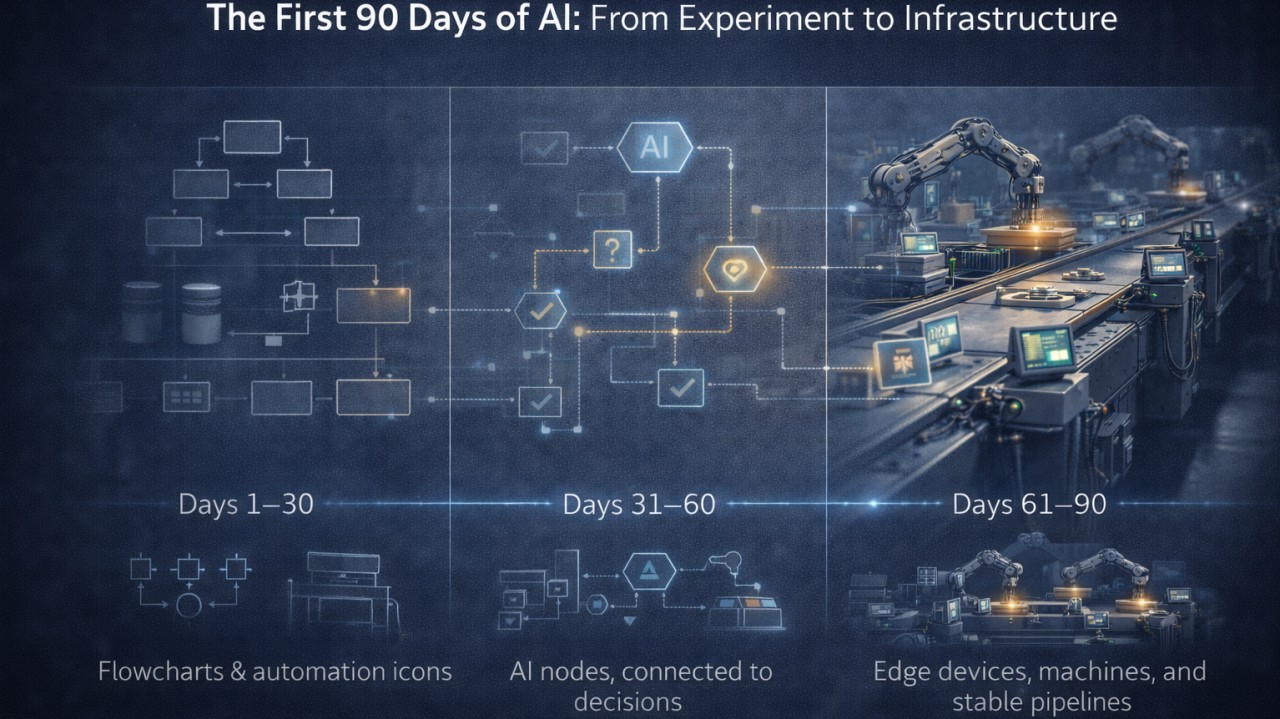
The First 90 Days of AI for Tech Teams who haven't started with AI yet...
A Practical Roadmap from Experimentation to Execution
Most AI initiatives don't fail because the technology is bad.
They fail because teams don't know what to do first.
The result is familiar:
- Proofs of concept that never ship
- Pilots that don't connect to real workflows
- Models that look impressive but don't change outcomes
The good news? Successful AI adoption follows a repeatable learning curve. This is a 90-day roadmap for technology teams who want to move from curiosity to real operational impact — without hype, chaos, or over-engineering.
Days 1–30: Build the Foundation (Flow Before Intelligence)
Goal
Create momentum by improving how work flows, not by chasing advanced models.
Focus Areas
1. Map Decisions, Not Data
Before touching AI, identify:
- Where decisions are made
- Who makes them
- What happens when they're delayed or wrong
If there's no decision, there's no AI opportunity.
2. Automate Existing Workflows (n8n / Low-Code Automation)
Start with tools like n8n to:
- Move data between systems
- Trigger alerts
- Route tasks to humans
No AI required yet. Why this matters: AI without a workflow is just output. Automation turns intelligence into action.
3. Introduce Human-in-the-Loop Gates
Design early systems so AI:
- Recommends
- Classifies
- Summarizes
…but humans approve. This builds trust, creates feedback loops, and captures valuable training data.
Outcomes by Day 30
- At least 2–3 real workflows automated
- Clear decision maps
- Teams asking "Where should AI help?" instead of "Where can we use AI?"
Days 31–60: Insert Intelligence (Bounded, Measurable, Useful)
Goal
Use AI to improve decisions, not replace people.
Focus Areas
4. Introduce AI Where Judgment Already Exists
Add AI to:
- Triage queues
- Quality review
- Maintenance recommendations
- Scheduling conflicts
Avoid open-ended "chatbots." Target specific loops.
5. Treat Models as Components, Not Magic
Select models based on task shape:
- Classification
- Prediction
- Recommendation
- Explanation
Use the simplest model that works. Accuracy is less important than consistency and speed.
6. Start AI CI/CD (Early, Lightweight)
By Day 60, AI should be:
- Versioned
- Testable
- Deployable
This includes:
- Prompt versioning
- Small evaluation datasets
- Basic regression tests
If AI can't be rolled back, it's not production-ready.
Outcomes by Day 60
- AI influencing real decisions
- Measurable cycle-time or quality improvements
- Reduced fear of "breaking things"
Days 61–90: Scale, Trust, and Move Closer to the Edge
Goal
Turn AI from an experiment into reliable infrastructure.
Focus Areas
7. Introduce Agentic Patterns (Carefully)
Agentic doesn't mean autonomous chaos.
Start with:
- One agent
- One responsibility
- One feedback loop
Think of agents as junior operators, not independent actors.
8. Move Intelligence Closer to the Edge
Evaluate where inference should live:
- Cloud for learning
- Edge for latency, reliability, and cost
- Embedded where milliseconds matter
In manufacturing especially, where AI runs is a strategic decision.
9. Establish Lightweight Governance
Good governance answers three questions:
- Who owns this AI?
- What happens when it's wrong?
- How do we learn from failure?
Log decisions. Track overrides. Review outcomes — not just accuracy.
Outcomes by Day 90
- AI systems teams trust
- Clear ownership and escalation paths
- Intelligence embedded into daily operations
What Success Looks Like After 90 Days
By the end of this roadmap:
- AI is no longer "the AI project"
- Teams understand what to build next
- Leadership sees real operational impact
- AI begins to feel like infrastructure, not innovation theater
The most mature AI systems aren't flashy. They're dependable. They quietly make the organization better — every day.
Final Question for Technology Leaders
Is your AI still an experiment — or is it becoming part of how work actually gets done?
Think this argument fits your event? Tell me about the room — the calendar is selective.
Start a conversation