The First 12 Months of AI Maturity: What Actually Changes

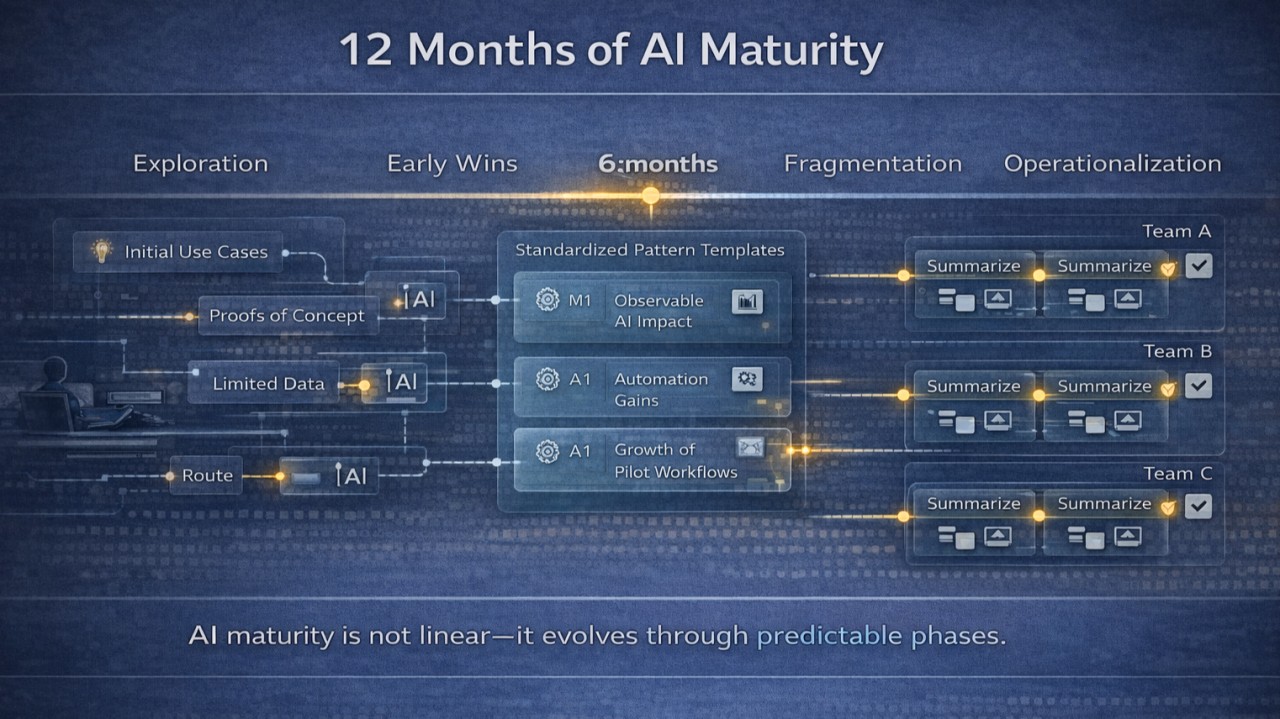
The First 12 Months of AI Maturity: What Actually Changes
The first year of AI adoption rarely looks the way organizations expect.
It doesn't follow a clean roadmap. It doesn't scale linearly. And it doesn't stay focused on initial use cases.
Instead, it evolves.
And the organizations that succeed are the ones that adapt to what actually changes.
Month 0–3: Exploration and experimentation
Early on:
- teams test tools
- use cases emerge
- excitement builds
- capabilities are discovered
This phase is valuable—but noisy.
Many ideas surface. Few are structured.
Month 3–6: Early wins and fragmentation
Then:
- initial use cases go live
- productivity gains appear
- different teams adopt differently
At the same time:
- duplication increases
- approaches diverge
- governance questions emerge
This is where many organizations stall.
Month 6–9: Need for structure becomes clear
As usage grows:
- inconsistencies become visible
- workflows begin to break under scale
- control gaps appear
- integration becomes a priority
The conversation shifts from:
"What can we do?" To: "How do we manage this?"
Month 9–12: Operationalization begins
At this stage:
- patterns are identified
- workflows are redesigned
- platforms are introduced or refined
- governance becomes embedded
AI starts moving from experimentation to capability.
What actually changes
Across this journey, several shifts consistently occur:
- From tools to workflows — Focus moves from individual tools to end-to-end processes.
- From individuals to teams — Usage becomes coordinated, not isolated.
- From experimentation to standardization — Patterns begin to repeat and consolidate.
- From speed to control — Balance between innovation and governance emerges.
- From output to outcomes — Measurement shifts toward business impact.
- the speed of fragmentation
- the importance of workflow design
- the need for early pattern recognition
- the role of operators in shaping systems
- enabling experimentation early
- introducing structure at the right time
- supporting standardization
- aligning systems and workflows
- accelerate maturity
- avoid common pitfalls
- build sustainable capability
- allow early exploration
- identify patterns quickly
- introduce structure progressively
- redesign workflows as needed
- build toward repeatable capability
What leaders underestimate
Common underestimations include:
These are not technical challenges.
They are operational ones.
The CTO's role
CTOs should guide the transition:
Timing matters.
Too early, and innovation slows. Too late, and fragmentation grows.
The opportunity
The first 12 months define trajectory.
Organizations that recognize the phases can:
The path forward
To navigate the first year:
Because AI maturity is not about how fast you start.
It is about how well you evolve over time.
Where is your organization in the AI maturity curve—and are you adapting at the right pace? Look at the future, not this sprint. Let's talk about it.
Think this argument fits your event? Tell me about the room — the calendar is selective.
Start a conversation