The AI Maturity Curve in Manufacturing: From Automation to Infrastructure

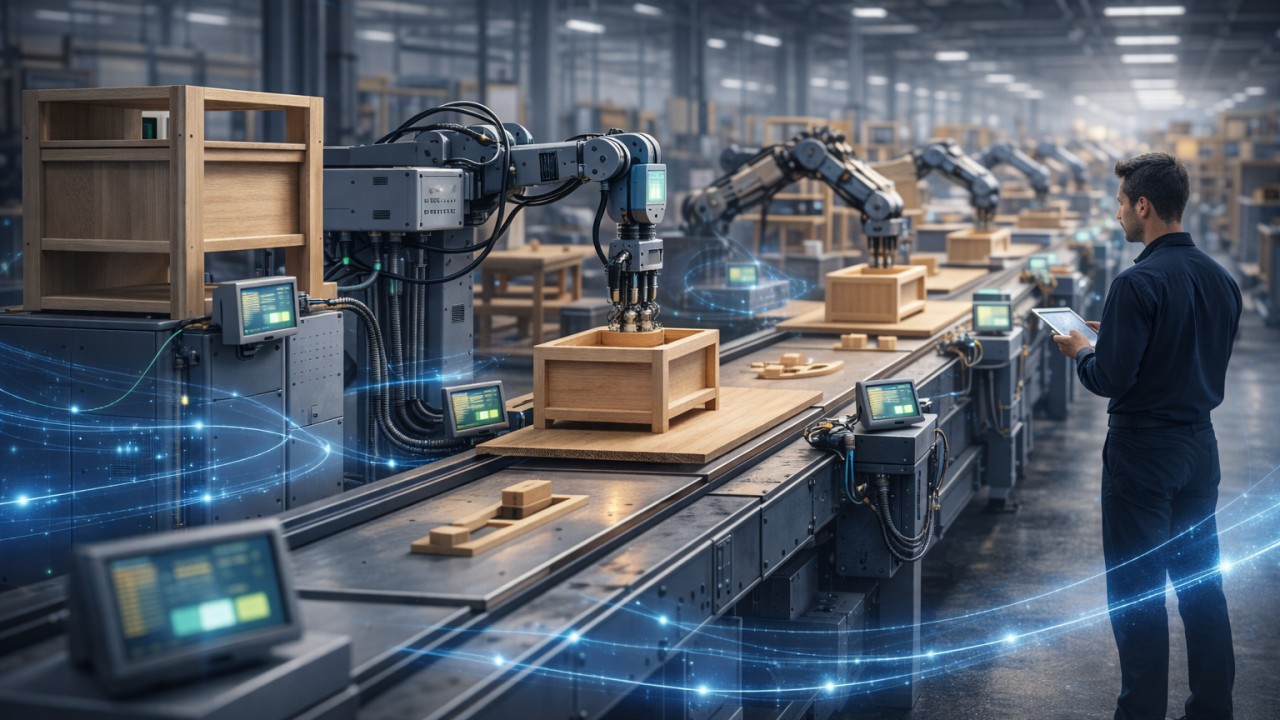
The AI Maturity Curve in Manufacturing: From Automation to Infrastructure
Manufacturing has always been a proving ground for technology.
From mechanization to electrification, from PLCs to robotics, each wave of innovation has delivered productivity by making work more precise, repeatable, and scalable. Artificial intelligence is the next wave — but it is fundamentally different from what came before.
Automation follows rules. AI develops understanding.
That difference is why AI maturity in manufacturing doesn't happen all at once. It unfolds in stages — each building capability, confidence, and value over time.
Stage 1: From Automation to Awareness
The first step in AI maturity isn't prediction or autonomy. It's visibility.
Most factories already generate massive volumes of data — vibration, temperature, torque, vision, sound, cycle time. Historically, that data was used reactively or summarized after the fact.
AI changes that by becoming an observability layer. At this stage, AI systems surface patterns humans cannot consistently see:
- Early indicators of mechanical drift
- Subtle quality degradation
- Cross-signal correlations that don't show up on dashboards
Nothing acts automatically yet. Operators remain fully in control. And that's the point.
This stage builds trust by improving situational awareness without disrupting proven workflows. AI earns credibility by helping teams see more clearly, not by trying to take control.
Manufacturers who rush past this stage often struggle later. Those who master it build the foundation everything else depends on.
Stage 2: When Machines Start Learning (and People Get Better)
Once AI can see reliably, the next step is learning. Here, models begin adapting to reality:
- Learning what "normal" looks like for this machine
- Understanding variation across shifts, products, and environments
- Reducing false alarms while sharpening true signals
This is where AI becomes a partner rather than a tool. Humans validate alerts. Engineers refine thresholds. Maintenance feedback improves accuracy.
The system learns — and so does the organization.
Alert fatigue drops. Root-cause analysis improves. Knowledge that once lived in individual experience becomes shared operational memory.
This stage is powerful not just technically, but culturally. People begin trusting AI because it improves with them, not in spite of them.
Stage 3: Intelligence Moves to the Edge
As AI matures, where it runs becomes critical. Manufacturing environments demand:
- Low latency
- High reliability
- Resilience to network disruptions
This is why AI naturally moves to the edge. Edge AI enables real-time inference directly at the machine:
- Immediate defect detection
- Instant anomaly response
- Faster feedback loops with lower data movement costs
The cloud doesn't disappear — it evolves.
- The cloud trains, coordinates, and stores
- The edge decides and acts
This architecture aligns with how factories actually operate. Intelligence lives where the work happens. Manufacturers who adopt edge AI don't become more "high tech." They become more responsive — and that responsiveness is competitive advantage.
Stage 4: From Recommendation to Action
Insight eventually wants action. At this stage, AI begins closing the loop — carefully and deliberately. Examples include:
- Automatic parameter adjustments within defined guardrails
- Dynamic quality thresholds
- Self-correcting process tuning
This is not full autonomy. It is bounded authority.
Humans define limits. AI operates inside them.
Done well, this stage reduces waste, improves consistency, and reacts faster than human-only processes ever could — especially in high-variability environments. Crucially, successful manufacturers design governance before automation:
- Clear escalation paths
- Clear override conditions
- Clear ownership
AI doesn't take control away. It gives people back time and focus for higher-value decisions.
Stage 5: AI Becomes a Trusted Operator
Eventually, AI stops being impressive. It becomes expected. At this stage, AI is embedded into daily operations:
- Trusted by operators
- Governed by engineering
- Accountable to leadership
It has a role — even if it doesn't have a badge. Overrides are rare but respected. Performance is measured. Failures are investigated, not feared. Factories operating here move faster not because AI is smarter — but because confidence is higher.
AI is no longer a pilot. It's part of how work gets done.
Stage 6: AI as Infrastructure
The highest level of AI maturity is quiet. AI becomes infrastructure — like electricity, networking, or control logic. It is:
- Governed
- Audited
- Maintained
- Essential
Organizations at this stage don't debate whether to use AI. They focus on where it delivers the most value next.
This is where long-term advantage emerges:
- Faster innovation cycles
- Lower operational risk
- Scalable expertise across the workforce
AI is no longer the headline. Performance is. And that's when you know maturity has been reached.
The Opportunity Ahead
AI maturity in manufacturing is not about hype or disruption. It is about alignment:
- With real-world constraints
- With human expertise
- With operational reality
The factories that win won't jump stages. They'll grow through them. And in doing so, they'll turn AI from a technology investment into a durable competitive advantage.
Think this argument fits your event? Tell me about the room — the calendar is selective.
Start a conversation