Standardizing AI Patterns Across the Enterprise

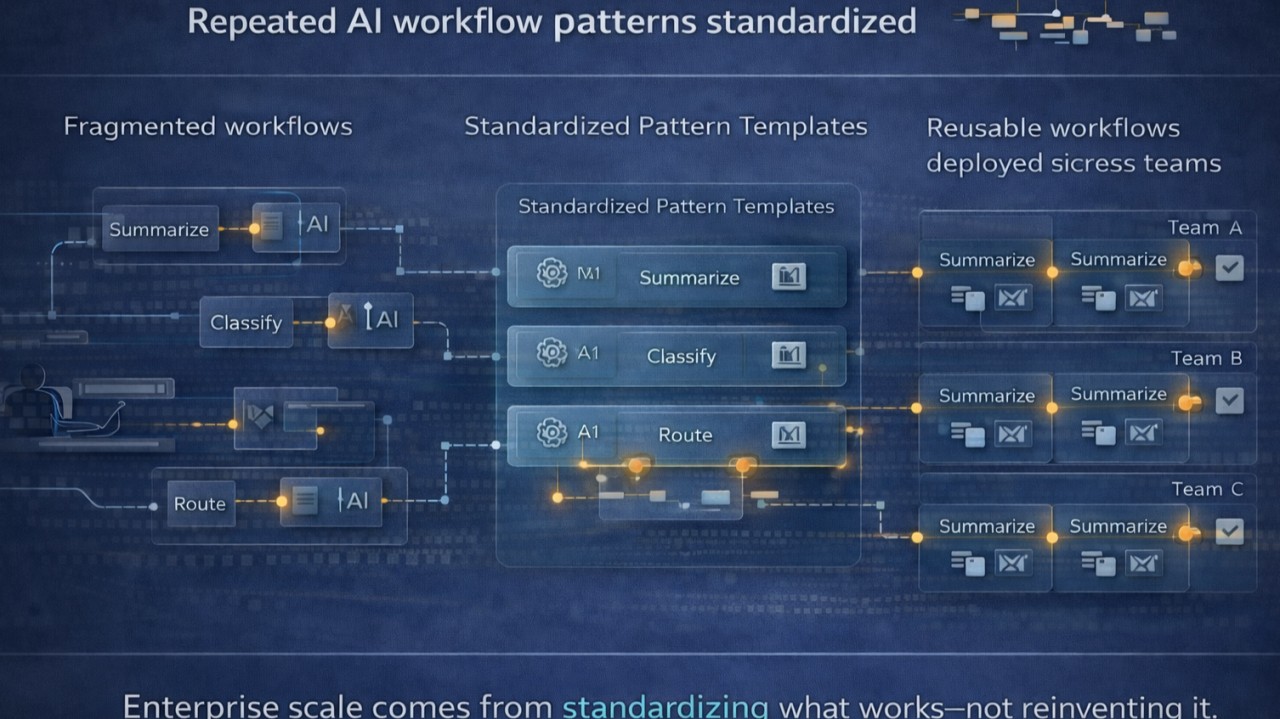
Standardizing AI Patterns Across the Enterprise
Most enterprises don't struggle with AI ideas.
They struggle with repetition.
The same use cases appear across teams:
- summarizing documents
- classifying requests
- routing work
- generating responses
- recommending actions
But instead of building once and scaling, organizations often:
- recreate solutions team by team
- use different prompts and tools
- apply inconsistent controls
- produce uneven results
This is not an innovation problem.
It's a standardization gap.
The hidden cost of reinvention
At first, decentralized experimentation is valuable.
It drives learning. It uncovers use cases. It builds momentum.
But over time, fragmentation grows:
- duplicated effort
- inconsistent outputs
- unclear quality standards
- higher governance complexity
The organization moves—but not efficiently.
Patterns already exist—you just need to see them
Across most enterprises, AI usage falls into a small set of repeatable patterns:
- summarize → extract → interpret
- classify → route → resolve
- analyze → recommend → decide
- draft → review → send
These patterns cut across functions:
- IT
- finance
- legal
- operations
- customer support
Recognizing this is the turning point.
Because once patterns are visible, they can be standardized and reused.
Standardization is not about control—it's about leverage
There is often resistance to standardization.
Concern about:
- slowing teams down
- limiting flexibility
- reducing innovation
In practice, the opposite happens.
Standardization:
- reduces duplication
- improves consistency
- accelerates new use cases
- simplifies governance
It creates a foundation teams can build on.
Define reusable workflow patterns
High-performing organizations codify patterns such as:
- document summarization pipelines
- classification and routing flows
- recommendation engines with approval steps
- response generation with review layers
Each pattern includes:
- workflow structure
- prompt templates
- control points
- integration hooks
This allows teams to start from a working model—not a blank page.
Consistency improves quality and trust
When patterns are standardized:
- outputs become more predictable
- decisions are handled consistently
- governance is easier to apply
- users trust the system more
This is critical at scale.
Because inconsistency erodes confidence quickly.
Standardization enables faster scaling
Once patterns are defined:
- new use cases can be deployed faster
- teams can reuse proven components
- onboarding becomes easier
- improvements propagate across the system
This is how AI capability scales across the enterprise.
The balance: standardize the core, allow flexibility at the edges
Effective standardization focuses on:
- core workflow structures
- key control mechanisms
- shared components
While allowing flexibility in:
- specific use case adaptation
- domain-specific tuning
- local optimization
This maintains both consistency and innovation.
The CTO's role
CTOs should lead pattern identification and standardization:
- map common workflows across the organization
- define reusable patterns
- enable shared infrastructure
- ensure adoption through usability
This is how isolated use becomes enterprise capability.
The opportunity
Most organizations are still in the experimentation phase.
Which means the opportunity to standardize early is significant.
The path forward
To standardize AI patterns:
- identify repeated workflows
- define reusable structures
- build shared components
- apply consistent controls
- enable easy reuse
Because the real power of AI is not just in what it can do once.
It is in what it can do consistently, everywhere.
How many times is your organization solving the same AI problem without realizing it? Let's Discuss.
Think this argument fits your event? Tell me about the room — the calendar is selective.
Start a conversation