The New Skills Every Engineering Leader Needs

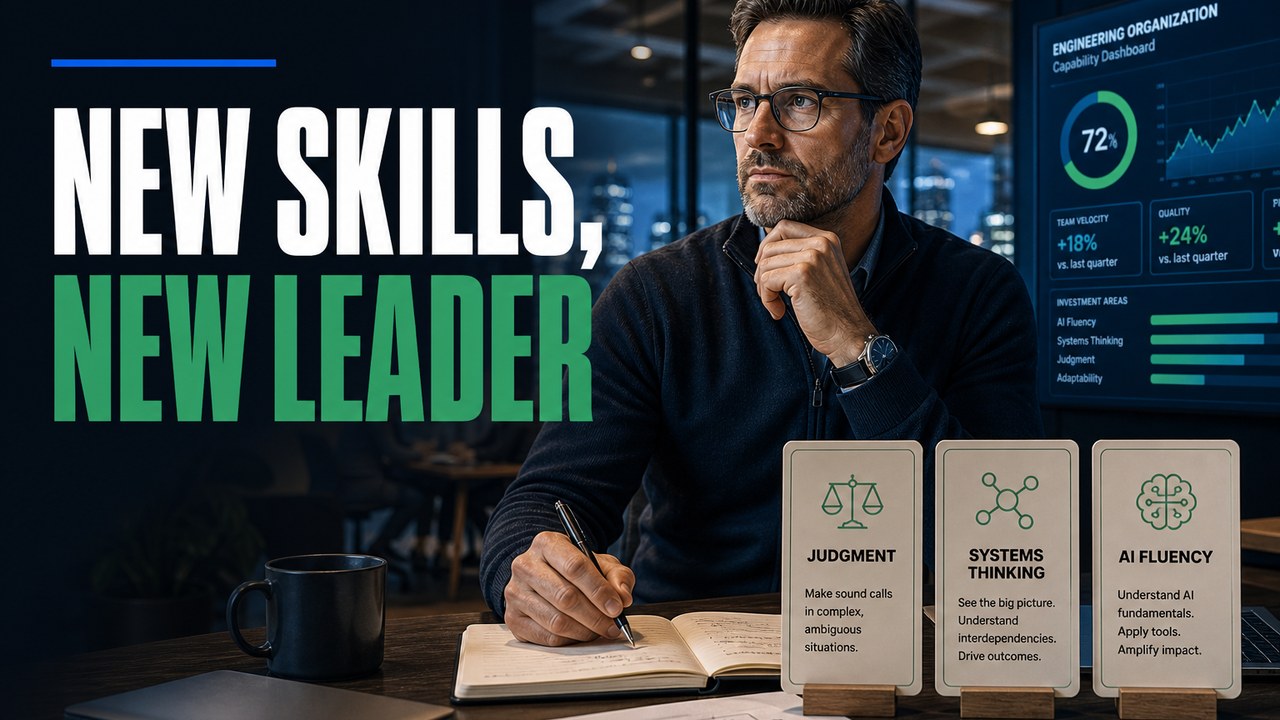
The skills that made you a successful engineering leader five years ago are still valuable. They are no longer sufficient.
Five New Skills for the AI Era
Prompt literacy is not about writing prompts. It's about evaluating them. Knowing when a prompt encodes bad assumptions or produces unreliable outputs. This is a leadership skill, not a technical one.
AI evaluation design — traditional testing breaks down with probabilistic outputs. Leaders need to define measurable success criteria and catch regressions before they reach production.
Systems thinking restoration — modern development has fragmented so much that most engineers can't think about entire systems anymore. AI restores this possibility, but only if leaders model it.
Organizational intelligence design — how knowledge flows, which decisions get captured, how understanding spreads. This is the highest-leverage skill in the AI era.
Calibrated trust — knowing when to trust AI and when to override. This only comes from experience. The leaders who develop it have seen enough failures to know the patterns.
Inspiring others — in the era of AI, knowledge workers are increasingly burnt out by collapsing feedback loops, new tools to learn, and the commoditization of their leverage. Engineers specifically need the guidance that, when everyone becomes a developer, we need more seniors. Fundamentally, teams that feel valuable deliver more value.
Where to Start
Pick prompt literacy or evaluation design. Invest a month getting competent. The rest will follow.
The leaders who develop these skills won't just survive the transition. They'll be the ones other CTOs call for advice.
Why These Skills Matter More Than Technical Depth
Technical depth will always be valuable. But in the AI era, it's table stakes. Every engineer can access deep technical knowledge through AI. The differentiator is the ability to evaluate that knowledge critically, apply it in context, and know when to trust it.
That's what these five skills enable. They're not replacements for technical expertise. They're multipliers. An engineer with deep technical knowledge and strong evaluation skills is far more effective than one with either alone.
How I'm Developing These Skills
I've been intentional about building these capabilities. For prompt literacy, I review AI outputs from my team every week and ask: what assumptions did the model make? What context was missing? How could the prompt be improved?
For evaluation design, I've been working with teams to define success criteria for AI systems before they're deployed. What does good look like? How will we measure it? What level of error is acceptable? These questions force clarity that makes deployment safer.
None of this is easy. But it's the work that matters most right now.
A Framework for Building These Skills
Pick one skill and practice it deliberately for a month. Prompt literacy is the easiest to start with because you can practice it daily. Every AI output you review, ask yourself: what context would have made this better? What assumptions did the model make? What guardrails were missing?
After a month, add a second skill. Over six months, you'll have built capability in all five. You won't be an expert in any of them, but you'll be competent — and that's enough to make better decisions and lead more effectively.
The leaders who invest in these skills today will be the ones who thrive in the AI era. Not because they're the smartest, but because they've learned to work with intelligence — both human and artificial.
Think this argument fits your event? Tell me about the room — the calendar is selective.
Start a conversation