"Human-in-the-Loop" Is Too Vague for Enterprise AI

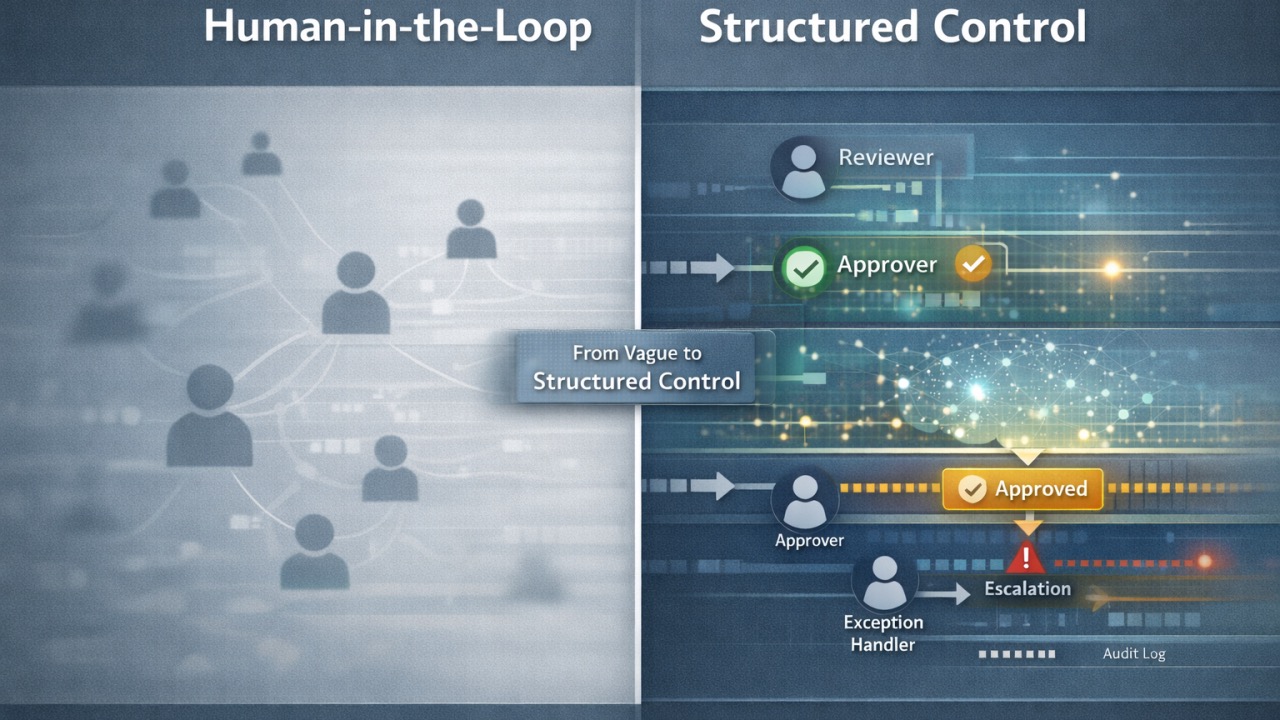
"Human-in-the-Loop" Is Too Vague for Enterprise AI
"Don't worry—we'll keep a human in the loop."
This has become the default reassurance in enterprise AI conversations.
It sounds responsible. It signals control. It suggests risk is being managed.
But in practice, it often means very little.
Because when AI systems start operating inside real workflows, "human-in-the-loop" is not a design—it's a placeholder.
And that vagueness is now becoming a scaling problem.
The issue isn't whether humans are involved. It's how, when, and why.
At executive level, the assumption is straightforward:
Add human oversight → reduce risk → increase trust.
But when you look at actual implementations, the pattern breaks down quickly:
- humans reviewing everything (and becoming the bottleneck)
- humans reviewing nothing (because volume is too high)
- humans approving outputs they don't fully understand
- humans bypassing the system to "get work done faster"
- no clarity on who is accountable when something goes wrong
In other words, the presence of a human does not guarantee control.
At enterprise scale, control comes from structured intervention, not symbolic involvement.
"Human-in-the-loop" hides critical design decisions
The phrase itself is problematic because it compresses multiple, very different responsibilities into one vague idea.
In practice, there are at least four distinct roles humans can play in an AI workflow:
- Reviewer — validates or edits outputs before action
- Approver — authorizes decisions above a certain threshold
- Exception handler — resolves ambiguous or edge cases
- Owner — accountable for the workflow's outcomes over time
- reviewers without authority
- approvers without context
- exception queues without ownership
- workflows without a responsible operator
- low-risk outputs flow through without interruption
- medium-risk outputs trigger targeted review
- high-impact decisions require explicit approval
- ambiguous cases route to specialized handlers
- a defined role
- a clear decision boundary
- supporting context and evidence
- a measurable outcome
- throughput collapses
- reviewers become fatigued
- rubber-stamping increases
- real risks become harder to detect
- teams work around the system entirely
- review only when confidence is below threshold
- escalate only when policy conditions are triggered
- sample outputs instead of checking all of them
- focus human attention on edge cases, not routine work
- no one owns exception handling
- decisions are made without traceability
- errors surface without clear accountability
- governance exists on paper, not in flow
- Who reviews this?
- Who approves this?
- Who handles edge cases?
- Who owns outcomes?
- from involvement → to defined roles
- from oversight → to decision boundaries
- from control as a concept → to control as a mechanism
- from safety statements → to operational design
- Where exactly are human intervention points?
- What triggers each intervention?
- What authority does each role have?
- What context is provided to make decisions?
- What is logged for audit and improvement?
- Who owns the workflow end-to-end?
Most organizations say "human-in-the-loop" without specifying which of these roles exists—or where.
That ambiguity creates operational gaps:
The result is predictable: AI systems that function in isolation but fail under real conditions.
The real design problem is intervention architecture
If you step back, this is not an AI problem. It is a workflow design problem.
The key question is not:
"Is there a human in the loop?"
It is:
"Where are the intervention points, and what decisions are made at each one?"
In mature systems, intervention is intentional and structured:
Each intervention point has:
This is what creates control.
Not the presence of a human—but the precision of their involvement.
Over-involvement is as risky as under-involvement
A common reaction to AI risk is to increase human oversight everywhere.
This creates a different failure mode.
When every output requires review:
In practice, excessive human involvement often reduces both speed and quality.
This is why leading organizations are shifting toward selective intervention models:
The goal is not more control points.
It is better-placed control points.
Under-specification creates hidden accountability gaps
The opposite problem is equally dangerous.
When "human-in-the-loop" is assumed but not operationalized:
This is where executive risk accumulates.
Not in the model itself—but in the absence of defined responsibility around it.
CIOs and executives should pay particular attention here.
If a workflow cannot answer:
Then "human-in-the-loop" is not a control. It is a gap.
Replace "human-in-the-loop" with explicit control patterns
Organizations that are successfully scaling AI are moving away from generic language and toward specific control designs.
Some common patterns:
Human-on-the-loop** — Humans monitor system behavior and intervene when signals indicate risk.
Human-in-the-decision** — AI provides recommendations, but humans make the final call for defined decision classes.
Human-for-exceptions** — AI handles standard cases; humans are triggered only for edge scenarios.
Human-as-owner** — A named operator is accountable for performance, drift, and redesign of the workflow.
Each of these patterns answers a different operational need.
More importantly, they can be combined intentionally within the same workflow.
This is what maturity looks like.
The real shift: from presence to precision
At enterprise scale, vague assurances do not create trust.
Precise systems do.
Moving beyond "human-in-the-loop" requires a shift in thinking:
This is not about slowing AI adoption.
It is about making AI operable in environments where accountability, auditability, and reliability actually matter.
What executives should require before scaling AI workflows
Before expanding AI into critical operations, leaders should push for clarity:
If those answers are unclear, the system is not ready—regardless of model performance.
The path forward
There is a path forward here, but it requires discipline.
AI does not remove the need for human judgment. It redistributes where that judgment matters.
Organizations that succeed will not be the ones that simply "keep humans in the loop."
They will be the ones that design clear, bounded, and accountable intervention models around AI-driven workflows.
Because in the end, enterprise trust is not built on presence.
It is built on precision, ownership, and control.
Are your AI systems designed with real decision accountability—or are you still relying on a phrase to carry that weight? Let me know in the comments.
Think this argument fits your event? Tell me about the room — the calendar is selective.
Start a conversation