Governance is Not About Slowing AI Down. They Are About Making It Usable at Enterprise Scale.

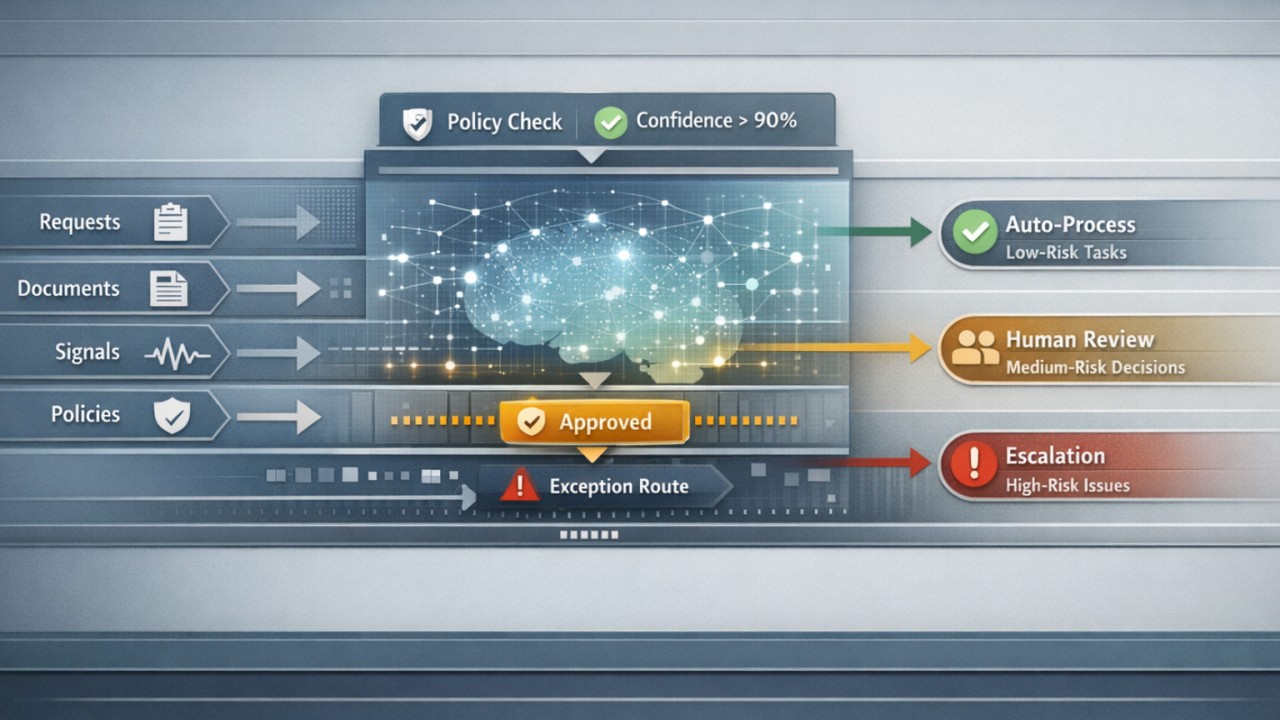
Governance is Not About Slowing AI Down. They Are About Making It Usable at Enterprise Scale.
A lot of AI initiatives stall for the wrong reason.
Not because the models are weak. Not because the use case is unclear. And not even because the technology is immature.
They stall because the workflow around the model is undefined.
That is the failure mode many enterprises are now running into. Teams can generate output. They can summarize documents, draft responses, classify tickets, recommend actions, and accelerate analysis. But once the output starts touching real operations, real customers, real decisions, or regulated processes, the conversation changes.
Now the question is no longer, Can AI do this task?
It becomes: Who owns the result, what controls shape the decision, and what happens when the system is wrong?
That is where governed AI workflows become essential.
The real issue is not model intelligence. It is workflow reliability.
In practice, most enterprise AI failure does not come from dramatic model collapse. It comes from much simpler operational problems:
- no defined approval boundary
- no clear human reviewer for high-impact outputs
- no escalation path for ambiguity or exceptions
- no record of why a recommendation was accepted or overridden
- no distinction between low-risk automation and high-risk augmentation
- no shared operational owner once the pilot becomes part of production work
This is why so many early AI deployments feel impressive in a demo and fragile in the business.
The model may be capable. The workflow is not.
At enterprise scale, trust is rarely created by intelligence alone. It is created by predictability, accountability, and decision design.
Governance is not a policy layer on top of AI. It is part of the workflow itself.
Many organizations still treat governance as a review committee, a security checklist, or a document that appears late in procurement. That is too narrow.
For AI to work inside real operations, governance has to be embedded directly into the workflow design.
That means the workflow itself should answer questions like:
- What kind of decision is being made?
- What is the impact of a wrong answer?
- What confidence threshold changes the handling path?
- When does a human approve, edit, or reject?
- What evidence is retained?
- Which exceptions require escalation?
- Who is accountable for the workflow outcome, not just the model output?
This is a different mindset.
Instead of thinking about AI as a tool inserted into a process, governed organizations design a controlled decision system where AI is one component inside a larger operational structure.
That is a more durable way to scale.
The most useful pattern is not full autonomy. It is bounded participation.
There is a tendency to frame AI adoption as a binary choice:
- either humans do the work manually
- or AI automates the work end to end
That framing creates unnecessary risk.
Most enterprise value sits in the middle.
The most effective governed AI workflows usually give AI a bounded role inside a sequence that still has clear ownership. For example:
- draft the response, but require approval before external send
- classify the request, but route edge cases to a specialist queue
- recommend the action, but require a manager sign-off above a threshold
- summarize the file, but retain source links and reviewer edits
- detect anomalies, but escalate only after rule-based validation
This is where workflow maturity matters.
A governed AI workflow is not trying to prove that humans are unnecessary. It is trying to ensure that automation happens inside known limits.
That is how trust accumulates.
Governance starts with decision tiering, not blanket restriction
One of the most common mistakes is applying the same control model to every AI use case.
That creates friction where none is needed and still misses risk where it matters.
A better approach is to tier decisions.
For example:
Tier 1: Low-risk productivity support** — Internal drafting, summarization, note cleanup, knowledge assistance. Governance focus: data handling, prompt boundaries, output labeling, usage logging.
Tier 2: Operational recommendations** — Ticket routing, document classification, next-best-action suggestions, workflow prioritization. Governance focus: confidence thresholds, human review, exception handling, performance drift.
Tier 3: High-impact or externally consequential actions** — Customer communications, pricing recommendations, regulated case handling, compliance-sensitive decisions. Governance focus: approval gates, decision traceability, audit records, role-based access, formal ownership.
This kind of structure does two things.
First, it prevents overreaction. Not every use case needs heavyweight approval. Second, it prevents under-control. High-impact workflows should not be treated like simple productivity tools.
Governance becomes practical when it is tied to decision consequence, not abstract anxiety.
Ownership is the missing layer in many AI programs
A governed workflow only works when ownership is explicit.
This sounds obvious, but it is often where programs break down. The platform team owns the tooling. Security owns the review. Legal owns the policy language. Business teams own the demand. But no one clearly owns the live workflow once AI is influencing work in production.
That gap creates familiar problems:
- unclear accountability when outputs are wrong
- weak monitoring after deployment
- unresolved handoffs between business and technical teams
- drift in usage patterns without process redesign
- governance artifacts that exist on paper but not in operations
The fix is not just "more oversight." The fix is naming a true workflow owner.
That owner is responsible for the operational design:
- where AI is inserted
- what boundary conditions apply
- what metrics indicate failure or drift
- when escalation is required
- how humans intervene
- how the workflow changes over time
Without that ownership, AI remains a capability without a control plane.
Good governed workflows make human involvement sharper, not heavier
There is also a misconception that governed AI means adding bureaucracy.
Done poorly, yes. Done well, no.
The best governed workflows do not force humans to re-do all the work. They concentrate human attention where judgment is actually required.
That might mean:
- only reviewing outputs below a confidence threshold
- surfacing rationale and source evidence with each recommendation
- routing exception classes to the right reviewer automatically
- logging overrides so patterns can be improved
- separating routine cases from ambiguous ones
This is a better design principle than "human in the loop" as a slogan.
The real objective is human judgment at the right control points.
Not constant supervision. Not ceremonial approval. Not blind trust.
Just clear intervention where enterprise risk, ambiguity, or accountability require it.
The strongest AI operating models treat escalation as a design feature
In mature organizations, escalation is not seen as failure. It is seen as part of safe flow.
The same should be true for AI workflows.
When the model is uncertain, when context is incomplete, when policies conflict, or when the recommendation has outsized impact, the workflow should know how to slow down and transfer control.
That means escalation paths should be intentionally designed:
- confidence-based routing
- policy-triggered review checkpoints
- exception queues with named owners
- reversibility for certain action types
- post-decision sampling and retrospective review
This is one of the clearest markers of operational maturity.
Ungoverned AI tries to hide uncertainty. Governed AI workflows make uncertainty visible and actionable.
What leaders should actually ask before scaling AI
Before approving broader rollout, leaders should ask a more disciplined set of questions:
- Where exactly does AI sit in the workflow?
- What decisions can it influence, recommend, or execute?
- Which actions require approval and by whom?
- What evidence supports each output?
- What gets logged for review or audit?
- How are exceptions handled?
- Who owns drift, quality failure, and workflow redesign?
- What happens when the system is right 80% of the time but wrong on the 20% that matter most?
These are not anti-AI questions.
They are the questions that separate experimentation from enterprise capability.
The path forward is not less AI. It is better workflow design.
There is a path forward here, but it requires a shift in thinking.
Organizations that succeed with AI will not be the ones that simply deploy the most powerful models. They will be the ones that design the clearest operational systems around them.
Because in the enterprise, value does not come from generating output alone.
It comes from creating workflows that people can trust, leaders can govern, and operators can actually run under pressure.
That is the real maturity curve.
Not model adoption. Governed AI workflow adoption.
Is your AI strategy really about intelligence, or is it finally forcing you to confront how decisions, ownership, and control actually work inside your organization? Let me know in the comments.
Think this argument fits your event? Tell me about the room — the calendar is selective.
Start a conversation