From Meaning to Control: Why AI Needs Guardrails, Not Just Models

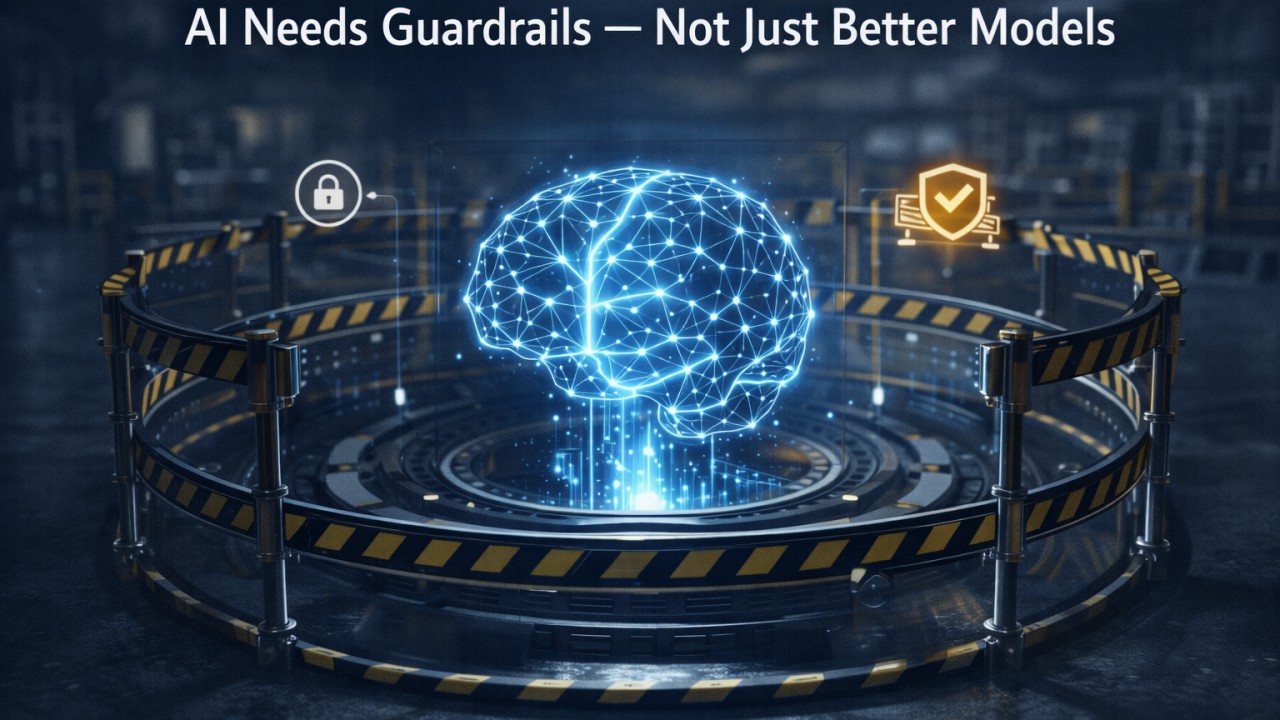
From Meaning to Control: Why AI Needs Guardrails, Not Just Models
Every generation of technology has its "oh no" moment.
For cloud computing, it was accidentally exposed S3 buckets. For DevOps, it was deploying to production on a Friday afternoon. For AI, it's the growing list of stories that all sound the same:
"The AI deleted production data." "The AI took an action no one approved." "The AI did exactly what we asked — not what we meant."
If that feels familiar, it should. We've all seen Silicon Valley — Son of Anton deleting production code because someone gave it too much authority and not enough restraint.
Large Language Models didn't invent this problem. They just accelerated it.
LLMs Are Powerful — and That's the Problem
Modern LLMs are exceptional at meaning:
- Interpreting ambiguous instructions
- Reasoning across incomplete information
- Acting with confidence even when uncertain
That makes them incredibly useful — and incredibly dangerous — in enterprise environments.
An LLM doesn't know:
- What shouldn't be changed
- Which systems are off-limits
- When a decision crosses a legal, financial, or safety boundary
Without guardrails, an LLM behaves like a brilliant intern with:
- Root access
- API keys
- Production credentials
- And no fear of consequences
That's not innovation. That's negligence.
Guardrails Are Not Anti-Innovation
Some leaders hear "guardrails" and think:
- Slower progress
- Bureaucracy
- Lost competitive advantage
In reality, guardrails are what enable scale.
There's a difference between:
- Exploration (experiments, sandboxes, demos)
- Operation (production systems that affect customers, revenue, and safety)
You don't put guardrails on creativity. You put guardrails on execution.
No one argues that aircraft safety checks stifle aviation innovation. They're the reason aviation works at all.
Policy, Constraints, and Governance Are Not the Same Thing
One of the biggest mistakes organizations make is collapsing these concepts into a single conversation.
They are not interchangeable.
- Policy defines intent — What is allowed? What is forbidden? Who is responsible?
- Constraints enforce behavior — What actions are technically impossible? What requires approval? What is sandboxed?
- Governance assigns accountability — Who owns the rules? Who reviews changes? Who answers when something goes wrong?
Most AI failures happen because policy exists — but constraints don't. Or constraints exist — but no one owns them.
Why These Conversations Are Happening Too Late
In many organizations, guardrails show up after the incident:
- After the AI sends the wrong email
- After it modifies the wrong record
- After it touches the wrong system
That's backwards.
If an AI system can:
- Write code
- Execute workflows
- Modify data
- Trigger real-world actions
Then it is no longer a tool. It is part of your operating model.
And operating models require control by design — not cleanup by incident response.
Control Is the Price of Trust
The real question isn't whether AI should have guardrails.
It's this:
Do you want AI systems that are impressive — or AI systems that are trustworthy?
Because trust doesn't come from better models alone. It comes from knowing what the system cannot do.
And that's where real AI leadership begins.
When an AI system makes a decision no one explicitly approved — who, exactly, is accountable? If your AI can take real-world action, what's stopping it from taking the wrong one? Is your AI governed like critical infrastructure — or treated like a demo that accidentally went live?
Think this argument fits your event? Tell me about the room — the calendar is selective.
Start a conversation