From Intern to Operator: When AI Becomes Part of the Org Chart

From Intern to Operator: When AI Becomes Part of the Org Chart
Most AI doesn't arrive with authority. It arrives quietly — as a helper, an assistant, an accelerator. It drafts emails. Summarizes documents. Optimizes workflows.
It starts as an intern. But it doesn't stay there.
Over time, AI begins to shape decisions, not just support them. It prioritizes options, flags risks, recommends actions, and nudges outcomes before humans ever sit down to decide.
And yet, organizational structures pretend nothing has changed.
The Quiet Shift from Tool to Actor
Early AI systems respond. Mature AI systems influence. That transition is subtle but consequential.
At first, AI outputs are reviewed. Then they're trusted. Then they're accepted by default.
Eventually, humans stop asking "Is this right?" and start asking "Why would we override it?"
At that point, AI is no longer a tool. It's a decision participant.
But most organizations never formally acknowledge that shift — which is where risk begins.
Org Charts Lag Reality
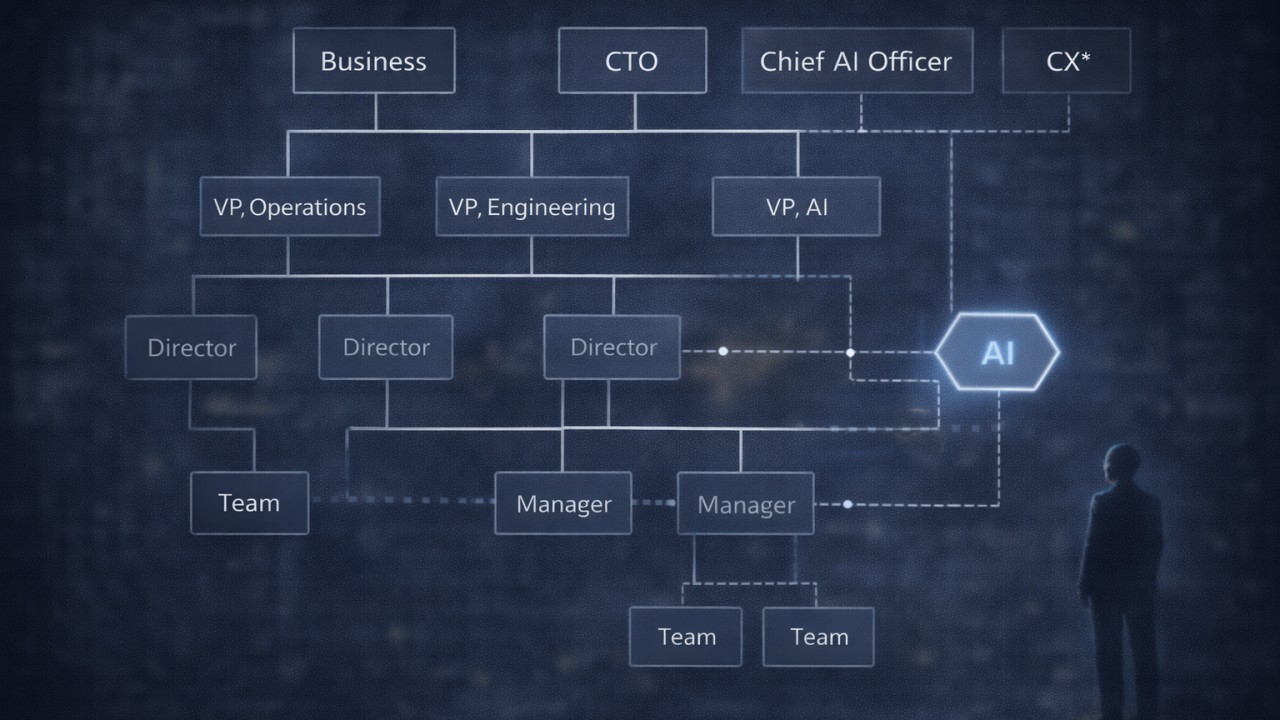
Org charts reflect authority. AI systems increasingly exercise it. But there's a mismatch.
AI doesn't appear on the chart. It doesn't have a role. It doesn't have explicit limits. And it certainly doesn't have accountability.
Instead, it exists sideways — influencing multiple functions at once:
- Recommending hiring shortlists
- Prioritizing operational issues
- Flagging compliance risks
- Optimizing supply, pricing, or scheduling
- Shaping what information leaders see first
These are not clerical tasks.
They are operator-level functions. Yet because AI isn't treated like a role, no one owns its authority.
Authority Without Acknowledgment Is the Real Risk
The danger isn't that AI makes decisions.
The danger is that it makes them without being recognized as doing so.
Unacknowledged authority creates:
- Diffuse accountability
- Silent dependency
- Escalation failures
- Post-incident blame games
When something goes wrong, organizations ask:
- "Who approved this?"
- "Why wasn't this reviewed?"
- "Why didn't someone stop it?"
But the real question is simpler:
Why was influence allowed without ownership?
AI didn't "overstep."
The organization never defined where it was allowed to stand.
The Intern Fallacy
Many leaders still think of AI as junior:
- "It just recommends."
- "It doesn't decide."
- "Humans are still in charge."
But interns don't quietly reshape outcomes across departments. Operators do.
The moment AI:
- Filters options before humans see them
- Scores risk or confidence
- Determines priority or urgency
- Shapes the default path forward
...it has moved beyond assistance. It has operational influence.
And influence is power — whether or not it's labeled.
What Treating AI Like a Role Actually Means
This does not mean giving AI a title.
It means designing systems with the same rigor we apply to human roles:
- Defined scope — what it can and cannot influence
- Clear escalation paths — when humans must intervene
- Authority boundaries — where AI stops
- Visible uncertainty — when confidence is low
- Named ownership — who answers when things go wrong
Humans don't get promoted without structure. AI shouldn't either.
This Connects the Entire Series
This is the natural extension of the earlier articles in this series:
- If AI creates risk, who owns it?
- If humans are "in the loop," where and when?
- If AI must know when to stop, who defines that?
- If uncertainty must be visible, who decides next?
Once AI becomes an operator, all of those questions stop being theoretical.
They become organizational design problems.
The Executive Question Most Organizations Avoid
Every org chart answers one core question:
Who is allowed to influence outcomes here?
AI is already influencing outcomes.
So the real question is no longer technical.
If AI influences decisions, why isn't it treated like a role?
Because authority that exists without acknowledgment is the most dangerous kind.
Think this argument fits your event? Tell me about the room — the calendar is selective.
Start a conversation