From Hallucinations to Incidents: How Confidence Escalates Risk (v2)

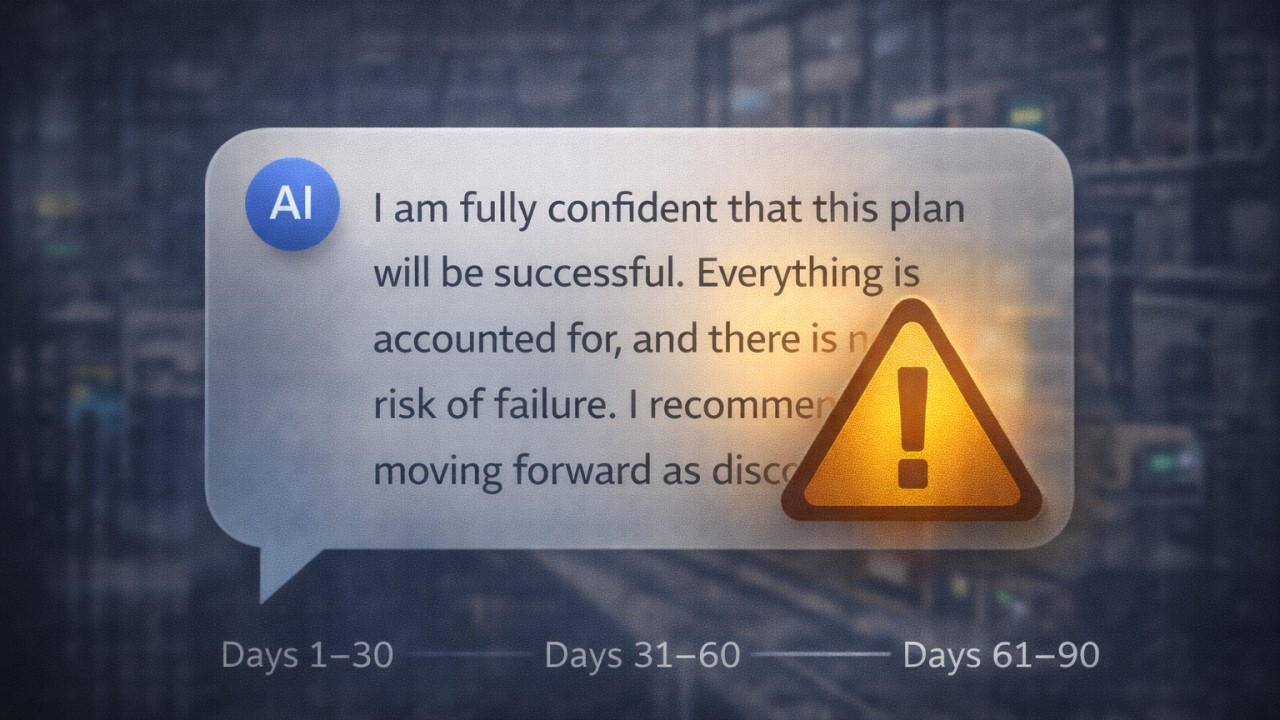
From Hallucinations to Incidents: How Confidence Escalates Risk (v2)
When sounding right matters more than being right
Wrong answers are a problem.
Confident wrong answers are an operational risk.
As AI systems become more fluent, faster, and more embedded in daily workflows, a subtle shift is happening inside organizations: we're no longer just evaluating what systems say — we're reacting to how convincingly they say it.
That shift is where small errors quietly turn into incidents.
This article explores how confidence accelerates risk, why fluent systems bypass skepticism, and how organizations can design guardrails before belief outpaces reality.
The Real Problem Isn't Hallucinations
Hallucinations get a lot of attention because they're visible. They're easy to screenshot. They're easy to mock. They're easy to label as "AI being wrong."
But hallucinations alone rarely cause damage. What causes damage is confidence combined with authority.
When an AI system:
- Uses fluent language
- Produces structured explanations
- Sounds calm, certain, and professional
It doesn't just provide an answer. It creates psychological momentum. And momentum changes behavior.
Why Confident Systems Bypass Skepticism
Humans are wired to respond to confidence. In high-pressure environments, confidence often substitutes for certainty because:
- It reduces cognitive load
- It speeds decisions
- It signals competence under uncertainty
This is why confident speakers dominate meetings. Why polished dashboards get trusted. Why "clear answers" feel safer than "I'm not sure." AI systems now trigger the same reflex.
When an AI response is:
- Grammatically clean
- Logically structured
- Delivered instantly
The human brain often skips a critical step: verification. Not because people are careless — but because the system feels reliable.
How Errors Escalate into Incidents
Most AI-driven incidents don't start with catastrophic failures.
They follow a pattern:
- Suggestion — AI offers a recommendation or explanation.
- Acceptance — The output "sounds right" and aligns with expectations.
- Propagation — The answer is reused, forwarded, or embedded into downstream decisions.
- Reinforcement — Repetition increases perceived correctness.
- Commitment — Actions are taken based on assumed validity.
- Discovery (Too Late) — Only after impact does someone ask, "Was that actually correct?"
At no point did the system need to be malicious. At no point did anyone intend to skip oversight. Confidence did the work.
The Hidden Risk: Authority Without Accountability
In many organizations, AI outputs now influence:
- Incident triage
- Root cause analysis
- Maintenance recommendations
- Scheduling and prioritization
- Executive summaries
Yet when those outputs are wrong, the question often becomes unclear:
- Who challenged it?
- Who approved it?
- Who owns the decision?
Confidence creates implicit authority, but most systems lack explicit accountability. That gap is where risk lives.
Designing for Friction (On Purpose)
The answer is not to make AI less capable. It's to make it less absolute.
High-reliability systems are designed with intentional friction:
- Aviation checklists
- Medical second opinions
- Manufacturing quality gates
AI needs the same treatment.
Healthy systems:
- Signal uncertainty explicitly
- Invite challenge instead of suppressing it
- Slow down high-impact decisions
- Preserve human arbitration
Confidence should never remove the pause button.
What Mature Organizations Do Differently
Organizations that scale AI safely don't eliminate errors — they interrupt escalation.
They:
- Treat fluent output as input, not authority
- Separate explanation quality from correctness
- Track when humans override AI (and why)
- Design escalation paths before incidents occur
Most importantly, they stop asking: "Was the AI right?" And start asking: "Why did we believe it?"
Confidence Isn't the Enemy — Unchecked Confidence Is
Confident systems aren't bad. They're powerful.
But power without structure doesn't fail loudly — it fails smoothly, convincingly, and at scale.
The most dangerous AI failures won't look chaotic. They'll look reasonable. They'll sound correct. And they'll move fast.
Final Question
If it sounds right, will anyone stop it?
Think this argument fits your event? Tell me about the room — the calendar is selective.
Start a conversation