From Data to Decisions: Where AI Actually Changes the Game

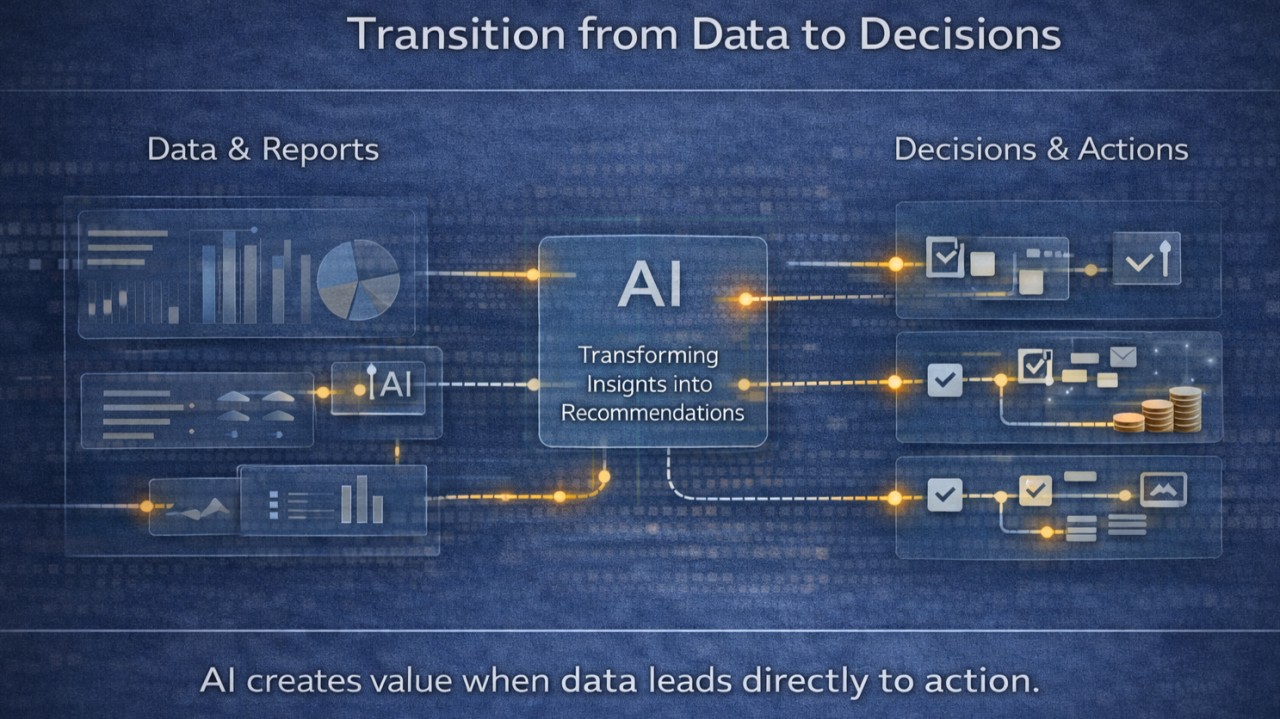
From Data to Decisions: Where AI Actually Changes the Game
Most enterprises have invested heavily in data infrastructure—dashboards, reports, and analytics platforms—based on the assumption that better data leads to better decisions. Yet a persistent gap remains: data is available, insights exist, but decisions still lag.
AI is beginning to close this gap by shifting focus from visibility to action.
The Core Problem: Visibility Without Action
Traditional data systems excel at making information accessible and improving reporting, but visibility alone doesn't guarantee action. Decisions still require interpretation, context, and prioritization.
AI's Solution: From Insight to Action
AI changes the equation by interpreting data, surfacing relevant signals, recommending actions, and reducing decision latency. This transforms organizations from asking "What happened?" to "What should we do next?"
Integration Creates Impact
Real value emerges when AI is embedded into workflows and connected to operational systems. This enables faster responses, consistent handling, and reduced delays. Disconnected insights—analysis without integration—create limited value.
Addressing Decision Latency
Many organizations possess available data and analytical capability but suffer from slow decision-making. AI reduces this latency by providing immediate context, narrowing options, and guiding action.
Scaling Consistency
AI standardizes decisions at scale, ensuring similar cases are handled similarly and reducing variability—critical in high-volume environments.
The Path Forward
Organizations must embed AI into decision points, focus on reducing latency, integrate systems, and measure outcomes.
The value of data ultimately lies not in what it reveals, but in what it enables you to accomplish.
Think this argument fits your event? Tell me about the room — the calendar is selective.
Start a conversation