From Copilots to Capability: Turning AI Into Real Enterprise Leverage

From Copilots to Capability: Turning AI Into Real Enterprise Leverage
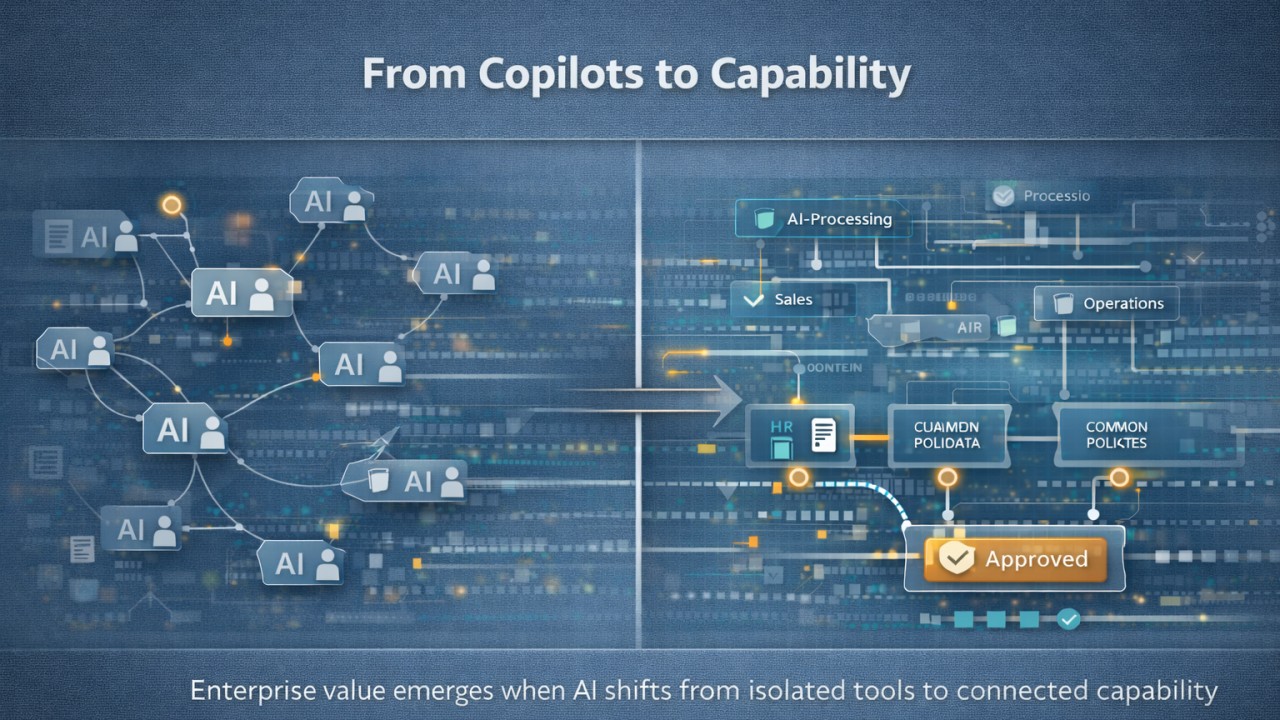
Most enterprises have moved beyond initial AI introduction, with copilots now widespread across email drafting, document summarization, coding assistance, and analysis tasks. However, individual success masks an emerging challenge: fragmentation.
The Plateau Problem
While copilots deliver initial gains—faster output, reduced manual effort, improved responsiveness—these benefits plateau. The issue stems from their isolated, task-level nature. Copilots operate disconnected from each other and inconsistently across teams, creating pockets of productivity rather than enterprise-wide leverage. Organizations move faster in isolated places but fail to function as cohesive systems.
Access Isn't Capability
Having AI tools differs fundamentally from operating AI as organizational capability. True capability requires repeatability, consistency, integrated workflows, and measurable outcomes—moving beyond ad hoc usage and individual experimentation toward structured approaches.
Systematic Thinking Drives Results
Success requires systems thinking: understanding how outputs feed into subsequent steps, ensuring consistent AI use across similar workflows, supporting decisions rather than merely completing tasks, and measuring results over time for continuous improvement.
Pattern Standardization Creates Scale
Most enterprises encounter repeating patterns:
- Summarize → interpret → decide
- Classify → route → resolve
- Analyze → recommend → approve
Leading organizations standardize these patterns through reusable workflows, consistent prompts, aligned control points, and shared components—reducing duplication while accelerating rollout and ensuring consistency.
Integration Multiplies Value
Real capability emerges when AI integrates into core operational systems and workflows. This means connecting AI outputs directly into operational processes, embedding recommendations at decision points, linking multiple AI steps cohesively, and ensuring outputs drive action rather than merely inform.
Measuring What Matters
Organizations should shift from activity metrics (usage, adoption rates, prompts, time saved) toward capability metrics: workflow throughput, decision speed, outcome quality, rework reduction, and team consistency. This transforms AI from tool metrics into business performance indicators.
Building Foundations for Reuse
CTOs play critical roles establishing reusable foundations: shared model access layers, standardized interfaces and APIs, common workflow components, governance patterns, and libraries of proven implementations. The goal isn't centralizing everything but making reuse easier than reinvention.
The Path Forward
Transforming copilots into organizational capability isn't revolutionary—it's evolutionary. The process involves identifying repeatable patterns, standardizing high-leverage areas, integrating AI into real workflows, measuring outcomes, and building reusable components.
Over time, this converts AI from isolated tools into reliable core enterprise capability—where real advantage resides.
Think this argument fits your event? Tell me about the room — the calendar is selective.
Start a conversation