Escalation Systems That Scale: When Human Review Doesn't Become a Bottleneck

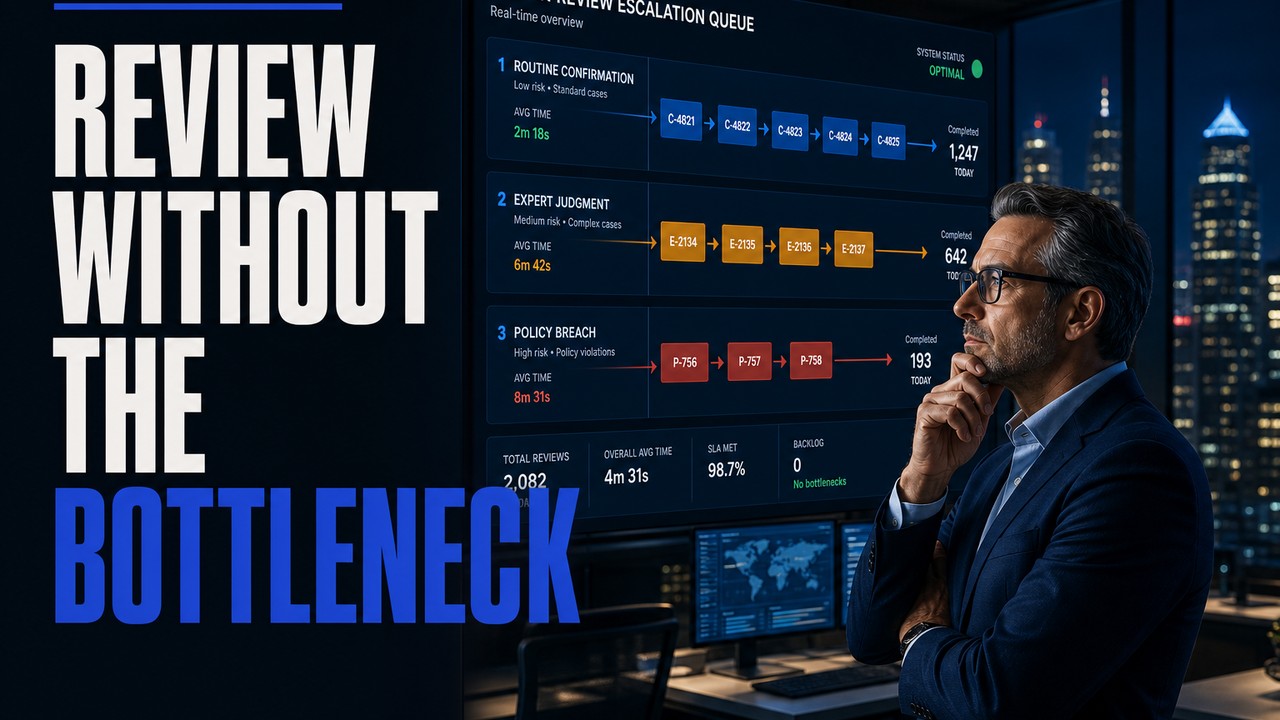
The most common objection I hear about AI governance goes something like this: "If every uncertain output gets escalated to a human, we'll need to hire an army of reviewers."
It's a fair concern. If you design escalation poorly, you turn an AI efficiency gain into a human bottleneck — and nobody wants that.
But here's what the teams getting this right understand: well-designed escalation systems don't add friction. They concentrate human attention where it matters most, and they reward operators with better decision-making support, not more toil.
The Difference Between a Queue and a System
A queue is a pile of work. A system is a pipeline with routing, triage, and feedback.
The organizations scaling human review successfully don't just dump escalated cases into a single "review" bucket. They design multi-lane systems:
Lane 1 — Routine exceptions.** Low-risk cases that need a quick confirmation. Pre-populated with context and a clear decision prompt. One operator can handle dozens per hour because the system does the preparatory work.
Lane 2 — Ambiguous edge cases.** These need judgment, not just confirmation. They get routed to domain experts with full context, source links, and explanation of what makes this case uncertain.
Lane 3 — Policy or threshold breaches.** These are signals that something in the system design needs attention. They go to the workflow owner, not just an operator — because the fix isn't a single decision; it's a design change.
This isn't theoretical. I've seen internal platforms where 80% of escalated cases resolve in Lane 1 within minutes. The human bottleneck people fear only emerges when every escalation lands in one undifferentiated queue.
How Escalation Volume Naturally Decreases Over Time
One of the most encouraging patterns I've observed is that well-designed escalation loops create their own improvement cycles.
When operators correct, confirm, or override AI outputs, that feedback gets captured. The system learns from it. Confidence calibration improves. Escalation rates drop — not because thresholds are loosened, but because the system becomes genuinely better at knowing its limits.
This is the flywheel effect of good governance: more escalation → more data → better calibration → less escalation needed over time. The bottleneck that keeps people from scaling turns into the mechanism that makes scaling possible.
Practical Starting Points
If you're building an escalation system today, start with three design decisions:
- Triage before routing. Don't let every escalated case hit the same human. Build a pre-filter that sorts by risk, complexity, and required expertise.
- Context is the operator's oxygen. Every escalated case should arrive with the relevant history, the system's confidence level, and the specific question the operator needs to answer.
- Close the loop. After every escalation, capture the outcome. If the operator overrode the system, why? If they confirmed it, was there nuance? This data is the raw material of continuous improvement.
Escalation isn't governance overhead. It's the feedback loop that makes AI systems trustworthy at scale.
Think this argument fits your event? Tell me about the room — the calendar is selective.
Start a conversation