Don't Automate the Org Chart

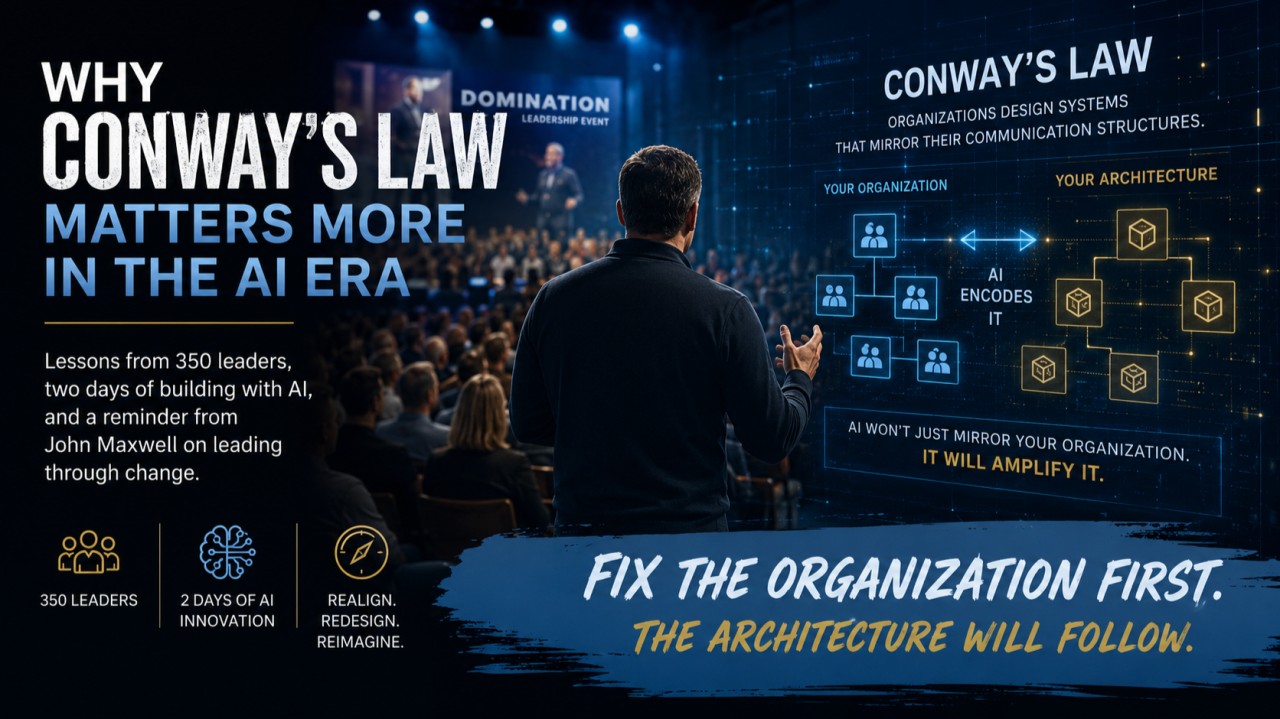
What 350 leaders, two days of building, and one leadership legend reminded me about the future of organizations.
I just spent the better part of a week at Domination, our annual gathering of roughly 350 leaders from across the world. Different countries, different functions, different parts of the business — operations, manufacturing, supply chain, retail, sales, finance, technology, distribution, and everything in between. We bring this group together to learn, align, and challenge ourselves. Most importantly, we get directionally aligned on where we're going next.
This year was different.
We talked strategy and leadership, sure. But we also spent two days putting AI directly into our leaders' hands, asking them to work on real business problems in what was essentially a massive AI hackathon. Not theoretical use cases. Not another presentation about how AI is going to change everything. Not a vendor on a stage with a perfectly scripted demo. People from across the business actually building. Experimenting. Breaking things. Trying again.
They took problems they understand better than anyone else and asked a very different question: what becomes possible now?
Watching that changed some of my own thinking about AI transformation. But before I get to the nerdy part — and yes, Conway's Law is coming — I need to tell you about something that happened earlier in the week.
25 Years of John C. Maxwell
We brought John Maxwell in to speak to our leaders at our Domination event, and it was a full-circle moment for me personally. I first heard him speak more than 25 years ago, at a very different point in my career. I was still figuring out what leadership actually meant, and probably still confusing it with authority, expertise, and being the person who had the answers.
At that event in 2001, I picked up his book Failing Forward. The idea seems simple in hindsight: failure isn't the opposite of success. It's part of the process that creates success — if you're willing to learn from it. But ideas land differently depending on where you are in life. That one stuck. Over the years, it became one of several books that shaped how I think about leadership, experimentation, risk, people, and change.
More than two decades later, I sat there watching him speak again, surrounded by hundreds of leaders I get to work alongside. The timing couldn't have been more appropriate. Immediately afterward, we were about to ask those same leaders to do exactly what Failing Forward taught me all those years ago: try something, build something, get it wrong, learn, try again. All the things that are crucial in the AI era.
On a super personal note, I had the amazing and humbling opportunity to have dinner with John and some of our executive team. He is exactly the same on stage as he is in person and how he writes in his books. Now, I've never been the kind of person who is a "star-struck" guy — but right there at dinner with me was someone who, in part, influenced who I am today. I am extremely honored and grateful that I had the opportunity to shake his hand and thank him. If you ever get the opportunity to listen to him speak in person, do it. He is 79, has been coaching leaders for 50+ years, and is an amazing human. If you don't get the opportunity, then at least get one (or 50) of his books — #WorthEveryPenny.
Ok, now back to my article...
You Can't PowerPoint Your Way Into Understanding AI
Everyone has spent the last few years talking about AI. Boards, CEOs, technology organizations, consulting firms — there are AI strategies, AI roadmaps, AI councils, AI centers of excellence, AI governance committees, AI presentations, and probably an AI maturity model evaluating the maturity of your AI maturity model.
But there's a massive difference between hearing about AI and experiencing what it makes possible. That became obvious during those two days. As our leaders worked through real-world scenarios in a hackathon environment, the conversation changed. Instead of "what can AI do?" people started asking a much more interesting question: "why do we do this process this way in the first place?"
Then came the rest. Why does this approval need to happen? Why does this information move through four different groups? Why do we enter this data twice? Why can't this decision happen closer to the person doing the work? Why are two teams solving essentially the same problem independently? Why does this process even exist?
Now we're getting somewhere. Because the real opportunity with AI isn't simply making today's organization faster. It's the chance to question whether today's organization should exist in its current form at all.
The First AI Breakthrough Isn't Technical
What I loved most about those two days was watching people from completely different parts of the business work together. They weren't thinking about models, vector databases, or token counts. (Okay, a few of us were. We're nerds. We can't help ourselves.) Most people were thinking about outcomes.
They know the business. They know where the friction is. They know the processes everyone complains about but has learned to live with. They know which spreadsheet gets emailed around every Tuesday. They know which approval takes three days even though the actual decision takes three minutes. They know where someone has to swivel between four systems to answer one customer question. They know which process requires six people because the information needed to make the decision historically lived in six different places.
Once they started understanding what AI and agents can actually do, something clicked. They didn't just see automation. They started seeing a different operating model. That's the part of enterprise AI I think we're dramatically underestimating.
Stop Automating the Org Chart
A lot of organizations are approaching AI the way they approached every previous technology transformation: take the existing organization, the existing processes, the existing systems, the existing ownership boundaries — then sprinkle AI on top. Finance gets finance AI. Marketing gets marketing AI. Supply chain gets supply chain AI. Every department gets agents, copilots, and automation.
Congratulations. You just spent millions of dollars building a faster version of your existing organizational problems.
That's not transformation. That's acceleration — and acceleration is only useful if you're traveling in the right direction. If the underlying process is bad, AI gives you a faster bad process. If the organization is siloed, AI gives you incredibly efficient silos. If ownership is fragmented, AI automates the fragmentation. If your data semantics are inconsistent, AI generates answers from those inconsistencies at machine speed. If your decision-making structure is unnecessarily complicated, agents execute that unnecessary complexity thousands of times faster than humans ever could.
This is where we need to get a little nerdier. Because there's a computer science principle from the 1960s that suddenly matters a lot more.
Enter Conway's Law
In 1967, computer scientist Melvin Conway observed something that became known as Conway's Law: organizations design systems that mirror their communication structures.
Four teams that rarely communicate? You end up with four systems that don't communicate well either. Responsibilities fragmented across seven groups? The architecture ends up fragmented across seven services. Two departments that don't trust each other's data? Eventually there are two copies of the data. The architecture becomes a reflection of the organization that created it.
For decades, that was treated as a software architecture problem. In the AI era, I think it becomes an organizational strategy problem. Because AI doesn't simply observe your organization. AI learns your organization — and eventually, AI encodes it.
AI Is Going to Learn Your Silos
Think about what we're doing when we introduce AI into a company. We connect it to our data, our documentation, our processes, our systems, our workflows, our organizational knowledge, our policies, our decisions, our exceptions, our approval chains. Essentially, we're teaching AI: "this is how our company works."
But what happens when the way our company works isn't actually how it should work? The AI learns that too. If three groups have three different definitions of the same business concept, the AI inherits the ambiguity. If departments hoard information, the AI encounters those boundaries. If two teams perform overlapping work, agents end up reproducing the overlap. If a process crosses seven organizational boundaries because of decisions made 15 years ago, the agent doesn't automatically know those boundaries are stupid. It may simply become incredibly good at navigating them.
That's the danger. AI can institutionalize organizational debt.
The Amplification Problem
Here's where Conway's Law becomes much more interesting. Historically, organizations that wanted to change their structure could take years to do it. AI compresses that timeline dramatically. When AI learns your organization, it doesn't just mirror it — it amplifies it. The silos get faster. The fragmentation gets more efficient. The organizational debt gets compounded at machine speed.
The fix isn't to automate the org chart. It's to fix the org chart — the processes, the ownership, the semantics — and then let AI amplify something worth amplifying. Because AI is a mirror. And if you don't like what it reflects, the answer isn't a better mirror. It's a better organization.
Think this argument fits your event? Tell me about the room — the calendar is selective.
Start a conversation