Designing Your First AI-Native Operating Model

Designing Your First AI-Native Operating Model
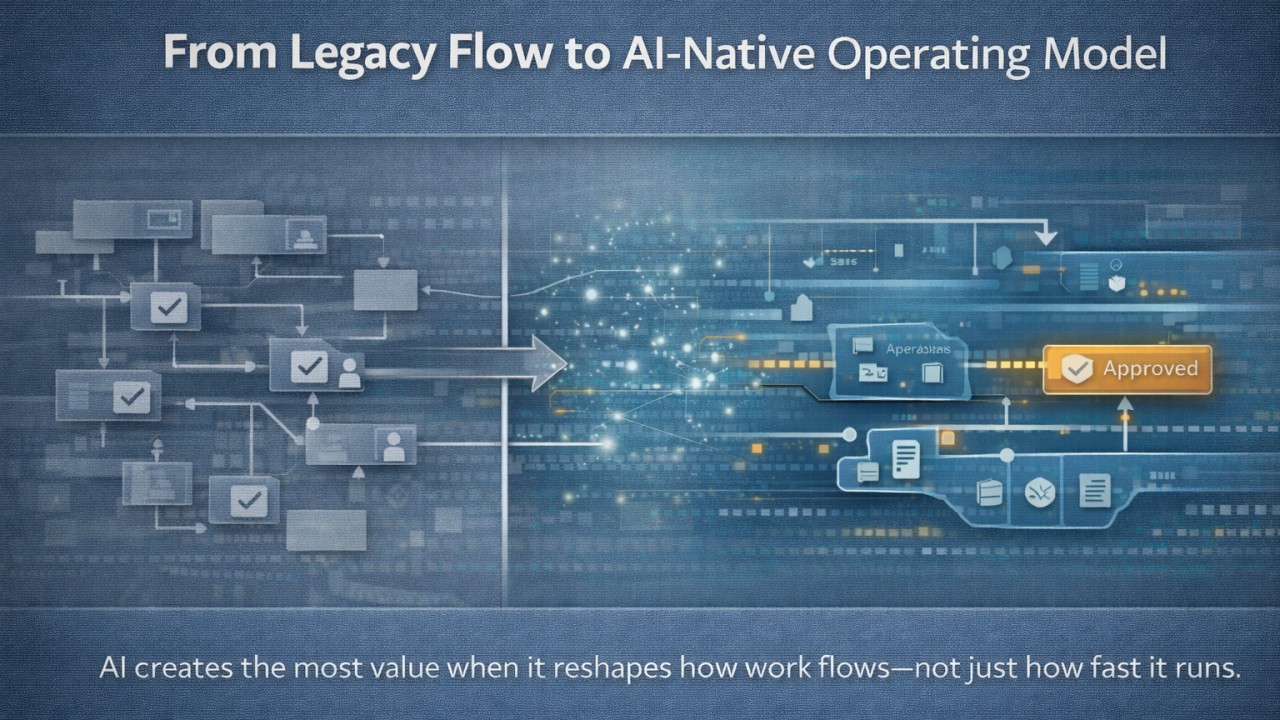
Most organizations treat AI as an add-on rather than a fundamental shift in how work gets done. While early AI adoption delivers quick wins through individual experimentation and isolated team improvements, organizations eventually hit a ceiling—not because AI capabilities plateau, but because underlying structures remain unchanged.
The Real Problem: Structure, Not Technology
The issue isn't AI's capability but organizational architecture. Early adoption typically follows this pattern: individuals experiment with copilots, teams embed AI into existing tasks, and productivity improves in pockets. However, the fundamental system persists unchanged—same roles, handoffs, decision layers, and workflow boundaries.
This mismatch between AI capability and organizational structure creates a constraint. The limitation isn't capability. It's structure.
Rethinking Workflows, Not Adding Tools
Transitioning to an AI-native model requires reframing the question from "Where can we add AI?" to "If AI were assumed at every step, how would this workflow be designed differently?"
This shifts focus from tool deployment to process redesign. Organizations should:
- Eliminate unnecessary handoffs
- Compress multi-step processes
- Reposition decision points
- Redefine where human judgment matters
- Reduce synchronous coordination needs
How Roles Actually Evolve
Rather than disappearing, roles reshape around higher-value activities. Analysts interpret rather than gather data. Operators handle more cases while focusing on exceptions. Managers optimize system performance rather than oversee tasks.
The New Bottleneck: Decision Velocity
As AI accelerates task execution, decision-making becomes the constraint. Organizations should push authority closer to work, clarify autonomous decision thresholds, reduce approval layers, and improve decision-point context.
Implementation Strategy
Start small: pick one high-impact, high-volume, decision-heavy workflow already using partial AI. Redesign it end-to-end by assuming AI availability at each step, removing redundant work, redefining responsibilities, and simplifying decision paths.
Once patterns emerge from successful redesigns, they can scale across the organization, creating competitive advantage that's harder to replicate.
Think this argument fits your event? Tell me about the room — the calendar is selective.
Start a conversation