Designing for AI Fluency Across the Organization

Designing for AI Fluency Across the Organization
Most organizations approach AI fluency as a training problem.
Upskill the workforce. Run workshops. Encourage experimentation.
These are useful steps.
But they miss a more important point:
fluency is shaped by the system people work in—not just what they know.
The misconception: fluency equals expertise
AI fluency does not mean everyone becomes an expert.
In practice, effective organizations aim for:
- confident usage
- appropriate application
- consistent behavior
This is less about deep knowledge.
More about practical capability.
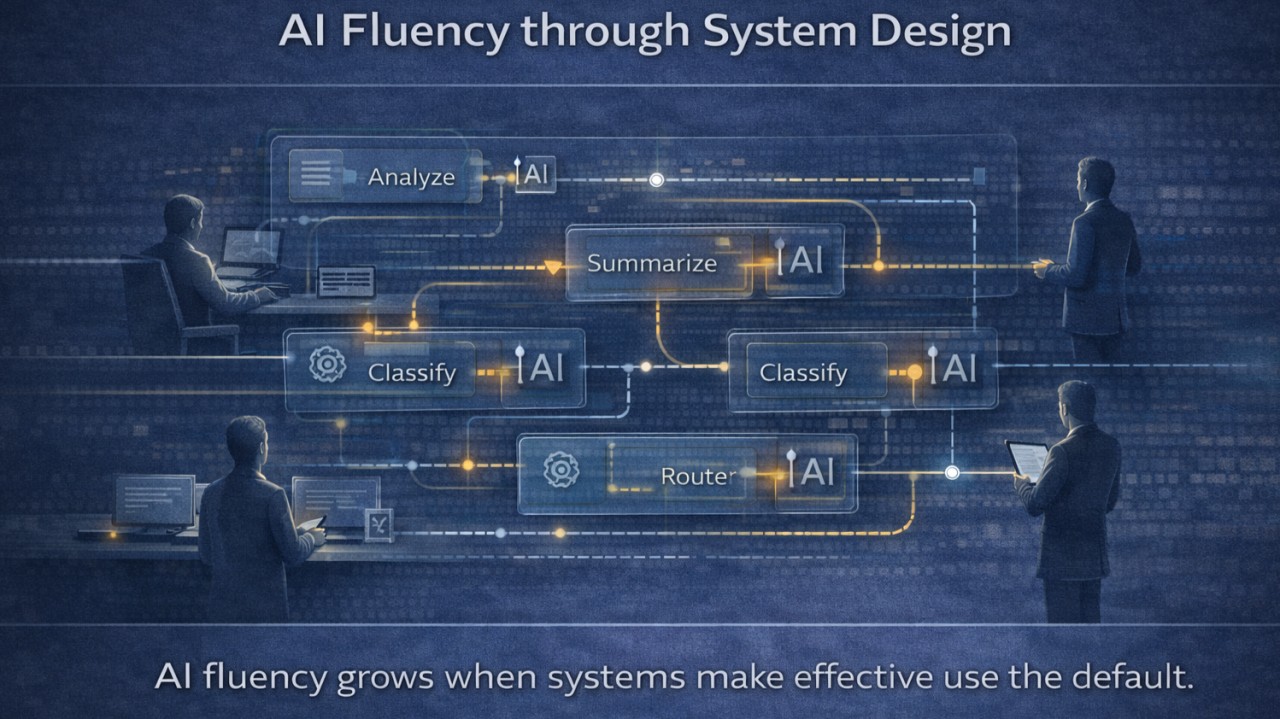
Fluency emerges from workflow design
People learn fastest when:
- tools are integrated into their work
- use cases are clear
- feedback is immediate
- outcomes are visible
This means fluency is driven by:
- workflow design
- system support
- user experience
Not just training sessions.
Reduce dependency on specialists
Early on, AI usage often depends on:
- a small group of experts
- centralized teams
- technical intermediaries
This limits scale.
Fluent organizations:
- embed AI into everyday tools
- provide clear patterns
- reduce friction in usage
- enable self-service within boundaries
This distributes capability across the organization.
Standard patterns accelerate learning
When workflows are standardized:
- users don't start from scratch
- behavior becomes consistent
- learning transfers across teams
This reduces variability and increases confidence.
Context matters more than instruction
Operators don't need abstract guidance.
They need:
- relevant examples
- clear use cases
- embedded support
Fluency increases when guidance is:
- contextual
- actionable
- aligned with real tasks
Feedback reinforces behavior
Fluency improves when users can see:
- what works
- what doesn't
- how outcomes change
This requires:
- visible results
- clear signals
- simple feedback loops
The CTO's role
CTOs should focus on enabling fluency through systems:
- embedding AI into workflows
- enabling consistent patterns
- reducing friction
- supporting feedback mechanisms
This is not just a training initiative.
It is a design challenge.
The opportunity
Organizations that build AI fluency effectively:
- scale usage faster
- reduce reliance on specialists
- improve consistency
- increase overall capability
The path forward
To design for fluency:
- embed AI into workflows
- provide reusable patterns
- reduce friction
- support contextual learning
- reinforce through feedback
Because fluency is not taught once.
It is built into how work happens every day.
Are you trying to train your organization to use AI—or designing systems that make effective use the default? Thoughts?
Think this argument fits your event? Tell me about the room — the calendar is selective.
Start a conversation