Designing AI Workflows That Get Better Over Time

Designing AI Workflows That Get Better Over Time
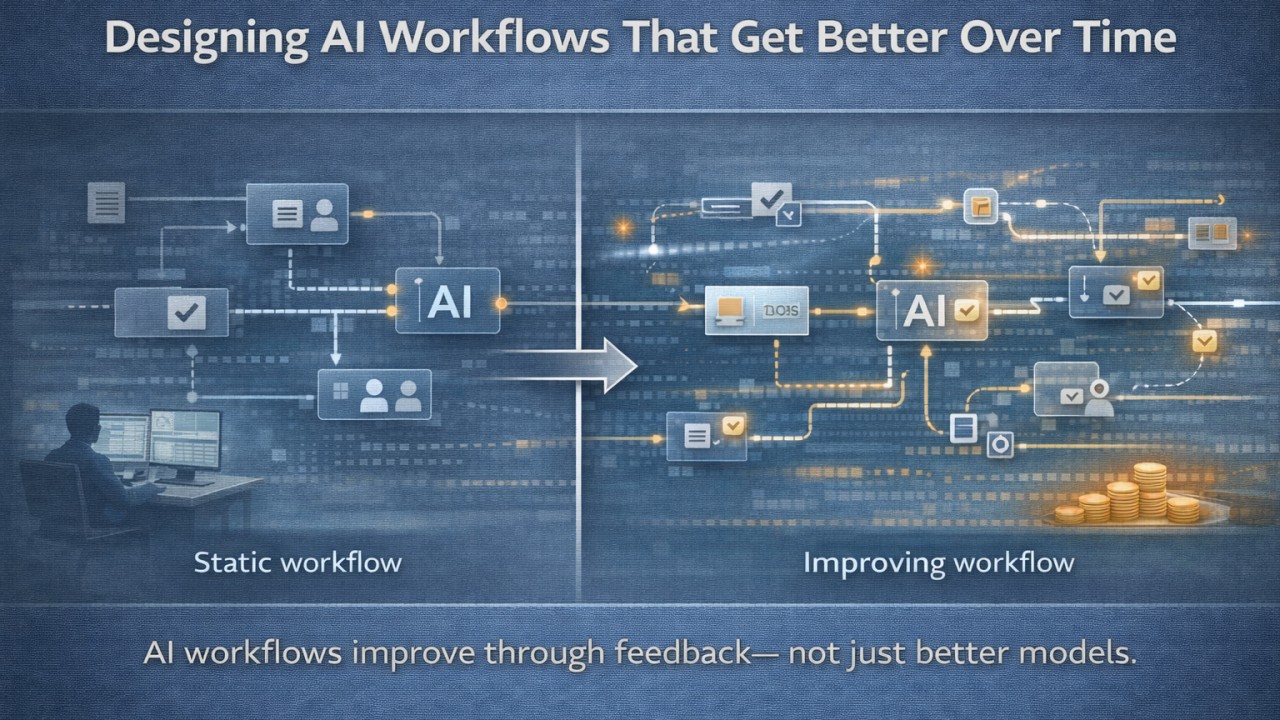
Most AI workflows are designed as if they are static. Define the use case. Deploy the model. Integrate into the workflow. Measure initial results. And then… move on.
But that assumption doesn't hold.
The Real Advantage: Continuous Improvement
The genuine competitive edge emerges from workflows that improve through operational use. Once AI enters real workflows, edge cases emerge, usage patterns shift, operator behavior adapts, and data changes over time. Without feedback loops, performance plateaus or degrades.
Improvement Beyond Model Enhancement
While better prompts, fine-tuning, and accuracy matter, significant improvement comes from how workflows handle outputs, manage human interaction with results, handle exceptions, and feed decisions back into the system. The workflow itself learns, not just the underlying model.
Capturing Existing Signals
Organizations already generate valuable signals: when outputs are accepted or rejected, when humans override recommendations, when escalations occur, and similar interactions. These signals are often overlooked but provide exactly what's needed for system improvement.
Design Principles for Learning Systems
Effective workflows intentionally embed feedback mechanisms, capturing why outputs were modified, logging override reasons, and tracking escalation patterns. These inputs drive prompt refinement, threshold adjustments, and training improvements.
High-performing systems distinguish between meaningful patterns and noise, prioritizing high-impact errors and avoiding overfitting to individual behaviors.
The Role of Operators
Operators recognize edge cases, understand context, and adapt to ambiguity. When workflows effectively capture operator decisions, they accelerate learning, improve consistency, and reduce future escalations—but feedback must be easy, not an additional burden.
Practical Implementation
A straightforward starting approach involves selecting one workflow, identifying one key signal (such as overrides), capturing it consistently, and reviewing patterns regularly. This creates a repeatable improvement cycle.
The Path Forward
The opportunity lies in treating deployment as a beginning rather than an endpoint. Most organizations have deployed AI; few have built systems that improve operationally over time. Long-term advantage sits in building systems that get better with each week of use.
Think this argument fits your event? Tell me about the room — the calendar is selective.
Start a conversation