Designing AI Systems That Are Allowed to Say "I Don't Know"

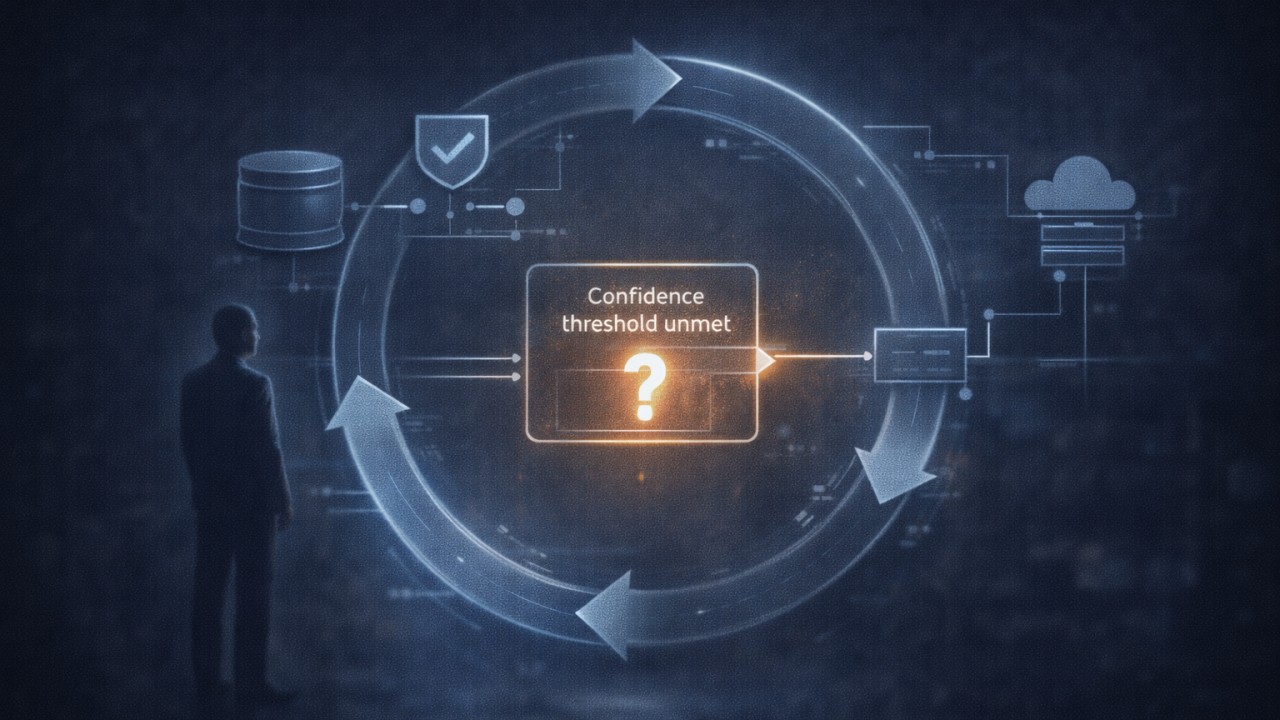
Designing AI Systems That Are Allowed to Say "I Don't Know"
Most AI failures don't start with bad answers. They start with answers that should never have been given at all.
In the rush to automate, optimize, and scale, we've built systems that are very good at doing — and almost incapable of not doing. They act when they shouldn't, decide when uncertainty is high, and proceed confidently past the point where a human would stop and ask a question.
This isn't a model problem. It's a design failure.
Intelligence Isn't Action — It's Restraint
Human intelligence is not defined by constant decisiveness. It's defined by judgment. Experienced operators hesitate. Experts pause. Leaders ask clarifying questions when signals don't line up. Most AI systems do the opposite.
They are optimized to:
- Produce outputs
- Minimize latency
- Avoid admitting uncertainty
- Keep workflows moving forward
In other words, we've trained AI to behave like the least experienced person in the room — fast, confident, and unaware of its own limits.
That's not intelligence. That's momentum.
From Runaway Automation to Designed Uncertainty
In the previous article, we explored the cost of AI systems that don't know when to stop. This is the architectural correction to that problem.
The solution is not more humans correcting mistakes after the fact. The solution is systems that can recognize when they should not proceed at all.
That requires a fundamental shift:
- From correction → restraint
- From optimization → judgment
- From "always-on" → conditionally-authorized
An AI system that cannot say "I don't know" is not autonomous. It's reckless.
"I Don't Know" Is a Capability, Not a Failure
In most organizations, uncertainty is treated as a defect.
Models are tuned to reduce ambiguity. Confidence is rewarded. Hesitation is seen as friction.
But in real operations — especially safety-critical, regulated, or high-cost environments — uncertainty is signal, not noise.
A system that can say:
- "Confidence too low"
- "Context incomplete"
- "Outcome risk exceeds threshold"
- "Escalation required"
...is not weak.
It's operationally mature.
This is the same evolution we went through with human decision-making:
- Junior staff act
- Senior staff judge
- Leaders decide when not to decide yet
AI systems should follow the same curve.
Why Most AI Systems Hide Uncertainty
So why don't they? Because uncertainty is uncomfortable for organizations.
Visible uncertainty:
- Forces ownership decisions
- Requires escalation paths
- Slows down automation
- Exposes gaps in governance
It's much easier to let the system act and deal with the consequences later — especially when accountability is diffuse.
But that convenience is exactly how small errors scale into incidents.
Designing "I Don't Know" Into the System
Allowing AI to say "I don't know" is not a UX feature. [Read that again — it's important.]
It's an architectural commitment.
It requires:
- Explicit confidence thresholds
- Clearly defined decision boundaries
- Escalation paths with real authority
- Humans positioned before irreversible action
- Organizational agreement on who decides next
This connects directly to the earlier themes in this series:
- Human-in-the-loop must be designed, not symbolic
- AI risk must have ownership, not committees
- Stopping conditions must exist before automation begins
Uncertainty without authority is noise. Authority without uncertainty is dangerous.
You need both.
The Executive Question No One Likes to Ask
Every AI system today is making a silent promise:
"I will act unless you explicitly stop me."
That's the wrong default.
The better promise is:
"I will act only when conditions justify it — and I will tell you when they don't."
That is what real intelligence looks like at scale.
Provocative Closing Question
If your AI system encounters a situation it doesn't fully understand, does it slow down — or does it power through?
Because the difference between intelligence and automation is not knowing what to do.
It's knowing when not to.
Think this argument fits your event? Tell me about the room — the calendar is selective.
Start a conversation