Data ≠ Information ≠ Knowledge ≠ Decisions — Why AI Blurs What Organizations Can't Afford To

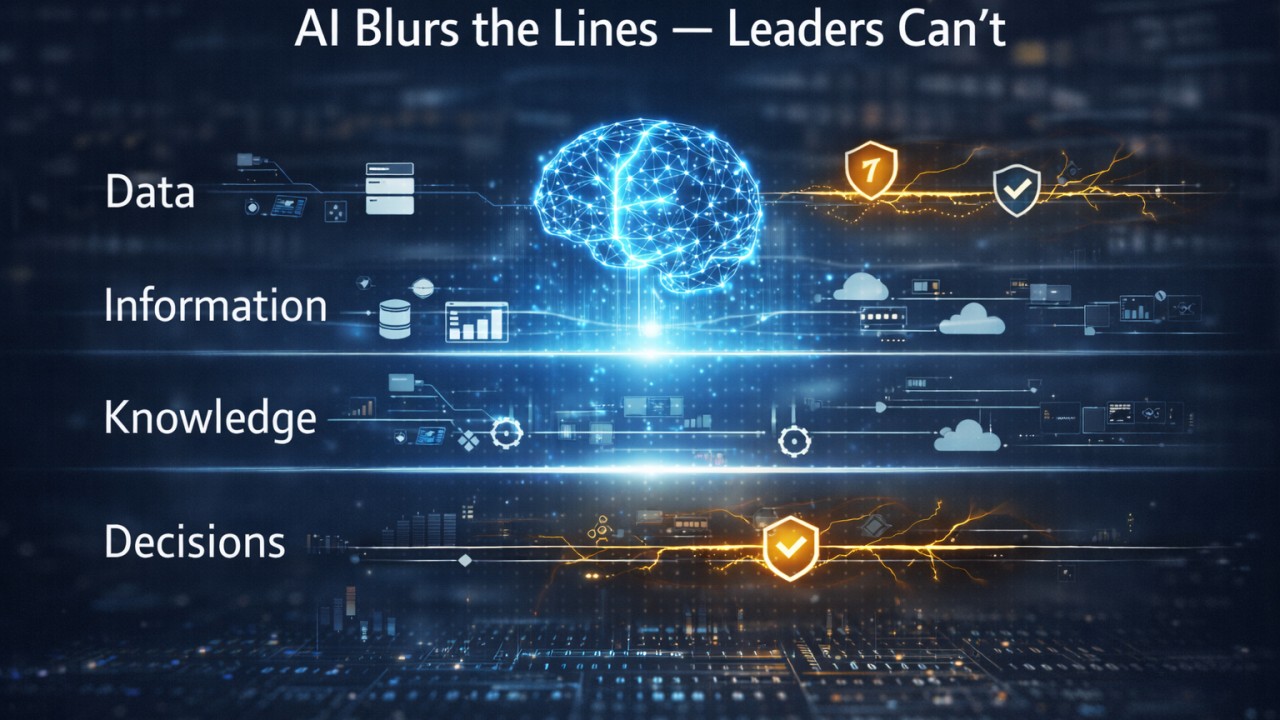
Data ≠ Information ≠ Knowledge ≠ Decisions — Why AI Blurs What Organizations Can't Afford To
One of the quietest failures in enterprise AI isn't model quality.
It's category collapse.
Modern AI systems — especially LLMs — are very good at making data, information, knowledge, and decisions look like the same thing.
They are not.
And when organizations let those layers blur, they don't just get bad answers — they get bad outcomes.
The DIKW Pyramid Still Matters (Even If AI Pretends It Doesn't)
Long before AI hype cycles, organizations relied on a simple but durable model:
- Data — raw facts
- Information — data with context
- Knowledge — interpreted understanding
- Decisions — committed actions
AI hasn't made this obsolete. It's made it easier to violate.
LLMs collapse these layers because:
- They retrieve data
- Summarize information
- Generate knowledge-like explanations
- Recommend actions — all in a single response
That compression feels magical. It's also dangerous.
Retrieval Is Not Understanding
Many enterprise AI initiatives quietly substitute:
"The model found it" for "The system understands it"
Retrieval-Augmented Generation (RAG) is powerful — but it does not magically convert documents into knowledge.
What it really does is:
- Fetch relevant text
- Pattern-match language
- Produce plausible synthesis
That's not understanding. That's fluency.
Without explicit semantic structure, the model has no idea:
- Which concepts are equivalent
- Which terms are overloaded
- Which distinctions matter operationally
This is why organizations confidently deploy systems that:
- Sound right
- Reference the right documents
- And still make the wrong decisions
When Knowledge Becomes a Decision (Accidentally)
The most dangerous moment in enterprise AI is when knowledge output quietly turns into execution.
Examples:
- A recommendation becomes an automated action
- A summary becomes a policy interpretation
- A suggestion becomes a system update
No meeting. No approval. No explicit decision boundary.
The system didn't decide. The organization failed to define where decisions actually happen.
Why LLMs Blur Boundaries by Design
LLMs are optimized for continuity, not correctness.
They:
- Don't naturally expose uncertainty
- Don't enforce decision thresholds
- Don't distinguish "informing" from "acting"
Unless you explicitly architect those boundaries, the model will happily glide across them — confidently.
This is not a model flaw. It's an architectural responsibility.
Organizations Don't Need Smarter AI — They Need Clearer Layers
The fix isn't better prompts.
It's better separation:
- Data systems that remain authoritative
- Semantic layers that encode meaning
- Knowledge systems that support reasoning
- Decision systems that enforce accountability
AI should assist within layers — not silently collapse them.
Control Starts With Knowing What You're Asking AI To Do
Before asking:
"Can the AI handle this?"
Leaders should ask:
- Is this data, or a decision?
- Is this information, or authority?
- Is the AI informing judgment — or replacing it?
Because once those lines blur, control disappears fast.
AI can traverse layers — data, information, knowledge, and decisions — but the Enterprise MUST control them.
If your AI gives an answer that leads directly to action — was that a recommendation, or a decision your organization never consciously made?
When your AI acts, can you point to the exact human decision it supported — or did the boundary disappear?
If regulators asked who made a decision, would your AI architecture give a clear answer?
Think this argument fits your event? Tell me about the room — the calendar is selective.
Start a conversation