Constraints Are Not the Enemy: What The Goal Teaches Us About Scaling AI

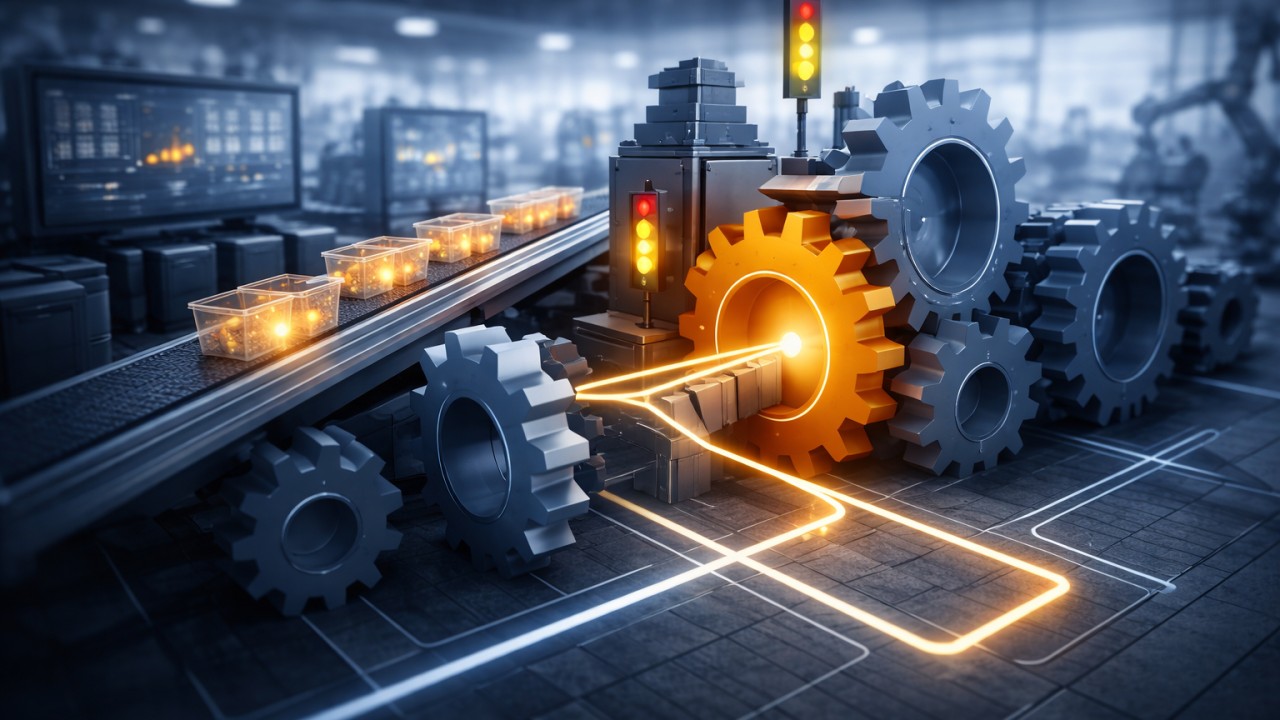
Constraints Are Not the Enemy: What The Goal Teaches Us About Scaling AI
The Original Mistake: Confusing Activity With Throughput
In The Goal, Eliyahu Goldratt dismantled a common assumption: that making every part of a system more efficient will make the system itself more efficient. Factories believed that if every machine ran at maximum capacity, output would increase. Instead, they created congestion, excess inventory, quality problems, and missed shipments.
The reason was simple but unintuitive. Throughput is governed by constraints. No matter how fast non-bottleneck machines run, the system can only move as fast as its slowest critical step. When everything else accelerates, work piles up, variability increases, and coordination collapses.
This insight matters because AI is currently being deployed under the same mistaken logic.
AI adoption is often framed as an activity multiplier. More decisions per minute. More content generated. More actions taken automatically. Dashboards show rising volume and shrinking cycle times. On paper, the system looks more productive.
But throughput is not volume. It is the rate at which valuable, correct, and complete outcomes leave the system.
When AI increases activity without respecting constraints, organizations experience the modern equivalent of work-in-progress explosion: human review overload, escalation backlogs, incident queues, and silent rework. Nothing appears blocked, yet everything feels slower.
The problem is not that AI is acting too much. It is that the system no longer knows where flow must be protected.
Transitional Manufacturing and Transitional AI
Early manufacturing transitions followed a predictable arc. New machines replaced human labor. Capacity increased rapidly. Managers assumed the constraint had been eliminated. In reality, it had merely moved.
Quality inspection became the new bottleneck. Shipping logistics lagged. Maintenance schedules failed to keep up. The system gained freedom in one dimension while losing control in others.
AI systems are now in this same transitional phase.
Capabilities expand faster than organizational understanding. Models handle tasks that once required expert judgment. Agents string together actions that used to require coordination across teams. Because this capability is new, limits feel artificial. Any constraint is perceived as leaving value unused.
So autonomy expands by default.
An AI assistant that was meant to draft summaries begins making recommendations. A recommendation system begins triggering actions. An agent meant to support workflows quietly becomes a decision-maker. None of this is malicious or even deliberate. It is what happens when boundaries are implicit rather than designed.
At small scale, this feels empowering. At larger scale, it creates fragility. Systems begin operating in contexts they were never evaluated for. Humans stop noticing edge cases because they appear incrementally, not catastrophically.
This is exactly what happened in early factories. Machines were capable of producing more than the system could absorb. The solution was not to remove limits, but to redesign the system around them.
Why Constraints Remove Bottlenecks at Scale
The most counterintuitive lesson from The Goal is that constraints are not what slow systems down. Poorly designed constraints do. Well-designed constraints do the opposite: they prevent hidden bottlenecks from forming.
In manufacturing, a controlled bottleneck stabilizes the entire line. It sets pace. It determines buffer placement. It protects quality by preventing overload. The rest of the system organizes itself around this reality.
AI systems need the same discipline.
Without constraints, uncertainty flows downstream until humans absorb it. Review teams become the accidental bottleneck. Incident response becomes the de facto quality gate. Trust erosion becomes the silent limiter of throughput.
These are expensive constraints because they are unmanaged.
Well-designed AI constraints are cheaper and earlier. Decision boundaries limit where autonomy applies. Stop conditions halt execution before errors propagate. Escalation paths route ambiguity to the right humans while it is still small. Ownership rules ensure someone can intervene immediately.
These constraints reduce total work, even if they introduce local pauses. They prevent the system from creating more problems than it solves. Throughput becomes predictable instead of spiky. Humans stop compensating informally because the system handles uncertainty explicitly.
This is not about slowing AI down. It is about preventing AI from overwhelming the system that must live with its outputs.
From Accidental Limits to Deliberate Control
The most dangerous phase in AI scaling is not early experimentation. It is the middle stage, where systems appear reliable but are operating beyond their original design assumptions.
In this stage, constraints still exist—but they are accidental. Human fatigue. Tribal knowledge. Quiet workarounds. Unwritten rules about "when not to trust the system." These are real bottlenecks, but they are invisible and fragile.
The transition to maturity happens when constraints become explicit.
Instead of humans deciding ad hoc when to intervene, the system signals it. Instead of autonomy expanding quietly, it is granted deliberately. Instead of throughput being limited by trust erosion, trust is protected through predictable behavior.
This mirrors the shift from early factories to disciplined production systems. Freedom does not disappear. It becomes structured. Variability is not eliminated. It is buffered. Flow is not maximized at every step. It is protected end-to-end.
The real transition in AI is not from constraint to freedom. It is from unmanaged freedom to governed freedom. From accidental bottlenecks to intentional control points.
The uncomfortable question for AI leaders is not where constraints are slowing them down.
It is whether the system knows which constraints are doing the most good—and which ones are still missing.
---
Final thoughts as questions:
- Are you still running your AI like an early factory—maximizing motion everywhere and hoping flow appears later?
- Do you know where your AI is supposed to slow down—or are you discovering the bottleneck only after something breaks?
- When your AI scales, will throughput be governed by designed constraints—or by the moment your organization stops trusting the output?
- If constraints define throughput, which ones are shaping your AI system today—the ones you designed, or the ones your people are quietly absorbing?
Remember: AI doesn't break because it's constrained—it breaks because the constraints are invisible.
Think this argument fits your event? Tell me about the room — the calendar is selective.
Start a conversation