Business Continuity for AI Systems: What Operators Need to Know Before Something Goes Wrong

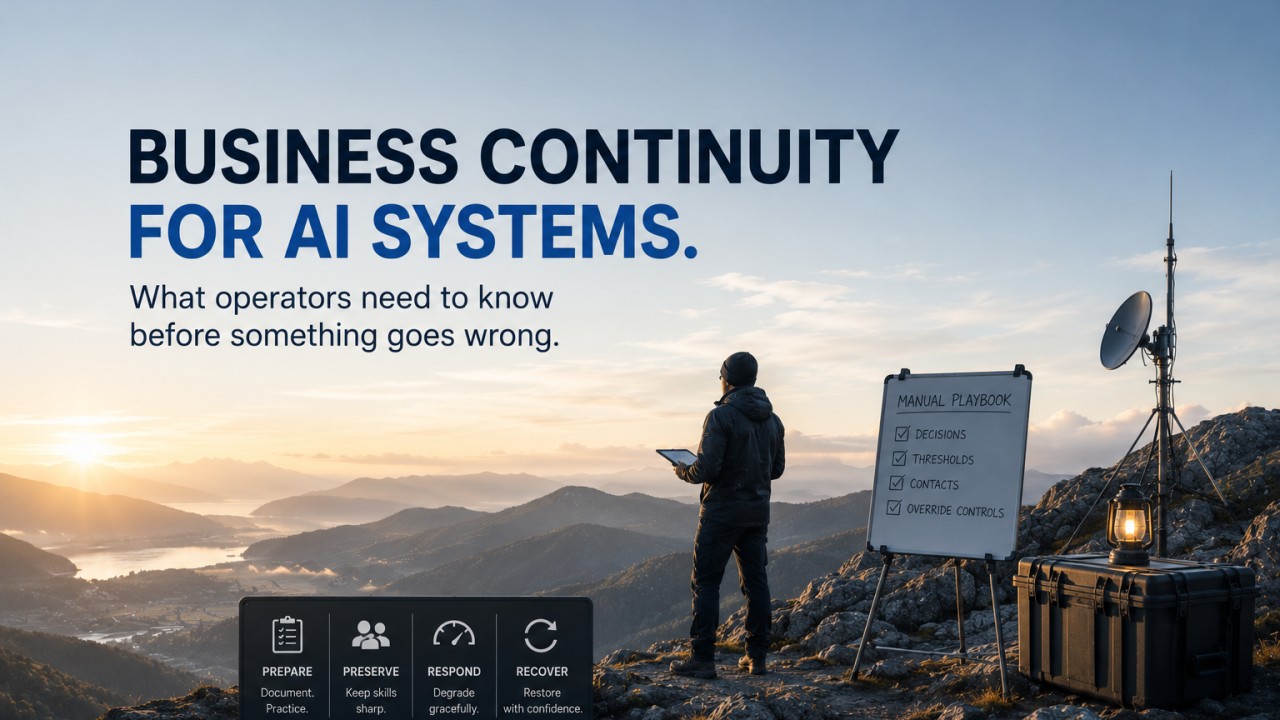
Business Continuity for AI Systems: What Operators Need to Know Before Something Goes Wrong
We design AI systems for their best moments. We test them on sunny-day scenarios. We optimize for accuracy, speed, and coverage. But the teams that sustain AI in production over years do something different: they design for the moments when the system isn't available at all.
This isn't pessimism. It's operational maturity. The same discipline that drives business continuity planning for every other critical system applies to AI. And when done well, it builds more confidence in the technology — not less — because everyone knows the organization is prepared for whatever comes next.
The Single Question That Changes Everything
I've asked dozens of teams operating AI in production a straightforward question: "If your AI system went down at noon today, could your team handle the manual volume by 2 PM?"
Most teams pause. Some admit they don't know. A few realize the answer is no — and that the skills to run the process manually have already atrophied.
This isn't a failure. It's a gap that's eminently fillable with the right preparation.
What Prepared Teams Do
The organizations that handle AI system failures with minimal disruption follow three practices:
1. They maintain manual playbooks that are actually usable.** Not 50-page documents that live in a compliance folder — one-page run sheets that answer: what decisions does this system make, what thresholds trigger each action, who do you contact at each severity level, and where are the override controls. These playbooks get tested in drills, not just written and filed.
2. They rotate operator exposure to manual processes.** The risk of skill atrophy is real. When a system has been running reliably for months, the people who knew how to run the process without it have moved on to other work. The best teams schedule periodic "lights out" exercises — 30 minutes where the system is intentionally bypassed and operators run a sample of the workflow manually. This isn't about distrusting the system. It's about preserving institutional capability.
3. They design graceful degradation, not just full failover.** A binary system — fully automated or fully manual — is brittle. The most resilient systems have intermediate states. Maybe the system continues running but requires explicit confirmation for every action above a certain threshold. Maybe it slows down but doesn't stop. Maybe it degrades by scope — continuing for one workflow while pausing another. These intermediate states preserve value during incidents and reduce the pressure for emergency fixes.
The Upside of Preparation
Here's the encouraging reality: organizations that invest in AI business continuity rarely need it. The act of preparing — documenting processes, testing playbooks, cross-training operators — surfaces gaps and builds confidence that the system itself benefits from.
Teams that know they can survive a system failure are more willing to trust the system during normal operations. The safety net makes the tightrope feel wider.
Start small. Pick one AI workflow that matters. Ask the noon question. If the answer isn't clear, you've found your first opportunity to build resilience.
Think this argument fits your event? Tell me about the room — the calendar is selective.
Start a conversation