The Biggest AI Risk Isn't Connected AI. It's Unconnected AI.

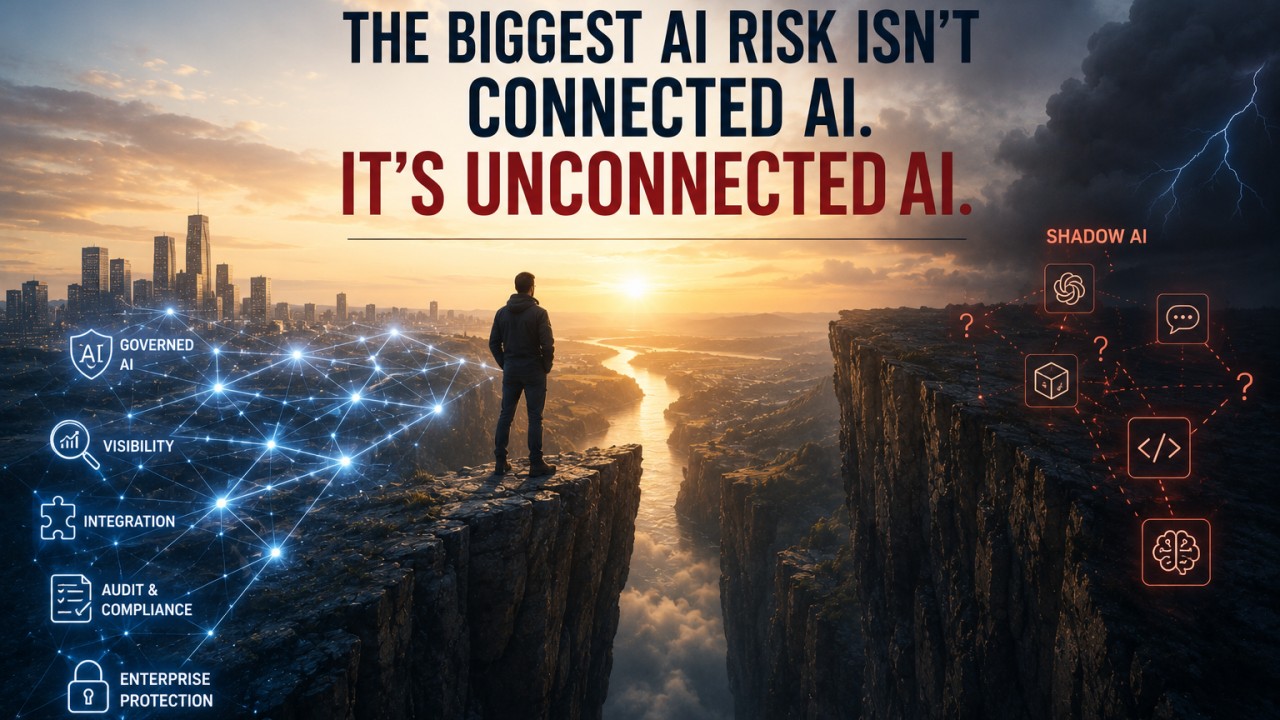
Conventional wisdom says the safest AI system is the one that's most isolated — a standalone model that touches nothing else.
I've come to believe the opposite is true. At least, it's true at enterprise scale.
Isolation feels safe because it limits blast radius. But it also limits visibility.
An isolated AI system becomes a black box that produces decisions without organizational context. Security teams can't correlate behavior across systems. Compliance teams can't trace how a recommendation became an action. When something goes wrong, every team points somewhere else because no one has a complete view.
Ironically, the greatest AI risk in many organizations isn't connected AI.
It's Shadow AI.
Employees are already using public AI tools, browser extensions, locally installed models, and unsanctioned SaaS applications to increase productivity. These tools operate completely outside enterprise governance. They aren't connected to corporate identity, logging, data classification, or security controls. They don't appear in audit reports because the organization often doesn't even know they exist.
That's real isolation. And it's far more dangerous than an integrated enterprise AI platform.
Shadow AI Creates Invisible Risk
Every disconnected AI tool introduces uncertainty.
Sensitive information may be copied into external services. Decisions may be influenced by models that no one has evaluated. Business processes begin depending on outputs that can't be reproduced, audited, or governed.
The problem isn't that employees are using AI. The problem is that the organization has no visibility into how AI is being used. Disconnected AI creates blind spots that security, legal, and compliance teams simply cannot manage.
Integration Enables Governance
The organizations making the fastest — and safest — progress with AI aren't isolating their systems. They're integrating them.
Not into one giant monolithic model, but through structured interfaces with clearly defined contracts, governance policies, and audit trails. Integration creates capabilities that isolated systems simply cannot provide.
Cross-system intelligence. When one AI system detects unusual behavior that another system can validate, the organization recognizes patterns instead of isolated events. Correlated signals identify problems much earlier than independent systems ever could.
Shared governance. When every AI interaction records confidence, lineage, user identity, and business context using common standards, governance becomes consistent across the enterprise instead of varying from application to application.
Policy enforcement at the boundaries. Rather than trusting every model to behave perfectly, organizations enforce policies where AI interacts with business systems. Approval requirements, spending limits, data access controls, and compliance rules become architectural guardrails instead of prompts inside a model.
This is where governance belongs.
The Architecture That Scales
The most successful enterprise AI architectures I've seen all share one characteristic.
They connect AI systems through thin, well-defined integration layers that enforce governance regardless of what happens inside any individual model.
Every integration point clearly defines: what data is allowed to cross the boundary, what identity and authorization are required, which governance policies apply, what confidence thresholds trigger human review, what audit information must be recorded, what happens if downstream systems become unavailable, and who owns the interface on both sides.
These interfaces become governance checkpoints. They don't attempt to control every internal model decision. They control what those decisions are allowed to influence.
Governance Is Better Than Prohibition
Many organizations respond to Shadow AI by banning AI tools altogether. That approach rarely succeeds. People use AI because it makes them more productive. If sanctioned tools don't meet their needs, they'll find alternatives. A better strategy is to provide enterprise-approved AI capabilities that are easier to use than unsanctioned ones while ensuring every interaction flows through governed integration points.
When employees can safely accomplish their work using approved AI services, Shadow AI naturally becomes less attractive.
A Practical Analogy
Think about building codes. Inspectors don't examine every outlet every day. Instead, they enforce standards at the electrical panel, the breakers, the wiring, and the points where electricity enters and moves through the building. Those control points protect the entire system.
Enterprise AI governance works the same way. You don't need complete control over every model's internal reasoning. You need strong controls wherever AI decisions intersect with business processes, enterprise data, customers, and employees.
That's how organizations achieve AI safety at scale. Not through isolation. Through visibility, governance, and well-designed connections.
Because the most dangerous AI isn't the one connected to your enterprise. It's the one operating outside of it.
Think this argument fits your event? Tell me about the room — the calendar is selective.
Start a conversation