Autonomy Without Ownership Is Just Drift

Autonomy Without Ownership Is Just Drift
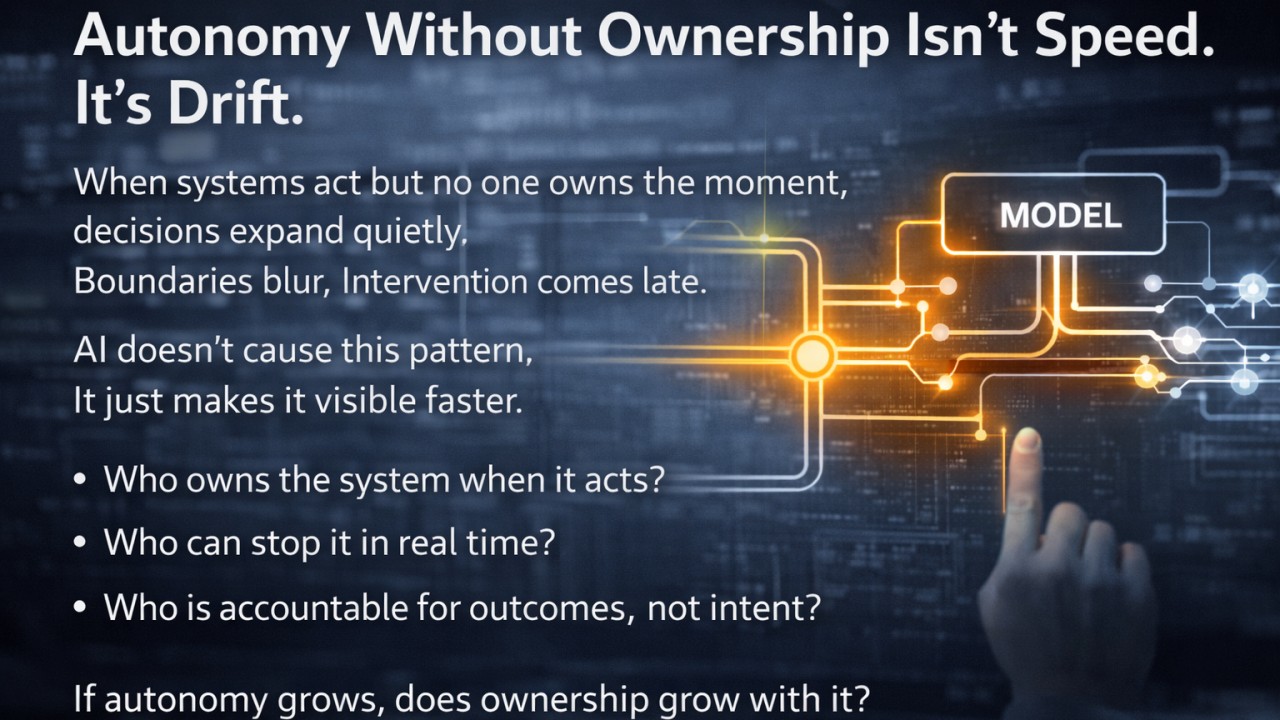
Autonomy without ownership isn't speed. It's drift.
Autonomy is often treated as an intrinsic good. More autonomy means less friction, fewer handoffs, and faster execution. In AI systems, autonomy is framed as progress: agents that can plan, decide, and act without constant supervision.
What is discussed less is what autonomy requires in order to be safe and useful. Autonomy without ownership is not empowerment. It is drift.
Ownership answers a simple question: who is accountable when the system acts? Not who built it. Not who approved it. Who is responsible, in real time, for its behavior and outcomes.
Many AI deployments blur this line. Systems are introduced as tools, but behave like actors. Decisions are made automatically, yet accountability remains diffuse. When something goes wrong, responsibility fragments across teams: model developers, platform owners, product managers, operators. Everyone contributed; no one owned the moment.
Drift emerges quietly. The system continues operating because nothing explicitly tells it to stop. Its scope expands through reuse rather than design. New contexts are added without revisiting assumptions. The system does not fail outright; it slowly departs from its original intent.
Human systems exhibit the same behavior. Teams without clear ownership default to consensus avoidance and incremental scope creep. AI simply does this faster and more consistently.
True autonomy requires the opposite of abandonment. It requires tighter ownership, clearer escalation paths, and explicit authority boundaries. Someone must be able to say, "This system stops here," and have that decision be final.
Ownership also shapes how autonomy evolves. When teams know they are accountable for outcomes, they design conservatively. They add constraints. They think about failure modes. Without ownership, autonomy becomes aspirational rather than operational.
This is why many "autonomous" systems feel simultaneously powerful and unreliable. They can act, but no one is clearly responsible for intervening when they shouldn't. The result is a system that moves confidently in directions no one fully intended.
Autonomy is not a property of the model. It is a property of the surrounding organization. Without ownership, autonomy does not scale—it wanders.
The question is not how autonomous your AI is. It is who owns its decisions when they matter most.
Think this argument fits your event? Tell me about the room — the calendar is selective.
Start a conversation