Auditability Without Gridlock: Designing AI Controls That Operators Will Actually Use

Auditability Without Gridlock: Designing AI Controls That Operators Will Actually Use
Most organizations agree on one thing when it comes to AI:
"We need auditability." The intent is right.
Leaders want traceability. Compliance teams want defensibility. Risk teams want visibility into decisions.
But in practice, auditability often turns into something else entirely: friction.
Processes slow down. Operators work around controls. Shadow workflows emerge. And the system that was meant to increase trust becomes harder to use—and easier to bypass.
This is the failure mode few teams plan for:
auditability that creates gridlock.
The hidden tradeoff: control vs. usability
At enterprise scale, every control introduces a choice:
- increase traceability
- or preserve flow
Many organizations try to maximize both by adding layers:
- more approvals
- more logging requirements
- more documentation steps
- more checkpoints
Individually, each makes sense.
Collectively, they create a system operators cannot realistically follow under pressure.
And when that happens, something predictable occurs:
people optimize for getting the work done—not for following the control model.
That is where auditability breaks down.
Not because controls are absent. Because they are unusable.
Auditability fails when it is detached from the workflow
A common pattern is treating auditability as a separate layer:
- logs stored somewhere else
- approvals tracked in disconnected systems
- rationale captured manually (if at all)
- audit trails reconstructed after the fact
This creates two problems:
First, it increases operator burden. Second, it reduces reliability of the audit itself.
In practice, if capturing evidence requires extra effort, it will be:
- skipped
- incomplete
- inconsistent
Which defeats the purpose.
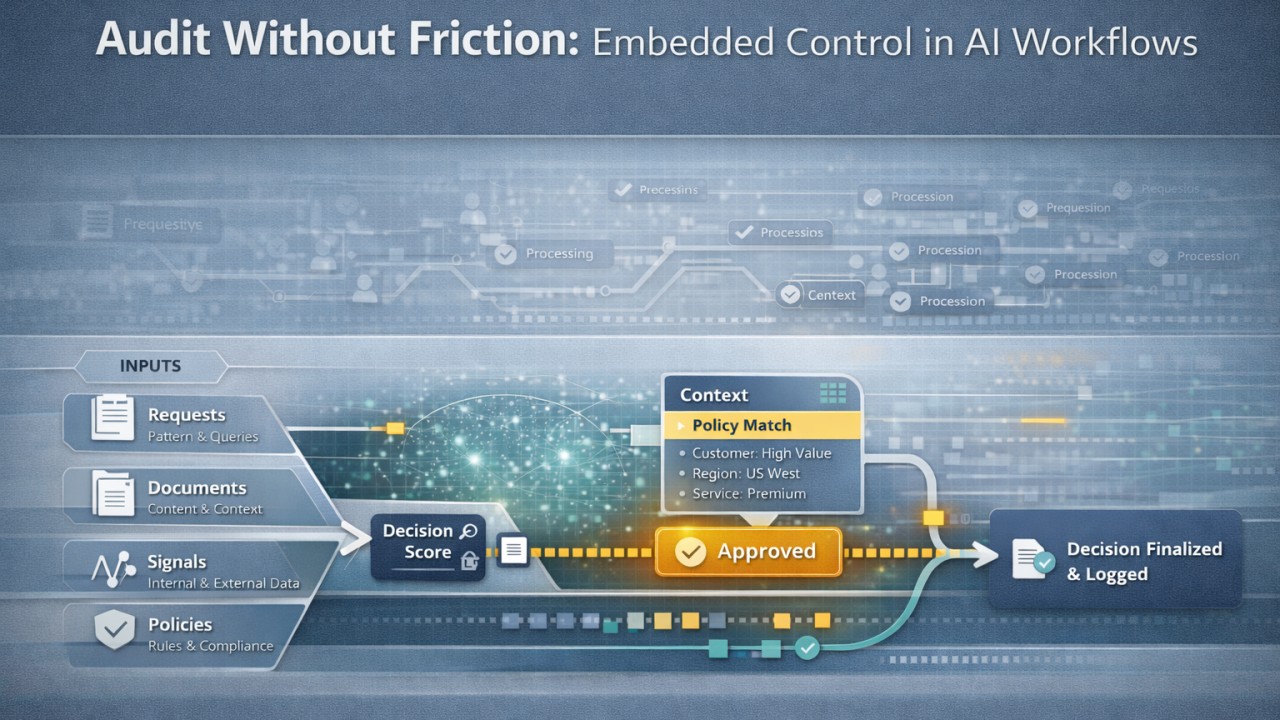
Effective auditability does not live outside the workflow.
It is generated by the workflow as it operates.
The goal is not more controls. It is embedded evidence.
The strongest AI systems do not ask operators to create audit trails.
They produce audit trails automatically.
That means:
- decisions are logged as they happen
- inputs and outputs are captured contextually
- intervention points are recorded by design
- overrides are tracked without extra steps
- rationale is attached to actions, not added later
This shifts auditability from a manual activity to a system property.
And it dramatically reduces friction.
Over-control creates performative compliance
When audit requirements become too heavy, organizations often fall into performative patterns:
- approvals given without meaningful review
- documentation written to satisfy policy, not reflect reality
- logs that exist but are rarely used
- audit processes that pass checks but miss actual risk
This creates a false sense of security.
Everything looks compliant. But very little is actually controlled.
In AI workflows, this is particularly risky.
Because decisions can scale quickly—and weak controls scale with them.
Good auditability focuses on decision moments, not everything
Another common mistake is trying to capture everything.
Every action. Every output. Every interaction.
This creates volume, not clarity.
What matters more is capturing the right moments:
- when a decision is made
- when a threshold is crossed
- when a human intervenes
- when an override occurs
- when an escalation is triggered
These are the points where:
- accountability matters
- risk is introduced or mitigated
- decisions can be reviewed meaningfully
Focusing on these moments creates useful audit trails, not just large ones.
Operators will only use controls that align with how work actually happens
This is where many audit designs fail.
They reflect how compliance teams think work should happen.
Not how operators actually execute under real conditions.
In practice:
- operators are managing volume and time pressure
- decisions are made with partial information
- workflows are dynamic, not linear
- edge cases are frequent, not rare
If controls do not align with this reality, they will be bypassed.
The most effective designs:
- minimize additional steps
- integrate into existing tools and flows
- surface context automatically
- reduce cognitive load during decision-making
In other words, they respect the operator's environment.
Auditability should support decisions, not just review them
Another shift is needed.
Auditability is often seen as retrospective—something used after the fact.
But in mature systems, it also supports real-time decisions.
For example:
- showing confidence levels alongside outputs
- surfacing source evidence automatically
- highlighting policy constraints at decision points
- displaying prior similar cases or overrides
This allows operators to:
- make better decisions in the moment
- reduce unnecessary escalations
- improve consistency across cases
Auditability becomes not just a control—but a decision support layer.
Ownership determines whether auditability works
Like most governance mechanisms, auditability fails without ownership.
If no one is responsible for:
- defining what needs to be captured
- ensuring logs are meaningful
- reviewing patterns over time
- improving controls based on findings
Then auditability becomes static.
A system of record, not a system of improvement.
In mature organizations, auditability has an owner who ensures it is:
- relevant
- usable
- aligned with evolving workflows
- connected to real operational outcomes
The executive risk: systems that look compliant but aren't usable
For CIOs and executives, the risk is subtle.
Not a lack of controls. But controls that exist in theory and fail in practice.
This leads to:
- hidden workarounds
- inconsistent decision handling
- weak traceability in critical cases
- delayed detection of systemic issues
And ultimately:
a gap between governance intent and operational reality.
What leaders should require before scaling AI controls
Before expanding AI-driven workflows, leaders should ask:
- Is audit data captured automatically or manually?
- Are controls embedded in the workflow or layered on top?
- Where are the key decision moments being recorded?
- Are operators able to comply without slowing down work?
- What signals are actually reviewed—not just stored?
- Who owns audit quality and continuous improvement?
If the answer relies heavily on manual effort, the system will not scale.
The path forward
There is a path forward—but it requires a different design philosophy.
Auditability should not be something operators do.
It should be something the system produces.
That means:
- embedding controls into workflows
- capturing evidence at decision points
- reducing friction for operators
- focusing on meaningful signals, not exhaustive logging
- continuously refining based on real usage
Organizations that get this right will not just be compliant.
They will be operationally trustworthy.
Because in the enterprise, auditability is not proven by how much you log.
It is proven by whether your system can explain, defend, and improve decisions—without slowing the business down.
Are your AI controls designed for audit—or for actual use under real operational pressure? Comment your opinion!
Think this argument fits your event? Tell me about the room — the calendar is selective.
Start a conversation