AI Made Your Teams Faster. It Also Exposed How Slow Your Decisions Really Are.

AI Made Your Teams Faster. It Also Exposed How Slow Your Decisions Really Are.
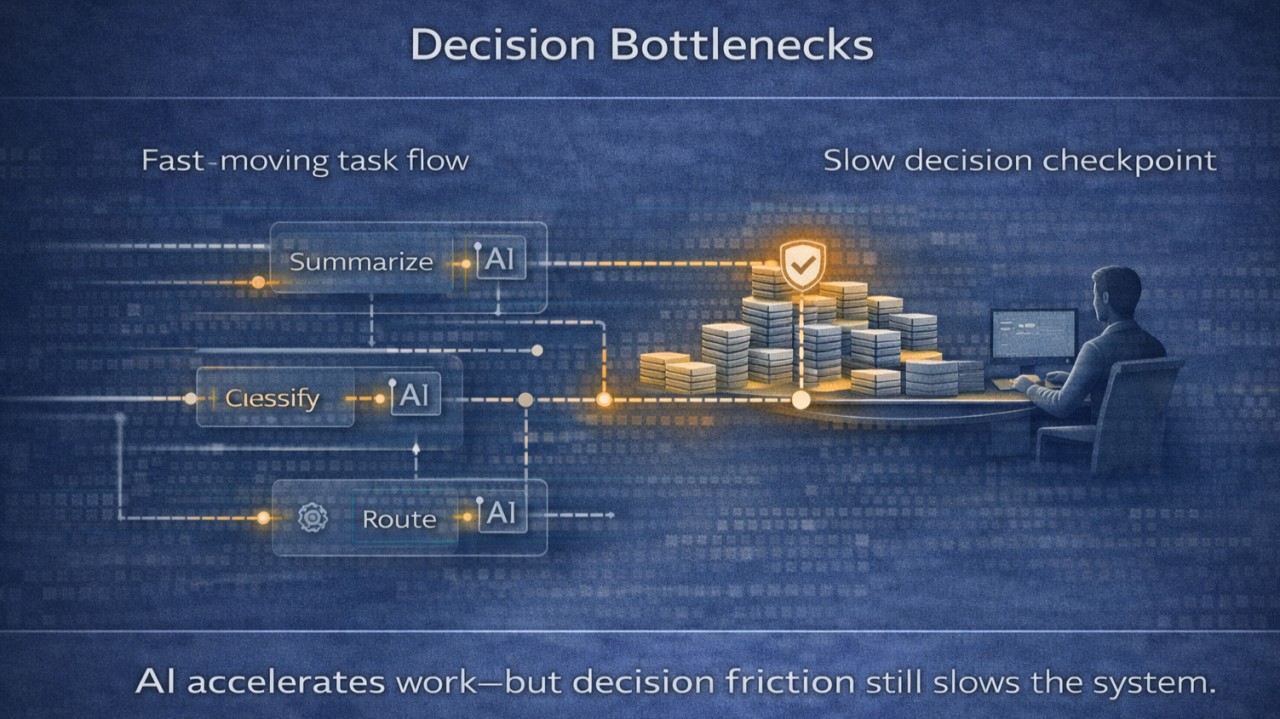
AI is delivering on its promises. Work executes faster—outputs generate instantly, analysis completes in minutes, responses draft in seconds. Yet overall progress remains sluggish because the genuine constraint has shifted.
The Real Bottleneck
The problem isn't execution speed anymore; it's decision-making velocity. As AI accelerates task completion, organizational friction becomes apparent at decision points. Approvals still require days, decisions demand multiple approval layers, ownership remains ambiguous, and critical context is missing.
Work moves faster. Decisions don't.
This creates a paradox: organizations achieve increased productivity and faster task completion, but overall cycle time doesn't improve proportionally because work queues at decision points while awaiting approval and alignment.
AI Reveals Hidden Inefficiencies
AI doesn't create decision bottlenecks—it exposes them. When execution was slow, decision delays stayed hidden. Now they stand out starkly as more work arrives faster and queues grow quicker.
Solutions Require Organizational Design
To capitalize on AI's speed gains, organizations must intentionally design decision frameworks:
- Clarify ownership**: Define who decides what, at what threshold, and with what information
- Reduce approval layers**: Push decisions closer to the work and empower teams within defined boundaries
- Provide context**: Use AI to summarize relevant information and surface key signals at decision points
- Tier decisions**: Categorize decisions by risk level—automated paths for low-risk, guided decisions for medium-risk, structured approval for high-impact choices
The CTO's Responsibility
Technical leaders should identify decision bottlenecks, enable systems supporting faster decisions, integrate context into workflows, and align authority with capability.
The path forward isn't technological—it's organizational.
Think this argument fits your event? Tell me about the room — the calendar is selective.
Start a conversation