AI Escalation Paths: The Missing Layer in Most Automation Programs

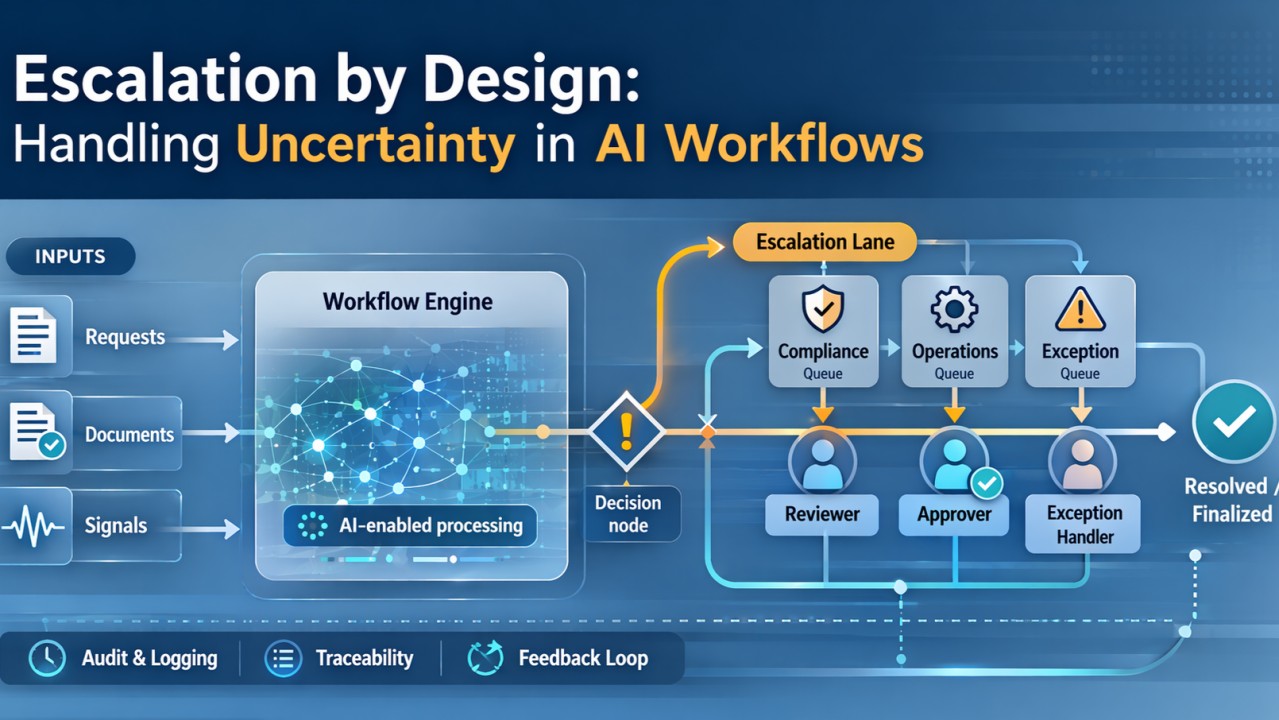
AI Escalation Paths: The Missing Layer in Most Automation Programs
Enterprise automation programs are missing a critical design element: structured escalation pathways for handling AI uncertainty.
Traditional automation assumes systems either work or fail cleanly. AI systems don't. They produce ambiguous outputs, low-confidence results, and edge cases that don't fit neatly into pass/fail logic.
Key Problems
Most AI workflows lack formal escalation mechanisms when facing:
- Low confidence outputs
- Incomplete or contradictory inputs
- Policy conflicts
- Correct-looking results without supporting evidence
- Edge cases outside training patterns
Escalation is not a failure condition. It is a designed pathway for uncertainty. Yet most organizations treat it informally—through assumptions like "someone will check it"—rather than explicit procedures.
Core Requirements for Effective Escalation
Trigger Design**: Systems need defined signals including confidence thresholds, policy-based triggers, anomaly detection, context gaps, and impact levels.
Routing**: Escalated work must go to appropriate domain-specific queues with clear role assignment and prioritization.
Ownership**: Every escalation path requires a named owner with defined service expectations and authority to resolve issues.
Learning Integration**: Organizations should analyze escalation patterns to improve models, refine thresholds, and identify workflow gaps.
Key Questions for Leaders
Before scaling AI automation, organizations should clarify:
- What triggers escalation?
- Where does work route?
- Who owns each path?
- What authority do they hold?
- What are resolution timelines?
- How is audit logging handled?
- How do patterns drive system improvement?
Without answers to these questions, automation programs scale fragility—not capability.
Think this argument fits your event? Tell me about the room — the calendar is selective.
Start a conversation