AI Doesn't Make Developers 10x Better — It Makes Organizations 10x Smarter

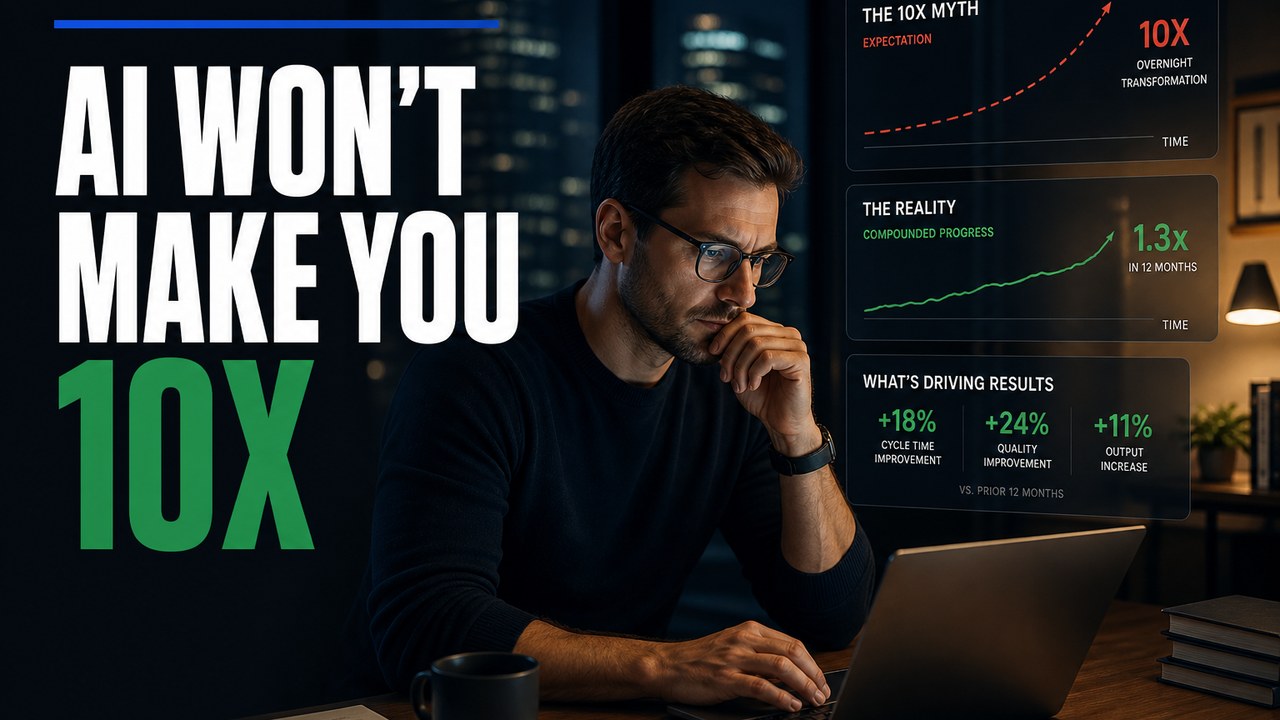
The 10x developer narrative is the most persistent myth in software engineering. The idea that a single exceptional person can be worth ten average ones has shaped how we hire, how we compensate, and how we build teams.
AI has not made this narrative more true. It has made it obsolete. The unit of analysis is no longer the individual. It is the organization.
Why the 10x Narrative Existed
The 10x narrative existed because expertise was scarce and unevenly distributed. An engineer who deeply understood a system, its history, and its failure modes was dramatically more productive than someone who did not. That expertise was personal. It could not be copied or transferred easily.
AI does not make every engineer 10x better. It makes every engineer's understanding searchable. It makes every decision's context available. It makes every past incident's lesson accessible.
The value is not at the individual level. It is at the organizational level.
What Gets Multiplied
When AI works well across an organization, several things happen simultaneously:
- A junior engineer can ask "how has this pattern failed in the past?" and get an answer from the organization's collective experience — not just their own four months of tenure.
- A senior architect can evaluate fifty proposals in a morning because AI surfaces the relevant context for each one — the dependencies, the history, the standards, the known failure modes.
- An incident responder can start with an AI-generated timeline that captures what happened across seventeen services — saving hours of manual correlation.
- A product manager can ask "what would it take to change this feature?" and get a dependency map and effort estimate in minutes, not days.
None of these are 10x individual improvements. They are organizational improvements — the total intelligence of the system is greater than the sum of its parts.
The Trap of Individual Metrics
The reason most AI investments underperform is that organizations measure individual productivity gains and miss the organizational ones.
A developer who saves two hours a day from AI code generation looks like a 25% productivity improvement. That is measurable. That is reportable. But the real value is the developer who saves thirty minutes a day from code generation and uses the other ninety minutes to understand a system they did not understand before — because an AI answered their questions about it.
This organizational learning does not show up in sprint metrics. It does not show up in velocity. It shows up six months later, when that developer makes a better architecture decision because they understand the system's history.
What Leaders Should Measure
If you want to measure organizational intelligence gains, look at:
- How long does it take a new team member to become independently productive? If AI-enabled knowledge access cuts this from three months to six weeks, that is organizational intelligence compounding.
- How many decisions are informed by past experience? If AI surfaces relevant past decisions during architecture reviews, the quality of current decisions goes up.
- How often do teams discover problems they would have missed? If AI finds a hidden dependency or a potential failure mode that a human review would have missed, that is organizational intelligence at work.
The Closing Paradox
The moment you accept that AI makes organizations smarter, not individuals more productive, the competitive dynamic changes. You are no longer racing to hire the smartest people. You are racing to build the smartest organizational systems.
The organizations that win will not be the ones with the most 10x engineers. They will be the ones whose collective intelligence — amplified by AI — exceeds that of any individual on the team.
If the unit of AI productivity is the organization, not the individual — what are you measuring to know if your organization is getting smarter?
Think this argument fits your event? Tell me about the room — the calendar is selective.
Start a conversation