AI as an Operational Multiplier, Not Just a Productivity Tool

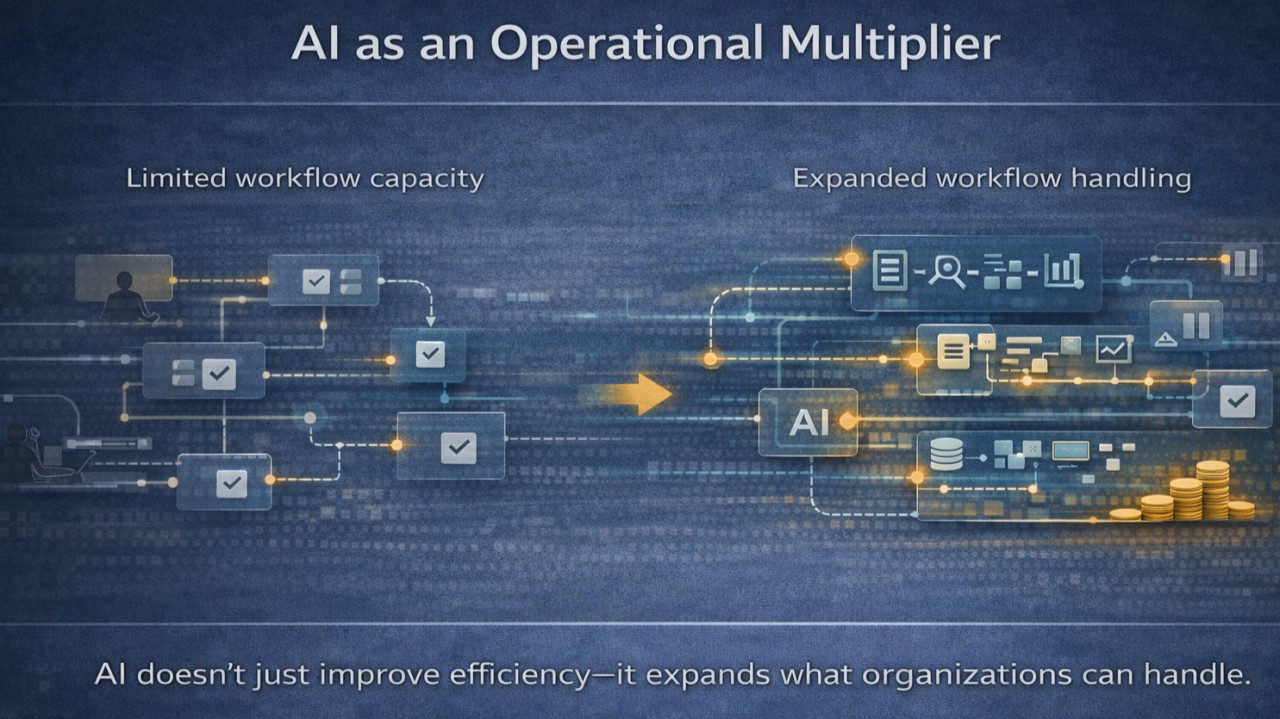
AI as an Operational Multiplier, Not Just a Productivity Tool
Most organizations start with AI as a productivity tool.
Faster emails. Quicker analysis. More efficient tasks.
These gains are real.
But they are only the beginning.
Because the real impact of AI is not just doing work faster.
It is changing how much work an organization can handle—and what kind of work it can take on.
The limitation of the productivity mindset
Productivity improvements focus on:
- doing the same work faster
- reducing manual effort
- improving efficiency
This creates incremental gains.
But it does not fundamentally change:
- capacity
- scope
- operational capability
To unlock that, a different perspective is needed.
AI as a multiplier of operational capacity
When AI is integrated into workflows, organizations can:
- handle higher volumes without proportional headcount growth
- manage more complex cases
- reduce bottlenecks in decision-making
- expand service offerings
This is where AI becomes a multiplier.
Not just improving tasks—but expanding what is possible.
Complexity becomes manageable
Traditionally, complexity creates friction:
- more variables
- more decisions
- more coordination
AI helps absorb complexity by:
- structuring information
- surfacing relevant context
- supporting decision-making
- handling variability
This allows organizations to take on work that was previously too complex or costly.
Throughput increases without linear scaling
One of the clearest impacts:
- more cases handled
- faster turnaround
- consistent quality
Without needing to scale teams proportionally.
This changes operating economics.
New capabilities emerge
As capacity increases, organizations can:
- offer faster response times
- expand into new service areas
- handle previously unprofitable work
- improve customer experience
This is where strategic value appears.
The risk of under-utilization
If AI is treated only as a productivity tool:
- workflows remain constrained
- capacity gains are not fully realized
- new opportunities are missed
The system improves—but does not evolve.
Designing for multiplication
To unlock multiplier effects, organizations must:
- redesign workflows for higher throughput
- reduce decision bottlenecks
- integrate AI across steps
- align roles with new capacity
This is not automatic.
It requires intentional design.
The CTO's role
CTOs should focus on:
- identifying where capacity constraints exist
- enabling systems that can scale
- ensuring integration across workflows
- aligning technology with operational expansion
This is about enabling growth—not just efficiency.
The opportunity
Most organizations are still in the productivity phase.
Which means the multiplier phase remains open.
The path forward
To treat AI as a multiplier:
- look beyond task efficiency
- focus on capacity and throughput
- redesign workflows for scale
- identify new opportunities enabled by AI
- align systems and roles accordingly
Because the real impact of AI is not doing the same work faster.
It is changing what your organization is capable of doing at all.
Are you using AI to work faster—or to fundamentally expand what your organization can handle?
Think this argument fits your event? Tell me about the room — the calendar is selective.
Start a conversation