AI as a New Layer of the Stack (And Why No One Owns It Yet)

AI as a New Layer of the Stack (And Why No One Owns It Yet)
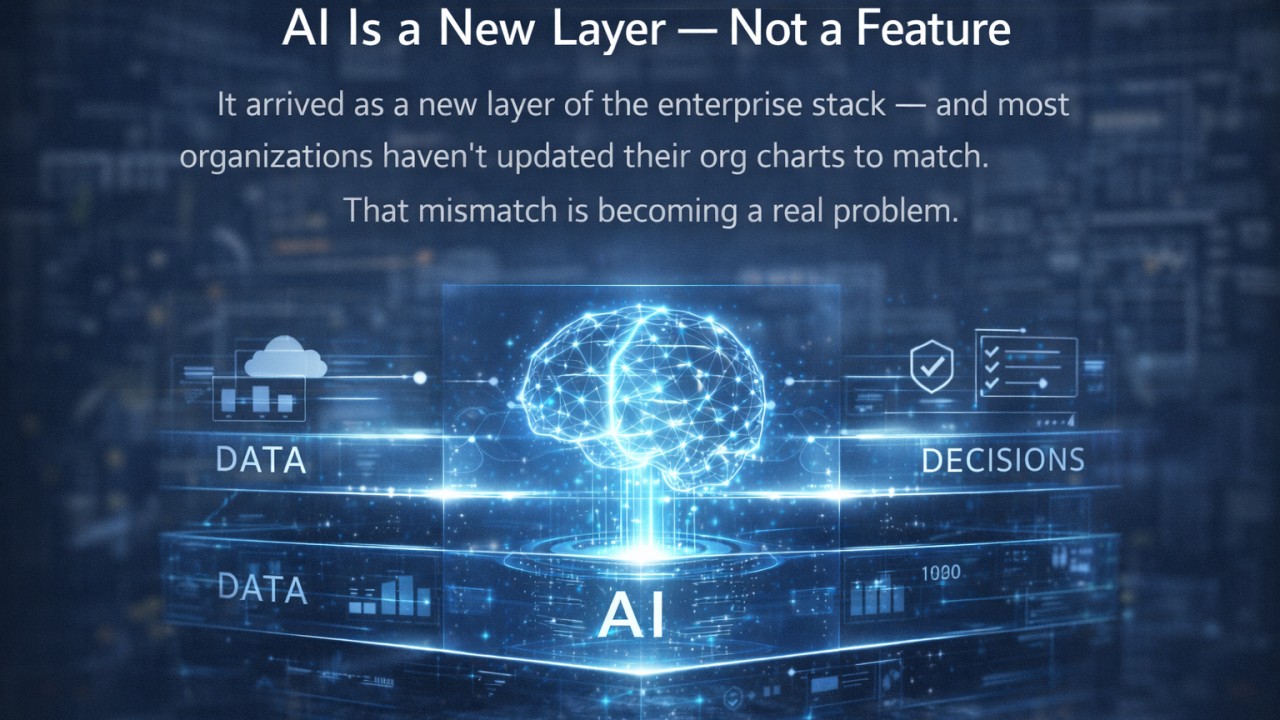
AI didn't arrive as a feature.
It arrived as a new layer of the enterprise stack — and most organizations haven't updated their org charts to match.
That mismatch is becoming a real problem.
AI Doesn't Fit Where We Keep Trying to Put It
Organizations keep asking:
- Is AI a data problem?
- Is it an application feature?
- Is it infrastructure?
- Is it security's responsibility?
The answer is uncomfortable:
AI is all of the above — and none of them cleanly.
Which is why ownership keeps falling through the cracks.
Where AI Actually Sits in the Stack
Traditionally, the enterprise stack looks something like this:
- Infrastructure
- Platforms
- Data
- Applications
- Business Processes
AI doesn't replace any of these.
It cuts across all of them:
- It consumes data
- Executes inside applications
- Depends on infrastructure
- Influences business decisions
- Alters workflows and authority
That makes AI less like a component — and more like a control plane.
And control planes need owners.
The Ownership Gap No One Wants
Because AI spans layers, responsibility often defaults to:
- "The data team"
- "The app team"
- "The platform team"
- "The innovation group"
- "The vendor"
Which usually means:
No one actually owns it end-to-end.
This leads to predictable failures:
- No clear accountability when AI decisions go wrong
- Security gaps between layers
- Governance applied too late
- Business leaders surprised by system behavior they didn't realize they approved
AI doesn't fail loudly. It fails organizationally.
Ownership is hard. We don't have an answer yet, but we will figure it out - hopefully not the hard way.
Org Design Is Lagging Technical Reality
Most enterprises are still organized around:
- Systems of record
- Systems of engagement
- Clear functional boundaries
AI breaks those assumptions.
It:
- Generates content instead of just storing it
- Makes recommendations instead of just retrieving data
- Acts on behalf of users instead of waiting for instructions
But org charts still assume AI is "just another tool." It isn't.
If Everyone Uses AI, Who Is Responsible?
Here's the tension executives can't avoid anymore:
If:
- Every team uses AI
- Every workflow embeds AI
- Every decision is influenced by AI
Then ownership cannot be optional.
Diffuse usage without clear ownership leads to:
- Unowned risk
- Shadow automation
- Unclear escalation paths
- Governance theater instead of control
AI Needs a Named Owner — Even If It's Shared
This doesn't mean creating an "AI department" that owns everything.
It means:
- Explicit accountability for AI behavior
- Clear ownership of meaning, authority, and limits
- Defined interfaces between AI, humans, and systems
- Governance that spans layers, not silos
Ownership doesn't slow AI down. It makes it survivable.
The Real Question Isn't Where AI Fits
It's this: If an AI-driven decision causes harm, delay, or loss — who answers for it?
Until organizations can answer that clearly, AI isn't a layer of the stack.
It's a liability floating between them.
Think this argument fits your event? Tell me about the room — the calendar is selective.
Start a conversation