Agents, Agentic Systems, and AI Workflows

Agents, Agentic Systems, and AI Workflows
What the Differences Really Mean — and Who Should Be Building AI
"Agentic AI" has quickly become a catch-all phrase.
Everything is an agent. Every automation is agentic. Every workflow is suddenly intelligent.
But when everything is called an agent, nothing is clearly understood.
In practice, there are important differences between AI workflows, agents, and agentic systems — and those differences determine risk, ownership, scalability, and ultimately whether the technology delivers value or chaos.
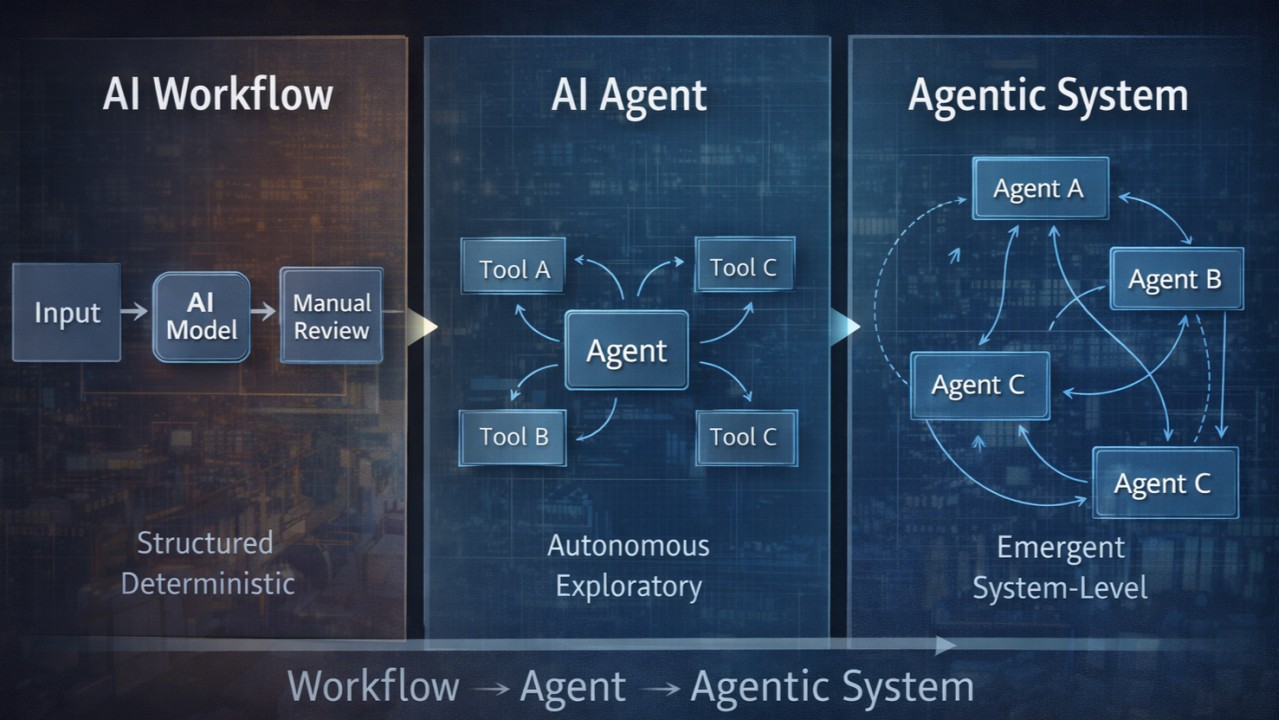
AI Workflows: Deterministic, Valuable, and Underestimated
Most AI in production today is not agentic. It's workflow-driven.
An AI workflow is:
- Structured
- Ordered
- Deterministic
- Designed with clear entry and exit points
Think:
- Document ingestion → extraction → validation → routing
- Forecast input → model run → review → publish
- Ticket intake → classification → recommendation → human decision
AI is used inside the workflow, not in control of it. These systems are easier to govern, easier to observe, scale well in enterprise environments, and deliver real ROI quickly.
They don't feel magical — but they work.
And importantly, they fail safely.
AI Agents: Autonomy Inside a Boundary
An AI agent introduces autonomy — but within constraints.
An agent can:
- Decide which tool to use
- Choose the next step
- React to intermediate outcomes
- Loop when necessary
But a well-designed agent still operates:
- Within a defined scope
- Against known tools
- Toward an explicit goal
Agents are powerful when:
- The problem space is fuzzy
- The environment is partially unknown
- Exploration is useful but bounded
Agents are components, not systems. And this is where many teams go wrong.
Agentic Systems: Where Risk Actually Lives
An agentic system is not just "an agent that runs longer."
It's a system where:
- Agents initiate actions
- Agents coordinate with other agents
- Agents operate across time
- Outcomes emerge, rather than execute
This is where:
- Observability becomes hard
- Validation becomes non-trivial
- Failure modes multiply
- Accountability blurs
Agentic systems demand systems thinking, not prompt engineering.
They require:
- Initialization phases
- Explicit constraints
- Progress tracking
- Human-in-the-loop boundaries
- Clear stopping conditions
- Real validation
Without those, you don't have intelligence — you have momentum.
Why These Distinctions Matter
Calling everything "agentic" hides responsibility.
A workflow can be owned by a team. An agent can be reviewed and tuned. An agentic system can quietly drift into behavior no one fully understands.
The more autonomy you introduce, the more you must invest in:
- Architecture
- Governance
- Safety
- Ownership
- Operations
Skipping those steps doesn't make systems move faster. It just makes failures harder to diagnose.
So… Who Should Be Building AI?
This is the uncomfortable part.
Not everyone should be building agentic systems. In fact, most organizations shouldn't start there at all.
AI workflows should be built by:
- Product teams
- Data teams
- Platform teams
- Engineers close to the business problem
Agents should be built by:
- Experienced engineers
- Teams that understand failure modes
- People who can reason about systems, not just outputs
Agentic systems should only be built by teams that:
- Own the operational outcome
- Understand the business risk
- Can support, monitor, and govern the system over time
This is not about intelligence. It's about responsibility.
The Pattern That Actually Works
The organizations seeing real success follow a predictable path:
- Start with AI-enhanced workflows
- Introduce agents where flexibility adds value
- Move toward agentic systems only when the organization is ready to own, operate, and govern them
Agentic AI is not the starting line. It's an advanced operating model.
Final Thoughts
Autonomy is not the same as intelligence. Motion is not the same as progress. And capability without ownership is just liability.
The future of AI won't be decided by who builds the most agents — but by who builds the most trustworthy systems.
That's where the real work is.
If an AI system makes a decision that materially impacts customers, operations, or revenue — who in your organization is accountable for that outcome today?
Are you investing in AI because it's impressive — or because your organization is actually ready to own, operate, and govern autonomous systems?
As AI systems gain autonomy, where are you intentionally slowing them down — and where are you comfortable letting go of control? If you do not know the boundary, and have it well defined, you need to slow them down. If you do not understand why — you need to hire someone who does, quickly.
Think this argument fits your event? Tell me about the room — the calendar is selective.
Start a conversation